The Impact of Financial Scams on Consumer Trust in the Banking Sector: A Qualitative Analysis
DOI:
https://doi.org/10.64060/IJDSS.v1i1.5Keywords:
financial scams, Consumer Trust, Pakistan, Digital Banking, Thematic Analysis, Consumer Protection, Institutional Response, Financial LiteracyAbstract
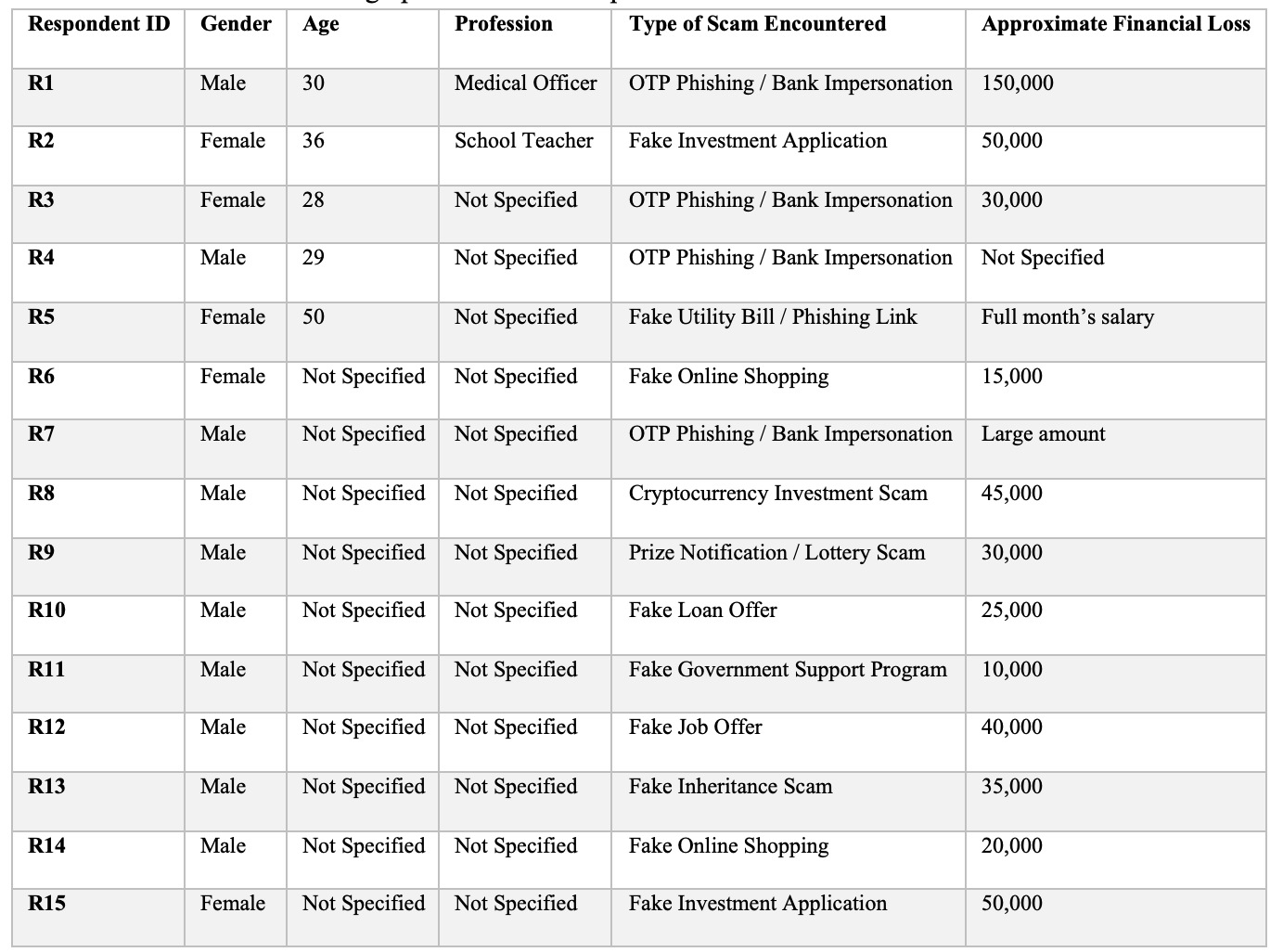
The high rate of digitization in Pakistan's banking sector has changed financial habits, but it has also made consumers vulnerable to advanced forms of financial fraud. This paper examines the affective, psychological, and behavioral consequences of banking scams on Pakistan-based consumers, focusing on their experiences and confidence in the banking system. By conducting a qualitative thematic analysis of interview data with 15 people who suffered scams, the study recognizes several scam-type variations, such as OTP phishing, fraudulent online purchases, and impersonation, and analyzes them in terms of their effects on the victim's perception and behavior. Results show that the effects of scam experiences are feelings of deep emotional distress, such as feelings of shame, anxiety, and a loss of self-confidence, and frequently because of cultural stigma. Institutional responsiveness comes out as a key element: compassionate treatment reinforces trust, whereas dismissive or accusatory reactions lead to increased symptoms of distrust and withdrawal. It is discovered that consumer vulnerability varies and is situational and depends on the gaps in digital literacy, manipulation through emotions, and weaknesses in the system as far as the learning of the consumer is concerned. Post-scam behaviors include adaptive caution down to maladaptive avoidance of digital financial services, with implications for financial inclusion objectives. Participants advocate strongly for proactive consumer education, transparent institutional communication, and coordinated regulatory action. The study contributes to both academic literature and practical policy by highlighting the socio-emotional dimensions of scam victimization in Pakistan’s digital banking ecosystem. It calls for holistic, consumer-centered strategies to strengthen trust and resilience in the face of evolving financial scams.
Downloads
References
Accenture. (2025). Global banking consumer study.
ADB. (2024). Cybercrime trends in Asia-Pacific digital finance. Asian Development Bank.
Afzal, J. (2024). An Overview of Digital Law. Implementation of Digital Law as a Legal Tool in the Current Digital Era. J. Afzal. Singapore, Springer Nature Singapore: 1-21.
Afzal, J. (2024). Best Practice of Digital Laws and Digital Justice. Implementation of Digital Law as a Legal Tool in the Current Digital Era. J. Afzal. Singapore, Springer Nature Singapore: 95-120.
Afzal, J. (2024). Development of Legal Framework of Digital Laws. Implementation of Digital Law as a Legal Tool in the Current Digital Era. J. Afzal. Singapore, Springer Nature Singapore: 139-154.
Afzal, J. (2024). Execution of Bilateral Digital Law. Implementation of Digital Law as a Legal Tool in the Current Digital Era. J. Afzal. Singapore, Springer Nature Singapore: 79-93.
Afzal, J. (2024). Future of Legal Tools and Justice. Implementation of Digital Law as a Legal Tool in the Current Digital Era. J. Afzal. Singapore, Springer Nature Singapore: 155-177.
Afzal, J. (2024). Implementation of digital law as a legal tool in the current digital Era, Springer.
Afzal, J. (2024). Legal Challenges Regarding Digital Operations. Implementation of Digital Law as a Legal Tool in the Current Digi-tal Era. J. Afzal. Singapore, Springer Nature Singapore: 23-45.
Afzal, J. (2025). "Comparative Review on Acceptance of Digital Evidence within the Legal Frameworks of Pakistan and China." In-ternational Journal of Law and Legal Advancement 1(1).
Afzal, J., C. Yongmei, A. Fatima and A. Noor (2024). "Review of various Aspects of Digital Violence." Journal of Engineering, Science and Technological Trends 1(2).
Alashwali, E. S., Khan, S., & Yusof, S. (2024). Emotional consequences of financial fraud: A qualitative perspective. Journal of Behavioral Finance, 25(1), 33–47.
Ali, F., & Ahmed, S. (2022). Digital fraud in Pakistan: Trends and consumer protection challenges. Journal of Financial Crime, 29(2), 521–534.
American Bankers Association. (2025). Annual report on consumer fraud and trust.
Bouveret, A. (2018). Cyber risk for the financial sector: A framework for quantitative assessment. IMF Working Papers, WP/18/143.
Braun, V., & Clarke, V. (2006). Using thematic analysis in psychology. Qualitative Research in Psychology, 3(2), 77–101.
Business Insider. (2025). How AI is transforming fraud detection in banks. https://www.businessinsider.com
Button, M., & Cross, C. (2017). Cyber frauds, scams and their victims. Routledge.
Button, M., Lewis, C., & Tapley, J. (2014). Not a victimless crime: The impact of fraud on individual victims and their families. Security Journal, 27(1), 36–54.
Chawla, D., Bansal, A., & Kaushik, R. (2023). Consumer vulnerability and trust loss in digital finance. International Journal of Consumer Studies, 47(2), 123–139.
Chubb. (2024). Biometric security in financial services: Trust and adoption. Chubb Insurance Insights.
Coombs, W. T. (2007). Protecting organization reputations during a crisis: The development and application of situational crisis communication theory. Corporate Reputation Review, 10, 163–176.
Coombs, W. T. (2020). Ongoing crisis communication: Planning, managing, and responding (5th ed.). Sage Publications.
Creswell, J. W. (2013). Qualitative inquiry and research design: Choosing among five approaches (3rd ed.). Sage Publications.
Cross, C., Richards, K., & Smith, R. G. (2016). Improving the prevention and reporting of cyber fraud. Trends & Issues in Crime and Criminal Justice, 508, 1–14.
CSIS. (2023). Cross-sector cybersecurity collaboration: Financial, insurance, and retail perspectives. Center for Strategic and Interna-tional Studies.
Cybersecurity Alliance. (2023). Stop. Think. Connect.: Awareness campaign report.
DeLiema, M. (2018). Elder fraud and financial exploitation: Application of routine activity theory. The Gerontologist, 58(4), 706–718.
Deloitte. (2024). Global financial services fraud outlook. Deloitte Insights.
Eliaeson, S. (2002). Max Weber's methodologies: Interpretation and critique. Polity.
Ennew, C., Sekhon, H., & Kharouf, H. (2021). Introducing a composite measure of trust in financial services. The Service Industries Journal, 41(13-14), 869-892.
Ernst & Young. (2023). Global banking risk culture and compliance study.
European Commission. (2023). PSD2 and the evolution of strong customer authentication in the EU. https://ec.europa.eu
FATF. (2023). Money laundering risks from digital fraud channels. Financial Action Task Force. https://www.fatf-gafi.org
FCA. (2024). Economic cost of persistent financial fraud. Financial Conduct Authority.
Featurespace. (2024). Fraud education and trust in banking institutions.
Federal Investigation Agency. (2022). Annual cybercrime report. Islamabad: FIA.
Federal Trade Commission. (2023). Consumer Sentinel Network data book 2022.
Feedzai. (2023). Trust recovery and compensation expectations in digital fraud.
Financial Conduct Authority. (2023). Financial Lives Survey 2022.
Financial Ombudsman Service. (2024). Recent case decisions on bank responsibility in scams.
Financial Stability Board. (2024). Cyber fraud and international cooperation frameworks.
Finextra. (2024). Blockchain and fraud reduction in KYC. https://www.finextra.com
Gallup Pakistan. (2022). Public trust in banking institutions survey. Islamabad, Pakistan: Gallup Pakistan.
Gomez, L., & Lin, Y. (2023). Language and equity in fintech trust: The chatbot gap. Journal of Digital Communication, 14(3), 78–93.
Greener, S. (2008). Business research for shocking students. Ventus Publishing.
Gupta, R., & Shukla, M. (2024). Customer perceptions of digital trust in Indian banks. Journal of Financial Services Research, 62(1), 45–60.
Han, S., Zhou, T., & Wang, L. (2025). A digital financial trust model for modern banking. Journal of Internet Banking and Com-merce, 30(1), 1–22.
Hasan, M., & Ali, F. (2020). Consumer vulnerability to online fraud in Pakistan: Challenges and responses. Journal of Consumer Protection and Policy, 43(1), 57–74.
Hofstede Insights. (2022). Collectivist culture and trust recovery in financial services. https://www.hofstede-insights.com
IMF. (2022). Compensation regulations and fraud resolution systems. International Monetary Fund.
Kantar. (2024). Green banking and trust among Gen Z consumers. Kantar Group.
Karandaaz Pakistan. (2022). Digital financial services consumer experience survey. Islamabad, Pakistan: Karandaaz.
Kim, H., Park, J., & Lee, S. (2021). Phishing, identity theft, and consumer trust in online banking: A systematic review. Cybersecu-rity & Finance, 26(4), 89-105.
Kivunja, C., & Kuyini, A. B. (2017). Understanding and applying research paradigms in educational contexts. International Journal of Higher Education, 6(5), 26-41.
KPMG. (2025). Global banking scam survey.
Lee, J., & Chung, N. (2022). The role of apology and action in crisis communication and trust recovery. Journal of Public Relations Research, 34(2), 112-130.
Lee, M. K. O., & Turban, E. (2001). A trust model for consumer internet shopping. International Journal of Electronic Commerce, 6(1), 75–91.
Lichtenstein, S., & Williamson, K. (2006). Understanding consumer adoption of internet banking: an interpretive study in the Aus-tralian banking context. Journal of Electronic Commerce Research, 7(2), 50–66.
Lincoln, Y. S., & Guba, E. G. (1985). Naturalistic inquiry. Sage.
Mahmood, A., & Malik, S. (2023). Gender differences in trust perceptions after financial scams. Journal of Gender and Finance, 5(1), 45-60.
Marwick, A., & Lewis, R. (2022). Social impacts of digital fraud. Data & Society.
Mayer, R. C., Davis, J. H., & Schoorman, F. D. (1995). An integrative model of organizational trust. Academy of Management Re-view, 20(3), 709–734.
McKnight, D. H., Carter, M., Thatcher, J. B., & Clay, P. F. (2011). Trust in information technology: A new set of constructs. The DATA BASE for Advances in Information Systems, 42(2), 35-57.
Müller, S. R., Meeßen, S. M., & Thielsch, M. T. (2020). Trust in management information systems. In HCI in Business, Govern-ment and Organizations. HCIBGO 2020. Lecture Notes in Computer Science (Vol. 12204). Springer.
News.com.au. (2024). Australian family loses $1.1 million in banking scam.
Nordic Bank Report. (2023). Crisis communication and trust rebound in Scandinavian banking.
OECD. (2023). Public-private partnerships for financial crime prevention.
Patel, V., & Huang, Y. (2023). Gamification in financial literacy education for young adults. Journal of Financial Education, 49(1), 88-105.
Patton, M. Q. (2002). Qualitative research and evaluation methods (3rd ed.). Sage.
PTA. (2023). Annual report 2022-23. Pakistan Telecommunication Authority.
PYMNTS. (2024). The role of human assistance in fraud resolution.
Rosenzweig, S., et al. (2023). Empathy in institutional responses to fraud. Journal of Consumer Psychology, 33(4), 550-565.
SBP. (2021). National financial literacy program report. State Bank of Pakistan.
SBP. (2022). Annual performance review of the banking sector. State Bank of Pakistan.
Schoorman, F. D., Mayer, R. C., & Davis, J. H. (2007). An integrative model of organizational trust: Past, present, and future. Academy of Management Review, 32(2), 344–354.
Shankar, A., et al. (2021). Biometric authentication and consumer trust. Journal of Retailing and Consumer Services, 61, 102581.
Smith, J. K. (1993). After the demise of empiricism: The problem of judging social and educational inquiry. Ablex.
State Bank of Pakistan. (2022). Guidelines on digital fraud prevention.
Thales. (2025). 2025 Digital Trust Index – Consumer Edition.
The Times. (2025). UK fraud losses reach record levels.
Thielsch, M. T., Meeßen, S. M., & Hertel, G. (2018). Trust and distrust in information systems at the workplace. PeerJ, 6, e5483.
Thompson, R., & Silva, M. (2023). Social media, crisis communication, and institutional trust. Public Relations Review, 49(5), 102345.
Vieras, T., et al. (2025). Real-time fraud detection using AI: A trust perspective. IEEE Transactions on Dependable and Secure Com-puting.
Waliullah, et al. (2025). Cyber threats in online banking: A review.
Whitty, M. T. (2018). The emotional and psychological impact of online fraud. In The Cambridge Handbook of Psychology and Economic Behaviour. Cambridge University Press.
Wikipedia. (2023). Wells Fargo account fraud scandal.
World Bank. (2021). Pakistan: COVID-19 and the digital finance ecosystem.
World Bank. (2024). Global financial literacy and fraud report.
Yongmei, C. and J. Afzal (2023). "Impact of enactment of ‘the prevention of electronic crimes act, 2016’as legal support in Pakistan." Academy of Education and Social Sciences Review 3(2): 203-212.
Zarsky, T. Z. (2020). The trouble with algorithmic decisions: An analytic review. Philosophy & Technology, 33, 405-423.
Downloads
Published
Issue
Section
How to Cite