
A Comparison of Unimodality Based on Size of the Test Criterion
DOI:
https://doi.org/10.64060/JASRv2i33Keywords:
Modality Tests, Hartigan’s Dip Test, Silverman Bandwidth Test, Proportional Mass (PM) Test and Excess Mass (EM) Test, Size of the test, Monte Carlo Simulation TechniqueAbstract
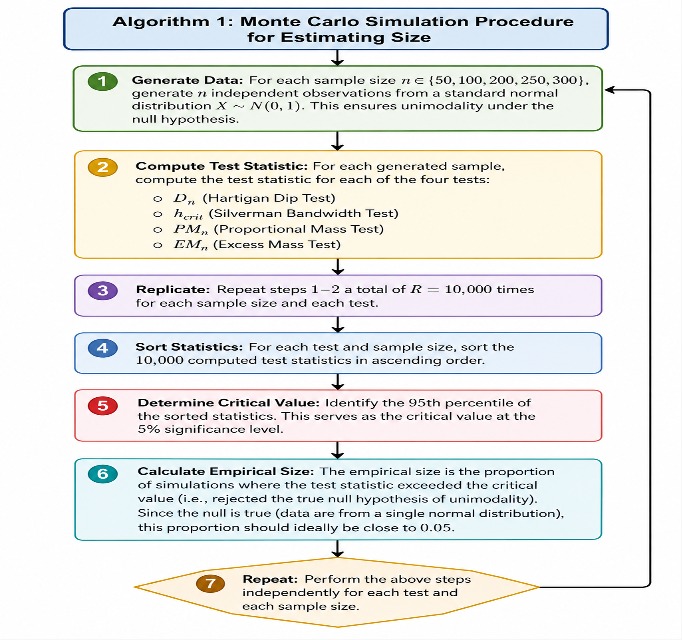
Non-parametric modality tests are widely and frequently used in every field of life especially in Economics, Social Sciences, Sports Sciences, Medical Sciences, and Biological Sciences etc. Some tests for modality are used for parametric (depend upon any distribution) and some are used for non-parametric (distribution free tests). But this study discusses the four famous non-parametric tests for modality or multimodality (a) Hartigan Dip Test; (b) Silverman Bandwidth test; (c) Proportional Mass test (d); Excess Mass test. These tests are frequently used in the literature of statistics. Most of the studies used these tests for testing modality. But nobody in the available literature compared these tests on the basis of size. This study compares these tests on the basis of the size and finds that which of them is the best test and which of them is the worst test. In addition to size, this study also evaluates the power of these tests under four alternative bimodal scenarios using Monte Carlo simulations with 10,000 replications. The simulation procedure is described in detail with a step-by-step algorithm and a flowchart to ensure full reproducibility.
References
Bianchi (1997). Testing for convergence: evidence from nonparametric multimodality tests, Journal of Applied Econometrics 12(4): 393-409.
Chaudhuri, P., & Marron, J. S. (2000). Scale space view of curve estimation. The Annals of Statistics, 28 (2), 408-428. https://api.semanticscholar.org/CorpusID:122661610
Cheng and Hall (1998), “Calibrating the Excess Mass and Hartigan Dip Test Tests of Modality,” Journal of the Royal Statistical Society, Series B, 60, 579-590.
Good, I. J. and Gaskins, R. A. (1980). Density estimation and bump-hunting by the penalized maximum likelihood method exempli_ed by scattering and meteorite data (with discussion).J. Amer. Statist. Assoc. 75, 42-73.
Hartigan, J. A. (1988). The span test of multimodality. In Classification and Related Methods of Data Analysis (H. H. Bock, ed.) 229{236. North-Holland, Amsterdam.
Hartigan, J. A. and Hartigan, P. M. (1985). The dip test of unimodality. Ann. Statist. 13, 70-84.
Hartigan, J. A. and Mohanty, S. (1992). The RUN test for multimodality. J. Classi_cation 9, 63-70.
Hartigan (1985), Algorithm AS217: Computation of the Hartigan Dip Test statistic to test for unimodality. Appl. Statist.34, pp. 320–325.
Hall and York (2001), “On the Calibration of Silverman’s Test for Multimodality,” Statistica Sinica, 11, 515-536.
Izenman, A. J. and Sommer, C. (1988). Philatelic mixtures and multimodal densities. J. Amer. Statist. Assoc. 83, 941-953.
Mueller and Sawitzki (1991) Excess mass estimates and tests for multimodality. JASA 86, 738 -746
Minnotte, M. C. (1992). A test of mode existence with applications to multimodality. Ph.D. thesis, Dept. Statistics, Rice Univ.
Muller, D. W. and Sawitzki, G. (1991). Excess mass estimates and tests for multimodality.J. Amer. Statist. Assoc. 86, 738-746.
Rozal, G. P. M. and Hartigan, J. A. (1994). The MAP test for multimodality. J. Classification 1,15-36.
Silverman, B. W. (1978). Weak and strong uniform consistency of the kernel estimate of a density and its derivatives. Ann. Statist. 6 177.
Silverman, B. W. (1981). Using kernel density estimates to investigate multimodality. J. Roy.Statist. Soc. Ser. B 43, 97-99.
Silverman (1983), `Some properties of a test for multimodality based on kernel density estimates',in J. F. C. Kingman and G. E. H. Reuter (eds), Probability, Statistics, and Analysis, Cambridge UniversityPress, Cambridge.
Silverman (1986), Density Estimation for Statistics and Data Analysis, Monographs on Statistics and Applied Probability. 26, Chapman and Hall, London.
Downloads
Published
Issue
Section
License
Copyright (c) 2026 Rana Muhammad Imran Arshad , Sadaf Khan , Farrukh Jamal , Shahina Imran (Author)

This work is licensed under a Creative Commons Attribution 4.0 International License.
How to Cite