Evaluating Air Quality through Ion Detection: An Application of JEOL Mass Spectrometry in Pollution Studies
DOI:
https://doi.org/10.64060/jestt.v3i1.2Keywords:
Aluminum, air particles, electrical detection system, ion implanter, spark source mass spectrometerAbstract
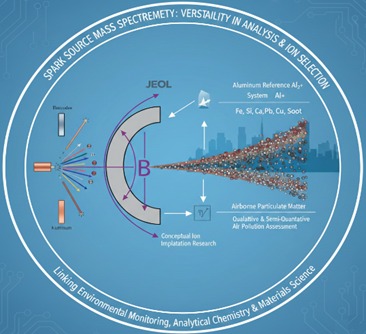
Spark source mass spectrometry provides a robust approach for multi-element analysis and controlled ion generation, yet its broader applicability remains insufficiently explored. This study evaluates the analytical performance of a JEOL JMS-01BM-2 spark source mass spectrometer using a controlled aluminium reference system and a heterogeneous airborne particulate matter sample. Stable detection of singly and multiply charged ions with reproducible mass-to-charge (m/z) separation is demonstrated across repeated measurements, confirming reliable ion generation and magnetic field-based ion selection. Aluminium is consistently resolved in multiple charge states, while aerosol analysis reveals a complex elemental composition characteristic of polluted urban–industrial atmospheres, including crustal, combustion-related, and trace metallic species. Differences between reference and aerosol samples highlight the influence of sample heterogeneity and electrode materials on ion formation. Although no direct ion implantation experiments are performed, the results establish the conceptual feasibility of adapting the instrument for ion selection processes relevant to implantation research. Simultaneously, the successful characterisation of airborne particulate matter demonstrates the utility of spark source mass spectrometry for qualitative and semi-quantitative air pollution assessment.
References
1. Hallen, A. and M. Linnarsson, Ion implantation technology for silicon carbide. Surface and Coatings Technology, 2016. 306: p. 190-193.
2. Current, M.I., Ion implantation of advanced silicon devices: Past, present and future. Materials Science in Semiconductor Processing, 2017. 62: p. 13-22.
3. Popok, V., Ion implantation of polymers: formation of nanoparticulate materials. Reviews on advanced materials science, 2012. 30(1): p. 1-26.
4. Jiang, S.-Y., A. Ma, and S. Ramachandran, Negative air ions and their effects on human health and air quality improvement. International jour-nal of molecular sciences, 2018. 19(10): p. 2966.
5. Schubert, E.F., Doping in III-V semiconductors. 2015: E. Fred Schubert.
6. Schustereder, W., Challenges for ion implantation in power device pro-cessing. ECS Transactions, 2017. 77(5): p. 31.
7. Jin, X., et al., Stability of MOSFET-based electronic components in wearable and implantable systems. IEEE Transactions on Electron De-vices, 2017. 64(8): p. 3443-3451.
8. Verlinden, J., R. Gijbels, and F. Adams, Applications of spark-source mass spectrometry in the analysis of semiconductor materials. A review. Journal of Analytical Atomic Spectrometry, 1986. 1(6): p. 411-419.
9. Fan, X., et al., Miniaturization of Mass Spectrometry Systems: An Over-view of Recent Advancements and a Perspective on Future Directions. Analytical Chemistry, 2025. 97(17): p. 9111-9125.
10. McKenna, C.M. A personal historical perspective of ion implantation equipment for semiconductor applications. in 2000 International Confer-ence on Ion Implantation Technology Proceedings. Ion Implantation Technology-2000 (Cat. No. 00EX432). 2000. IEEE.
11. Yarling, C., History of industrial and commercial ion implantation 1906–1978. Journal of Vacuum Science & Technology A: Vacuum, Surfaces, and Films, 2000. 18(4): p. 1746-1750.
12. Luebke, K.I.T., Dissolution and Electrochemical Recovery of UO2, UO3, and U 3 O 8 in Ionic Liquids. 2022, University of Nevada, Las Ve-gas.
13. Eskina, V.V., et al., Direct precise determination of Pd, Pt and Rh in spent automobile catalysts solution by high-resolution continuum source graphite furnace atomic absorption spectrometry. Spectrochimica Acta Part B: Atomic Spectroscopy, 2020. 165: p. 105784.
Downloads
Published
License
Copyright (c) 2026 Hafiza Rabia Naveed, Ghulam Sarwar Butt, Saira Riaz, Shazad Naseem (Author)

This work is licensed under a Creative Commons Attribution 4.0 International License.
How to Cite