Reactive Multiphase Flows: Interfacial Chemistry in Dynamic Transport Systems
DOI:
https://doi.org/10.64060/jestt.v3i1.3Keywords:
Carbon capture, Electrochemical systems, Interfacial phenomena, Multiphase flow, Reactive transport, Sustainable chemical engineeringAbstract
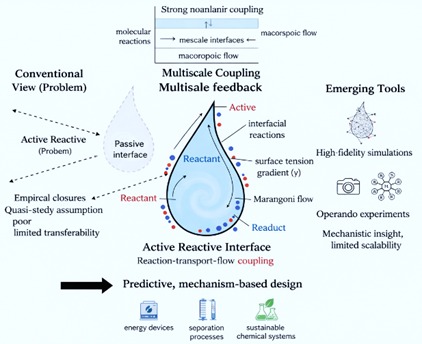
Reactive multiphase flows underpin a wide range of energy, environmental, and chemical technologies, yet their predictive description remains limited. Although interfaces are now widely recognised as chemically active, most theoretical and computational frameworks continue to treat them as quasi-steady boundaries or incorporate their effects through empirical closures. This Perspective argues that such approaches are fundamentally inadequate when reaction, transport, and hydrodynamic timescales become comparable and when reaction-driven interfacial forces actively restructure phase distributions. We critically examine the limitations of prevailing modelling paradigms using dimensionless reasoning and order-of-magnitude estimates, highlighting how coupled Damköhler, Marangoni, and capillary effects undermine model transferability across operating regimes. By synthesising advances in operando diagnostics, interface-resolved simulations, and physics-informed data-driven methods, we propose a unifying framework that treats interfaces as dynamically evolving, rate-determining subsystems. We further articulate a set of concrete, testable research challenges that define a forward-looking agenda for predictive design. This perspective aims to shift reactive multiphase flow research from descriptive integration toward quantitatively grounded, mechanism-based understanding across diverse application domains.
References
1. Chen, Z., J. Xu, and Y. Wang, Gas-liquid-liquid multiphase flow in microfluidic systems–A review. Chemical Engineering Science, 2019. 202: p. 1-14.
2. Zhu, L.-T., et al., Review of machine learning for hydrodynamics, transport, and reactions in multiphase flows and reactors. Industrial & Engineering Chemistry Research, 2022. 61(28): p. 9901-9949.
3. Coppens, M.-O., Nature-inspired chemical engineering for process intensification. Annual Review of Chemical and Biomolecular Engineering, 2021. 12(1): p. 187-215.
4. Dudukovic, N.A., et al., Cellular fluidics. Nature, 2021. 595(7865): p. 58-65.
5. Fainerman, V.B., et al., Particular behavior of surface tension at the interface between aqueous solution of surfactant and alkane. Langmuir, 2019. 35(47): p. 15214-15220.
6. Miller, R., E. Aksenenko, and V. Fainerman, Dynamic interfacial tension of surfactant solutions. Advances in colloid and interface science, 2017. 247: p. 115-129.
7. Dehghani, M.R., S.F. Ghazi, and Y. Kazemzadeh, Interfacial tension and wettability alteration during hydrogen and carbon dioxide storage in depleted gas reservoirs. Scientific reports, 2024. 14(1): p. 11594.
8. Ross, B., et al., Transient Simulation of Gas Bubble Evolution and Overpotential Dynamics for the Hydrogen Evolution Reaction. ACS Electrochemistry, 2025.
9. Zaytsev, M.E., et al., Gas–vapor interplay in plasmonic bubble shrinkage. The Journal of Physical Chemistry C, 2020. 124(10): p. 5861-5869.
10. Ciesielski, P.N., et al., Bridging scales in bioenergy and catalysis: a review of mesoscale modeling applications, methods, and future directions. Energy & Fuels, 2021. 35(18): p. 14382-14400.
11. Ngo, S.I. and Y.-I. Lim, Multiscale Eulerian CFD of chemical processes: A review. ChemEngineering, 2020. 4(2): p. 23.
12. Ström, H., H. Luo, and Q. Xiong, Perspectives on Particle–Fluid Coupling at Varying Resolution in CFD-DEM Simulations of Thermochemical Biomass Conversion. Energy & Fuels, 2024. 38(18): p. 17179-17190.
13. Subramaniam, S., Multiphase flows: Rich physics, challenging theory, and big simulations. Physical Review Fluids, 2020. 5(11): p. 110520.
14. Hong, J.S., et al., Evaporation-driven solutal-Marangoni instability in a saline solution: Theoretical and numerical studies. Physics of Fluids, 2023. 35(10).
15. Jia, F., et al., Marangoni effect on the impact of droplets onto a liquid-gas interface. Physical review fluids, 2020. 5(7): p. 073605.
16. Etminan, A., K. Pope, and K. Mashayekh, Artificial intelligence in fluid dynamics and thermal transport: A comprehensive review of methods, challenges, and emerging applications. AI Thermal Fluids, 2025: p. 100022.
17. Ghezelbash, A., et al., Challenges in High‐Fidelity Implicit Block‐Based Numerical Simulation of Dynamic Out‐of‐Plane Two‐Way Bending in Unreinforced Brick Masonry Walls. Earthquake Engineering & Structural Dynamics, 2025. 54(7): p. 1836-1858.
18. Sheng, K.-M., et al., Structural-state integrated modeling of multi-mechanism formation damage during drilling–completion. Petroleum Science, 2026.
19. Ding, Y., P.D. Howes, and A.J. deMello, Recent advances in droplet microfluidics. Analytical chemistry, 2019. 92(1): p. 132-149.
20. Teh, S.-Y., et al., Droplet microfluidics. Lab on a Chip, 2008. 8(2): p. 198-220.
21. Yang, G., et al., Data-driven methods for flow and transport in porous media: A review. International Journal of Heat and Mass Transfer, 2024. 235: p. 126149.
22. Govea-Alvarez, P., et al., Integrating Electrochemical CO2 Reduction Technology for Smart, Sustainable, and Stable In-Situ Resource Utilization for Outer-Space Applications. Engineering, 2025.
23. Qasem, N.A. and G.A. Abdulrahman, A recent comprehensive review of fuel cells: history, types, and applications. International Journal of Energy Research, 2024. 2024(1): p. 7271748.
Downloads
Published
Issue
Section
Categories
License
Copyright (c) 2026 Asad Ullah, Samaha , Anus Nadeem , Muhammad Zahid Amin (Author)

This work is licensed under a Creative Commons Attribution 4.0 International License.
How to Cite