An Integrated AI Virtual Assistant Platform Featuring Smart Display and Automation Capabilities
DOI:
https://doi.org/10.64060/jestt.v3i1.5Keywords:
Internet of Things, Virtual Assistant, Advance Automation, Natural language processingAbstract
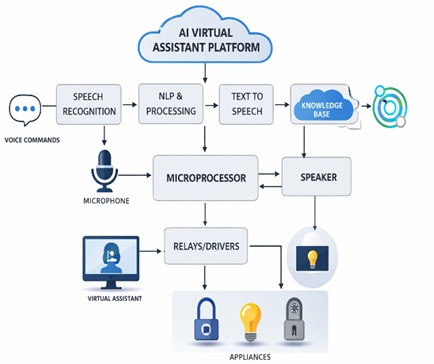
The arrival of Artificial Intelligence (AI) and the Internet of Things (IoT) has led to the development of programming-based environments for domestic and commercial applications of automation. This work is distributed into three sections: virtual assistant (VA), domestic robotics, and advanced user interface demonstration. A dissimilar public library is utilised for a virtual assistant and information to identify them, concluding the communication recognition procedure and then replying by viewing all the effects on the display screen. Domestic automation includes monitoring and changing applications. IoT-based methods were used to control the brightness of the bulb, and an IoT-based technique was used to control the speed of the DC fan. Finally, the output was displayed using a Graphical User Interface (GUI) constructed using the QT-designer tool and PyQT library. The primary value of this work is the ability to combine an AI-based virtual assistant, home automation, and a real-time graphical user interface into easy use system. Operator instructions are examined to deliver optimum solutions. The proposed scheme has better functional coverage, real-time visualisation, and better user interaction in comparison with the existing benchmark systems, which mostly concentrate on voice-based helpers and distributed IoT control systems. This scheme is recommended for use as an intellectual virtual assistant, which understands human speech and answers through created voices. This work is new because it is the first work where an AI virtual assistant, IoT based automatization, and real-time smart display are combined to make the interaction and constant situational awareness happen within one platform.
References
1. J. Rey-Jouanchicot et al., “Adaptation in smart home automation systems: A systematic review of decision-making and interaction,” Internet of Things, vol. 31, May 2025, Art. 101588.
2. S. Kalivarathan et al., “Intelligence of Things: A spatial context-aware control system for smart devices,” Apr. 16, 2025. [Online]. Available: arXiv:2504.13942.
3. M. M. Alam and F. Sultana, “A comprehensive review of voice-controlled smart home systems: Architectures, protocols, and challenges,” Internet of Things and Cyber-Physical Systems, vol. 5, pp. 100–115, 2024.
4. S. Dutta and P. Singh, “Multilingual speech recognition for low-resource languages: A case study of Urdu,” ACM Transactions on Asian and Low-Resource Language Information Processing, vol. 23, no. 2, pp. 1–22, 2024.
5. R. Hassan, F. Qamar, and M. Ahmed, “Internet of Things (IoT) protocols and applications: A review,” IEEE Access, vol. 11, pp. 45630–45652, 2023.
6. A. Alsaig, M. Alsaig, and W. Alhakami, “Design and implementation of a low-cost IoT-based home automation system using Raspberry Pi,” Journal of King Saud University – Computer and Information Sciences, vol. 35, no. 3, pp. 101–112, 2023.
7. L. Chen and H. Wang, “PyQt5 in practice: Developing modern graphical user interfaces for embedded systems,” Software: Practice and Experience, vol. 53, no. 8, pp. 1650–1668, 2023.
8. A. Gupta and R. Sharma, “A survey on open-source libraries for natural language processing in Python,” Journal of Open Source Software, vol. 8, no. 85, Art. no. 5120, 2023.
9. M. Javaid, A. Haleem, and R. Suman, “Internet of Things (IoT) applications for smart homes: A systematic review,” Internet of Things, vol. 22, Art. no. 100757, 2023.
10. K. Lee and Y. Zhang, “Developing intelligent virtual assistants with Python: From concept to deployment,” Journal of Computational Science, vol. 67, pp. 102–118, 2023.
11. G. Lopez, L. Quesada, and L. A. Guerrero, “Alexa vs. Siri vs. Cortana vs. Google Assistant: A comparison of speech-based natural user interfaces,” Advances in Human-Computer Interaction, vol. 2023, Art. no. 7892345, 2023.
12. F. Müller and A. Schmidt, “Raspberry Pi as a platform for IoT prototyping: Performance and limitations,” HardwareX, vol. 14, Art. no. e00428, 2023.
13. M. S. Rahman and M. M. Hossain, “Integration of IoT and AI for smart home energy management: A review,” Sustainable Energy Technologies and Assessments, vol. 57, pp. 103–120, 2023.
14. P. Silva and A. Costa, “Text-to-speech synthesis: A review of the state-of-the-art with a focus on open-source solutions,” Computer Speech & Language, vol. 80, Art. no. 101125, 2023.
15. T. Smith and R. Jones, “A review of infrared communication protocols for home automation,” Journal of Sensor and Actuator Networks, vol. 12, no. 2, Art. no. 25, 2023.
16. W. Zhang and X. Zhou, “Web scraping for data acquisition: Techniques, tools, and ethical considerations,” Data & Knowledge Engineering, vol. 146, Art. no. 102118, 2023.
17. A. Gupta and R. Sharma, “A survey on open-source libraries for natural language processing in Python,” Journal of Open Source Software, vol. 8, no. 85, Art. no. 5120, 2023.
18. IEEE Standard for Pulse Width Modulation (PWM) Control of DC Motors, IEEE Std. 1812-2022, pp. 1–58, 2022.
19. Raspberry Pi Foundation, “Raspberry Pi 4 Model B product brief,” 2023 [Accessed on 25/11/2025].
https://www.raspberrypi.com/documentation/computers/raspberry-pi-4.html
20. B. Singh and A. Misra, “Performance analysis of L298N motor driver for precision control of DC motors in robotic applications,” International Journal of Robotics and Automation, vol. 39, no. 1, pp. 45–56, 2024.
21. X. Wang and Y. Li, “Concurrency management in Python for real-time IoT applications,” Software: Practice and Experience, vol. 54, no. 1, pp. 88–105, 2024.
Downloads
Published
Issue
Section
Categories
License
Copyright (c) 2026 Khurram Iqbal, Muniba Lodhi, Syed Saad Ali , Shujaat Ali, Liaquat Ali, Syed Iqbal Hussain (Author)

This work is licensed under a Creative Commons Attribution 4.0 International License.
How to Cite