Twisted Bilayer Graphene at the Magic Angle: A Review of Highly Correlated Physics and Unconventional Superconductivity
DOI:
https://doi.org/10.64060/jestt.v2i2.4Keywords:
Twisted Bilayer Graphene, Magic Angle, Superconductivity, Correlated Insulators, Moire SuperlatticeAbstract
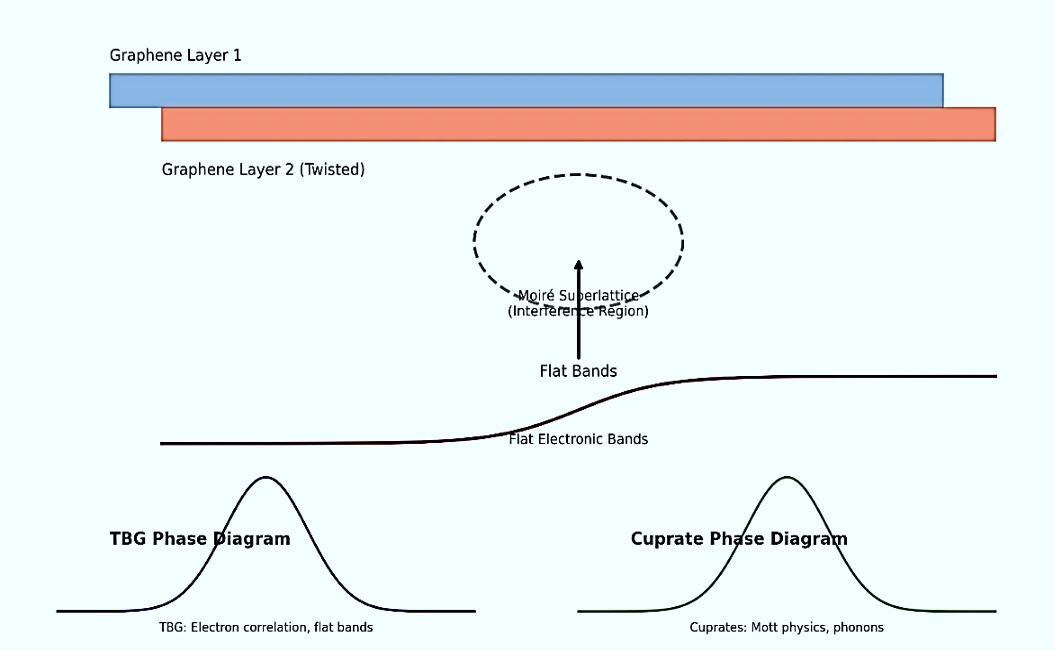
A novel platform for researching topological quantum phenomena, unusual superconductivity, and strongly coupled electron physics is Twisted Bilayer Graphene (TBG) at the “Magic Angle” (~1.05°). Two graphene layers are rotated to this exact angle to form a moiré superlattice, which produces flat electronic bands that significantly improve electron-electron interactions. This results in a rich phase diagram with non-Fermi liquid behaviour, correlated insulators, and superconductivity. This review covers the theoretical foundations, experimental results, and unanswered concerns about magic-angle TBG, including significant challenges like twist angle control, disorder effects, and the interaction of strain and electrical characteristics. Beyond basic research, TBG has great technological potential, with potential applications in neuromorphic devices, ultra-sensitive sensors, and quantum computing (e.g., topological qubits). This system provides a novel approach to comprehending high-temperature superconductivity and achieving next-generation quantum technologies by fusing insights from correlated physics with device engineering.
References
1. Cao, Y., Fatemi, V., Fang, S., Watanabe, K., Taniguchi, T., Kaxiras, E., & Jarillo-Herrero, P. (2018). Unconventional superconductivity in mag-ic-angle graphene superlattices. Nature, 556(7699), 43-50.
2. Lu, X., Stepanov, P., Yang, W., Xie, M., Aamir, M. A., Das, I., ... & Efetov, D. K. (2019). Superconductors, orbital magnets and correlated states in magic-angle bilayer graphene. Nature, 574(7780), 653-657.
3. Codecido, E., Wang, Q., Koester, R., Che, S., Tian, H., Lv, R., ... & Lau, C. N. (2019). Correlated insulating and superconducting states in twisted bilayer graphene below the magic angle. Science Advances, 5(9), eaaw9770.
4. Rai, G., Crippa, L., Călugăru, D., Hu, H., Paoletti, F., de’Medici, L., ... & Wehling, T. (2024). Dynamical correlations and order in magic-angle twisted bilayer graphene. Physical Review X, 14(3), 031045.
5. Tao, Z., Zhao, W., Shen, B., Li, T., Knüppel, P., Watanabe, K., ... & Mak, K. F. (2024). Observation of spin polarons in a frustrated moiré Hubbard system. Nature Physics, 20(5), 783-787.
6. Dutta, R., Ghosh, A., Mandal, S., Watanabe, K., Taniguchi, T., Krishna-murthy, H. R., ... & Das, A. (2025). Electric Field-Tunable Superconduc-tivity with Competing Orders in Twisted Bilayer Graphene near the Mag-ic Angle. ACS nano, 19(5), 5353-5362.
7. Díez-Mérida, J., Das, I., Di Battista, G., Díez-Carlón, A., Lee, M., Zeng, L., ... & Efetov, D. K. (2025). High-yield fabrication of bubble-free magic-angle twisted bilayer graphene devices with high twist-angle ho-mogeneity. Newton, 1(1).
8. Choi, Y., Kim, H., Peng, Y., Thomson, A., Lewandowski, C., Polski, R., ... & Nadj-Perge, S. (2021). Correlation-driven topological phases in magic-angle twisted bilayer graphene. Nature, 589(7843), 536-541.
9. Andrei, E. Y., & MacDonald, A. H. (2020). Graphene bilayers with a twist. Nature materials, 19(12), 1265-1275.
10. Douçot, B., Mukhopadhyay, A., Policastro, G., & Samanta, S. (2021). Linear-in-T resistivity from semiholographic non-Fermi liquid mod-els. Physical Review D, 104(8), L081901
11. Wang, Y. J., Zhou, G. D., Peng, S. Y., Lian, B., & Song, Z. D. (2024). Molecular pairing in twisted bilayer graphene superconductivi-ty. Physical Review Letters, 133(14), 146001.
12. Arp, T., Sheekey, O., Zhou, H., Tschirhart, C. L., Patterson, C. L., Yoo, H. M., ... & Young, A. F. (2024). Intervalley coherence and intrinsic spin–orbit coupling in rhombohedral trilayer graphene. Nature Phys-ics, 20(9), 1413-1420
13. Fischer, A., Goodwin, Z. A., Mostofi, A. A., Lischner, J., Kennes, D. M., & Klebl, L. (2022). Unconventional superconductivity in magic-angle twisted trilayer graphene. npj Quantum Materials, 7(1), 5.
14. Tanaka, Y., Tamura, S., & Cayao, J. (2024). Theory of Majorana zero modes in unconventional superconductors. Progress of Theoretical and Experimental Physics, 2024(8), 08C105.
15. Braz, L. B., Martins, G. B., & Dias da Silva, L. G. (2024). Superconduc-tivity from spin fluctuations and long-range interactions in magic-angle twisted bilayer graphene. Physical Review B, 109(18), 184502.
16. Wang, W. X., Liu, Y. W., & He, L. (2025). Quantum anomalous Hall effect in twisted bilayer graphene. Chinese Physics B.
17. Wang, W. X., Liu, Y. W., & He, L. (2025). Quantum anomalous Hall effect in twisted bilayer graphene. Chinese Physics B.
18. Maeda, K., Fukaya, Y., Yada, K., Lu, B., Tanaka, Y., & Cayao, J. (2025). Classification of pair symmetries in superconductors with uncon-ventional magnetism. Physical Review B, 111(14), 144508.
19. Oh, M., Nuckolls, K. P., Wong, D., Lee, R. L., Liu, X., Watanabe, K., ... & Yazdani, A. (2021). Evidence for unconventional superconductivity in twisted bilayer graphene. Nature, 600(7888), 240-245.
20. Else, D. V. (2024). Holographic models of non-Fermi liquid metals revis-ited: An effective field theory approach. Physical Review B, 109(3), 035163.
21. Nguyen, D. H., Sidorenko, A., Taupin, M., Knebel, G., Lapertot, G., Schuberth, E., & Paschen, S. (2021). Superconductivity in an extreme strange metal. Nature Communications, 12(1), 4341.
22. Heier, G., Park, K., & Savrasov, S. Y. (2024). Competing dxy and s±pairing symmetries in superconducting La3Ni2O7: LDA+ FLEX calcu-lations. Physical Review B, 109(10), 104508.
23. Klimin, S. N., Tempere, J., Devreese, J. T., & der Marel, D. V. (2017). Multiband superconductivity due to the electron–LO–phonon interaction in strontium titanate and on a SrTiO3/LaAlO3 interface. Journal of Su-perconductivity and Novel Magnetism, 30, 757-761.
24. Giannetti, C., Capone, M., Fausti, D., Fabrizio, M., Parmigiani, F., & Mihailovic, D. (2016). Ultrafast optical spectroscopy of strongly corre-lated materials and high-temperature superconductors: a non-equilibrium approach. Advances in Physics, 65(2), 58-238.
Downloads
Published
Issue
Section
License
Copyright (c) 2025 Journal of Engineering, Science and Technological Trends

This work is licensed under a Creative Commons Attribution 4.0 International License.
How to Cite