Natural Disaster Prediction and Mitigation through Machine Learning
DOI:
https://doi.org/10.64060/jestt.v2i3.2Keywords:
Climate Change, Disaster management, Flood Forecasting, Machine learningAbstract
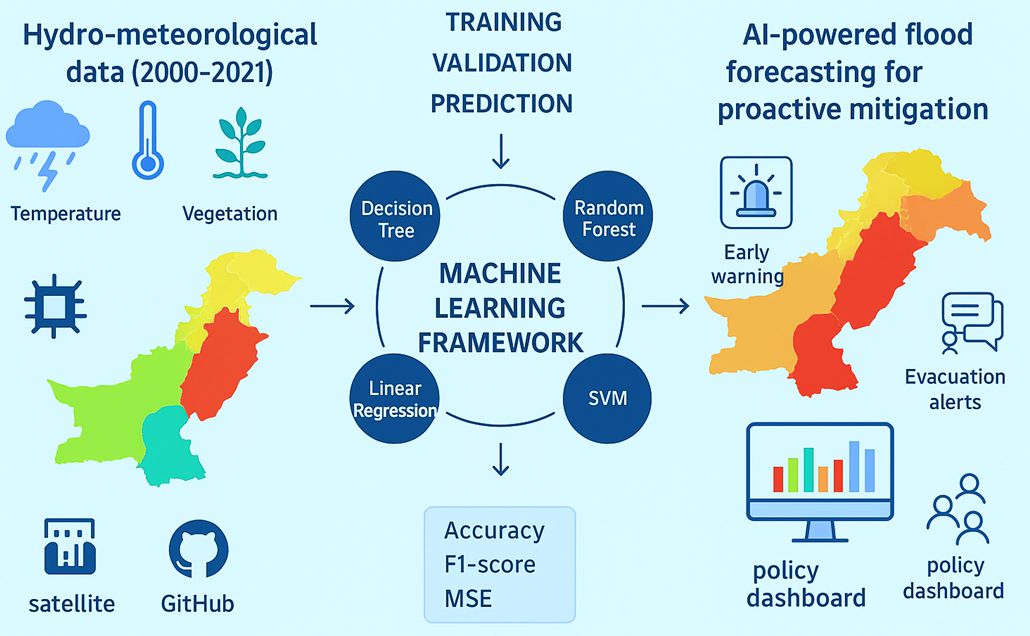
Flooding remains a major natural disaster affecting Pakistan's provinces of Punjab, Sindh, Khyber Pakhtunkhwa, and Balochistan, with increasing severity due to climate change and human activities. This research explores the application of machine learning techniques to enhance flood prediction accuracy for the years 2025 to 2030. The study utilises historical hydro-meteorological data, including rainfall, temperature, and vegetation indices, to train four machine learning models: Decision Tree, Random Forest, Linear Regression, and Support Vector Machine (SVM). Standard evaluation metrics such as precision, recall, F1-score, and mean squared error (MSE) are used to assess model performance. Results show that Random Forest and SVM outperform the other models in terms of both accuracy and generalizability. These models effectively identify high-risk flood zones across the studied provinces. The findings demonstrate the potential of data-driven approaches to support early warning systems, enabling better disaster preparedness, resource allocation, and mitigation planning. This research highlights how machine learning can play a critical role in reducing flood-related risks and enhancing resilience against future natural disasters in Pakistan.
References
1. El-Magd, S.A.A., B. Pradhan, and A. Alamri, Machine learning algorithm for flash flood prediction mapping in Wadi El-Laqeita and surroundings, Central Eastern Desert, Egypt. Arabian Journal of Geosciences, 2021. 14(4): p. 323.
2. Ahmad, A., et al., Flood risk modelling by the synergistic approach of machine learning and best-worst method in Indus Kohistan, Western Himalaya. Geomatics, Natural Hazards and Risk, 2025. 16(1): p. 2469766.
3. Akhyar, A., et al., Deep artificial intelligence applications for natural disaster management systems: A methodological review. Ecological Indicators, 2024. 163: p. 112067.
4. Efraimidou, E. and M. Spiliotis, A gis-based flood risk assessment using the decision-making trial and evaluation laboratory approach at a regional scale. Environmental Processes, 2024. 11(1): p. 9.
5. Alshammary, M.J., I.R. Karim, and M.Y. Fattah, Monitoring Flood Waves Due to Overtopping: Case Study of Mosul Dam from Iraq. Journal of Engineering, Science and Technological Trends, 2025. 2(1).
6. Brunner, M.I., et al., Challenges in modeling and predicting floods and droughts: A review. Wiley Interdisciplinary Reviews: Water, 2021. 8(3): p. e1520.
7. Islam, A.R.M.T., et al., Predicting flood risks using advanced machine learning algorithms with a focus on Bangladesh: influencing factors, gaps and future challenges. Earth Science Informatics, 2025. 18(3): p. 300.
8. Afzal, J., et al., Effects of dam on temperature, humidity and precipitation of surrounding area: a case study of Gomal Zam Dam in Pakistan. Environmental Science and Pollution Research, 2023. 30(6): p. 14592-14603.
9. Jain, H., et al., Leveraging machine learning algorithms for improved disaster preparedness and response through accurate weather pattern and natural disaster prediction. Frontiers in Environmental Science, 2023. 11: p. 1194918.
10. Khalaf, M., et al., IoT-enabled flood severity prediction via ensemble machine learning models. IEEE Access, 2020. 8: p. 70375-70386.
11. Khan, I., et al., Climate change impact assessment, flood management, and mitigation strategies in Pakistan for sustainable future. Environmental Science and Pollution Research, 2021. 28(23): p. 29720-29731.
12. Khan, M., et al., Developing a machine learning-based flood risk prediction model for the Indus Basin in Pakistan. Water Practice & Technology, 2024. 19(6): p. 2213-2225.
13. Kumar, V., et al., Machine learning applications in flood forecasting and predictions, challenges, and way-out in the perspective of changing environment. AIMS Environmental Science, 2025. 12(1): p. 72-105.
14. Shaikh, T.A., et al., A fundamental overview of ensemble deep learning models and applications: systematic literature and state of the art. Annals of Operations Research, 2024: p. 1-77.
15. Lawal, Z.K., H. Yassin, and R.Y. Zakari. Flood prediction using machine learning models: a case study of Kebbi state Nigeria. in 2021 IEEE Asia-Pacific Conference on Computer Science and Data Engineering (CSDE). 2021. IEEE.
16. Mahmood, S., A. Sajjad, and A.-u. Rahman, Cause and damage analysis of 2010 flood disaster in district Muzaffar Garh, Pakistan. Natural hazards, 2021. 107(2): p. 1681-1692.
17. Rahman, Z.U., et al., GIS-based flood susceptibility mapping using bivariate statistical model in Swat River Basin, Eastern Hindukush region, Pakistan. Frontiers in Environmental Science, 2023. 11: p. 1178540.
18. Ruichen, M., et al., Vegetation variation regulates soil moisture sensitivity to climate change on the Loess Plateau. Journal of Hydrology, 2023. 617: p. 128763.
19. Shehzadi, M., et al., Enhancing flood resilience: Streamflow forecasting and inundation modeling in pakistan. Engineering Proceedings, 2023. 56(1): p. 315.
20. Siddiqui, M.A., et al., Advance Ensemble Flood Warning System: A Case Study for Nullah Lai. Environmental Sciences Proceedings, 2023. 25(1): p. 96.
21. Tehrany, M.S., B. Pradhan, and M.N. Jebur, Flood susceptibility mapping using a novel ensemble weights-of-evidence and support vector machine models in GIS. Journal of hydrology, 2014. 512: p. 332-343.
22. Ahmed, R., Essays on Infrastructure, Firm Productivity, Natural Disaster and Life Course Transition in South Asia. 2017.
23. Nishtar, Z. and J. Afzal, A review of real-time monitoring of hybrid energy systems by using artificial intelligence and IoT. Pakistan Journal of Engineering and Technology, 2023. 6(3): p. 8-15.
24. Waleed, M. and M. Sajjad, Advancing flood susceptibility prediction: A comparative assessment and scalability analysis of machine learning algorithms via artificial intelligence in high‐risk regions of Pakistan. Journal of Flood Risk Management, 2025. 18(1): p. e13047.
25. Afzal, J., et al., A complex wireless sensors model (CWSM) for real time monitoring of dam temperature. Heliyon, 2023. 9(2).
26. Rajab, M.A., F.A. Abdullatif, and T. Sutikno, Classification of grapevine leaves images using VGG-16 and VGG-19 deep learning nets. TELKOMNIKA (Telecommunication Computing Electronics and Control), 2024. 22(2): p. 445-453.
27. Khan, M., et al., Assessing Agrometeorological Damage after the 2022 Pakistan Floods: Insights from Multi-Sensor Satellite Data. Earth Systems and Environment, 2025: p. 1-21.
28. Şen, Z., Flood modeling, prediction and mitigation. 2018: Springer.
29. Goldberg, M.D., et al., Mapping, monitoring, and prediction of floods due to ice jam and snowmelt with operational weather satellites. Remote Sensing, 2020. 12(11): p. 1865.
30. Benn, D.I., et al., Response of debris-covered glaciers in the Mount Everest region to recent warming, and implications for outburst flood hazards. Earth-Science Reviews, 2012. 114(1-2): p. 156-174.
Downloads
Published
License
Copyright (c) 2025 Journal of Engineering, Science and Technological Trends

This work is licensed under a Creative Commons Attribution 4.0 International License.
How to Cite