Assessment and Critical Review of PM0.1 Pollution in Pakistan
DOI:
https://doi.org/10.64060/jestt.v2i3.4Keywords:
Air pollution, Air quality monitoring, Combustion emissions, Environmental policy, Health effects, Ultrafine particlesAbstract
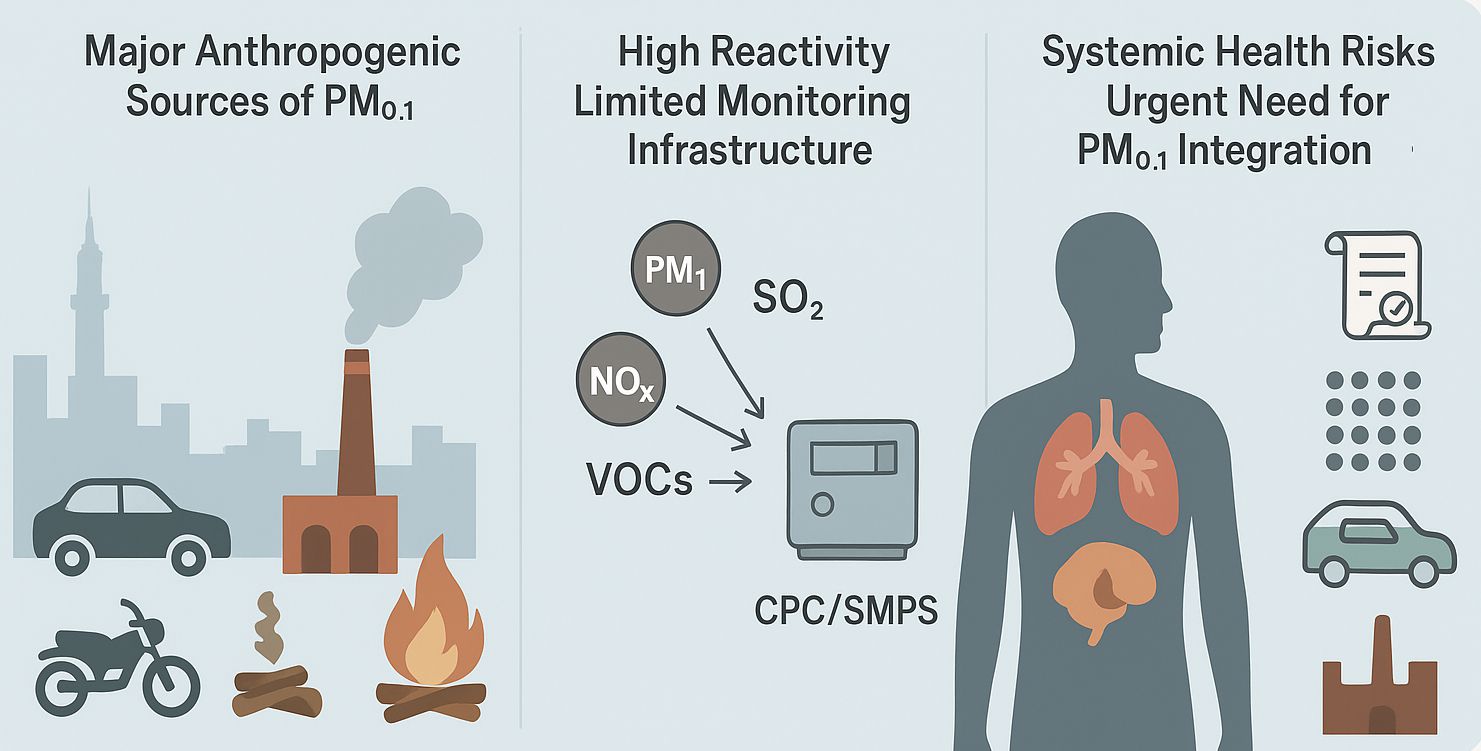
Particulate matter (PM) is among the most significant air pollutants globally, with severe implications for environmental integrity, human health, and climate stability. Among its various fractions, ultrafine particles (PM0.1, particles with an aerodynamic diameter ≤ 0.1 μm) are gaining increasing attention due to their high surface area-to-mass ratio, deep pulmonary penetration, and potential to translocate into systemic circulation and vital organs. This paper presents a comprehensive critical review of PM0.1 assessment in Pakistan, emphasising its sources, spatiotemporal distribution, measurement limitations, and health consequences. Despite the mounting evidence of air quality degradation in Pakistan, data on PM0.1 remain scarce and fragmented. The few available studies indicate that urban centres such as Lahore, Karachi, Islamabad, and Faisalabad exhibit ultrafine particle concentrations substantially higher than international safety benchmarks. Anthropogenic activities, including vehicular emissions, industrial combustion, biomass burning, and construction dust, are dominant contributors. This review identifies key gaps in current research, highlighting the lack of long-term monitoring, standardised methodologies, and toxicological assessments specific to PM0.1 exposure in local populations. It further stresses the urgent need for policy integration, investment in high-resolution monitoring technologies, and public health interventions. Overall, the assessment underscores that PM0.1 pollution in Pakistan poses an emerging environmental health crisis that remains scientifically underexplored and administratively underprioritized.
References
1. Farahani, Vahid Jalali, et al. "The oxidative potential of particulate matter (PM) in different regions around the world and its relation to air pollution sources." Environmental Science: Atmospheres 2.5 (2022): 1076-1086.
2. Daellenbach, Kaspar R., et al. "Sources of particulate-matter air pol-lution and its oxidative potential in Europe." Nature 587.7834 (2020): 414-419.
3. Li, Chi, et al. "Reversal of trends in global fine particulate matter air pollution." Nature communications 14.1 (2023): 5349.
4. Brook, Robert D., and Sanjay Rajagopalan. "Particulate matter, air pollution, and blood pressure." Journal of the American Society of Hypertension 3.5 (2009): 332-350.
5. Arif, Muhammad Maaz, Muhammad Abu Bakar, and Sajid Rashid Ahmad. "Impacts of air pollution on human health in Lahore city, Pakistan: A review." Global Research Journal of Natural Science and Technology 1.2 (2023).
6. Nasar-u-Minallah, Muhammad, et al. "Assessing and anticipating environmental challenges in Lahore, Pakistan: future implications of air pollution on sustainable development and environmental govern-ance." Environmental Monitoring and Assessment 196.9 (2024): 865.
7. Shi, Yuan, et al. "Urbanization and regional air pollution across South Asian developing countries–A nationwide land use regression for ambient PM2. 5 assessment in Pakistan." Environmental Pollu-tion 266 (2020): 115145.
8. Ahmad, Shafiq, et al. "Morphological, mineralogical, and biochemi-cal characteristics of particulate matter in three size fractions (PM10, PM2. 5, and PM1) in the urban environment." ACS omega 8.35 (2023): 31661-31674.
9. Benabed, Ahmed, and Amir Boulbair. "PM10, PM2. 5, PM1, and PM0. 1 resuspension due to human walking." Air Quality, Atmos-phere & Health 15.9 (2022): 1547-1556.
10. Schraufnagel, Dean E. "The health effects of ultrafine particles." Experimental & molecular medicine 52.3 (2020): 311-317.
11. Phairuang, Worradorn, et al. "Characterizing chemical, environmen-tal, and stimulated subcellular physical characteristics of Size-Fractionated PMs down to PM0. 1." Environmental Science & Tech-nology 58.28 (2024): 12368-12378.
12. Traboulsi, Hussein, et al. "Inhaled pollutants: the molecular scene behind respiratory and systemic diseases associated with ultrafine particulate matter." International journal of molecular sciences 18.2 (2017): 243.
13. Phairuang, Worradorn, et al. "Airborne nanoparticles (PM0. 1) in southeast Asian cities: a review." Sustainability 14.16 (2022): 10074.
14. Sharma, R., et al. "Health implications due to exposure to fine and ultra-fine particulate matters: A short review." International Journal of Ambient Energy 45.1 (2024): 2314256.
15. Shabbir, Muneeba, et al. "A paradigm shift: Low-cost sensors for effective air quality monitoring and management in developing coun-tries." Environment International (2025): 109521.
16. Wangchuk, Tenzin, et al. "Mobile assessment of on-road air pollu-tion and its sources along the East–West Highway in Bhutan." At-mospheric Environment 118 (2015): 98-106.
17. Bachmann, John. "Will the circle be unbroken: a history of the US National Ambient Air Quality Standards." Journal of the Air & Waste Management Association 57.6 (2007): 652-697.
Downloads
Published
License
Copyright (c) 2025 Journal of Engineering, Science and Technological Trends

This work is licensed under a Creative Commons Attribution 4.0 International License.
How to Cite