AI/ML-Driven Design and Optimisation of Quantum Dots: A Perspective Toward Intelligent Materials Discovery
DOI:
https://doi.org/10.64060/jestt.v2i3.5Keywords:
Artificial intelligence (AI), Autonomous synthesis, Data-driven modelling, Intelligent materials discovery, Machine learning (ML), Materials informatics, Optoelectronic properties, Physics-informed learning, Predictive design, Quantum dots (QDs), Synthesis optimizationAbstract
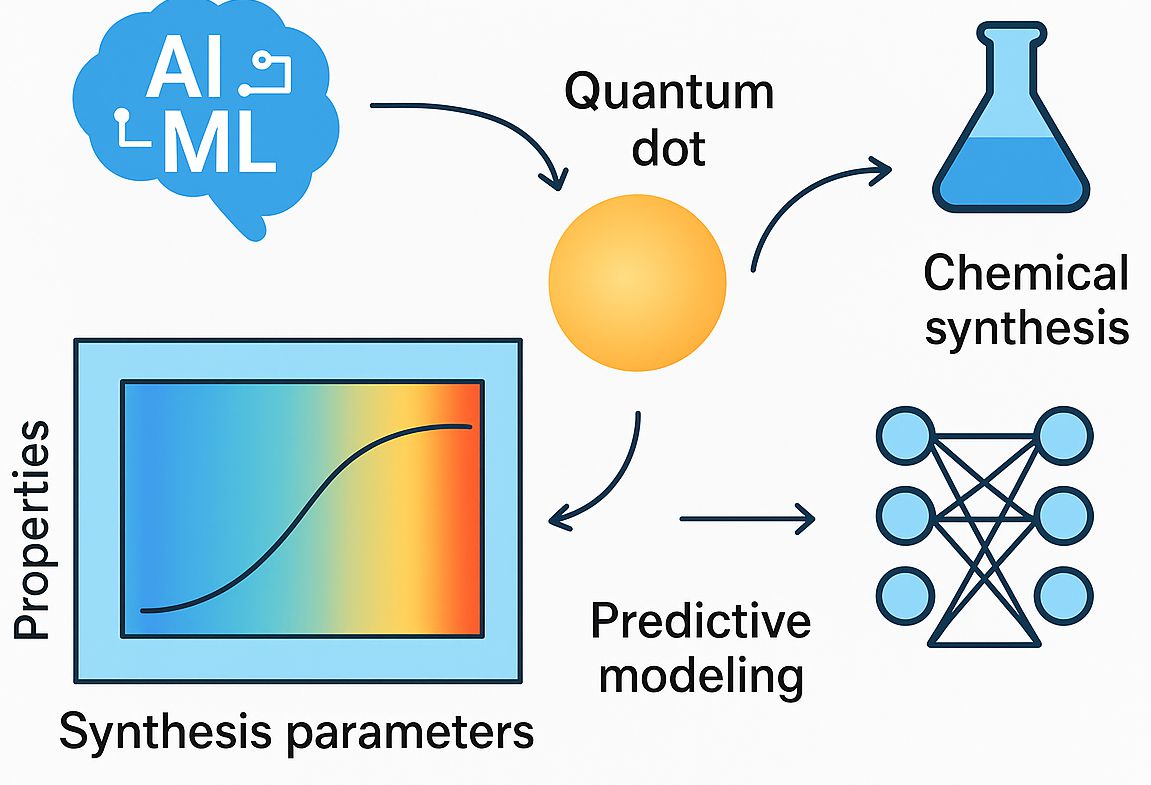
Quantum dots (QDs), nanoscale semiconductors with size-dependent and tunable optoelectronic properties, are central to next-generation technologies spanning displays, photovoltaics, bioimaging, and quantum information systems. However, their synthesis and optimisation remain challenging due to the intricate interplay of reaction parameters and nonlinear physicochemical interactions. The integration of artificial intelligence (AI) and machine learning (ML) is redefining this landscape, enabling predictive design, autonomous synthesis control, and accelerated discovery across the QD domain. This Perspective highlights the conceptual advances and methodological innovations driving AI/ML-assisted QD research, emphasising achievements in data-driven modelling, synthesis optimisation, and materials informatics. Persistent challenges, including data scarcity, model transparency, and limited generalizability, are critically examined, alongside emerging strategies toward physics-informed and autonomous discovery frameworks. We propose that the convergence of intelligent algorithms and human expertise will catalyse a paradigm shift from empirical experimentation toward rational, self-evolving materials design in quantum dot science.
References
1. Georgakilas, Vasilios, et al. "Broad family of carbon nanoallotropes: classification, chemistry, and applications of fullerenes, carbon dots, nanotubes, graphene, nanodiamonds, and combined superstruc-tures." Chemical reviews 115.11 (2015): 4744-4822.
2. García de Arquer, F. Pelayo, et al. "Semiconductor quantum dots: Technological progress and future challenges." Science 373.6555 (2021): eaaz8541.
3. Kovalenko, Maksym V. "Opportunities and challenges for quantum dot photovoltaics." Nature Nanotechnology 10.12 (2015): 994-997.
4. Resch-Genger, Ute, et al. "Quantum dots versus organic dyes as fluorescent labels." Nature methods 5.9 (2008): 763-775.
5. Li, Xu-Bing, Chen-Ho Tung, and Li-Zhu Wu. "Semiconducting quantum dots for artificial photosynthesis." Nature Reviews Chem-istry 2.8 (2018): 160-173.
6. Medintz, Igor L., et al. "Quantum dot bioconjugates for imaging, labelling and sensing." Nature materials 4.6 (2005): 435-446.
7. Matea, Cristian T., et al. "Quantum dots in imaging, drug delivery and sensor applications." International journal of nanomedicine (2017): 5421-5431.
8. Kargozar, Saeid, et al. "Quantum dots: a review from concept to clinic." Biotechnology Journal 15.12 (2020): 2000117.
9. Mohamed, Walied AA, et al. "Quantum dots synthetization and fu-ture prospect applications." Nanotechnology Reviews 10.1 (2021): 1926-1940.
10. Agarwal, Kushagra, Himanshu Rai, and Sandip Mondal. "Quantum dots: an overview of synthesis, properties, and applications." Mate-rials Research Express 10.6 (2023): 062001.
11. Chugh, Vibhas, et al. "Employing nano-enabled artificial intelligence (AI)-based smart technologies for prediction, screening, and detec-tion of cancer." Nanoscale 16.11 (2024): 5458-5486.
12. Diao, Shanhui, et al. "From synthesis to properties: expanding the horizons of machine learning in nanomaterials research." Materials Horizons 12.12 (2025): 4133-4164.
13. Guo, Kai, et al. "Artificial intelligence and machine learning in design of mechanical materials." Materials Horizons 8.4 (2021): 1153-1172.
14. Dunjko, Vedran, and Hans J. Briegel. "Machine learning& artificial intelligence in the quantum domain." arXiv preprint arXiv:1709.02779 (2017).
15. Haram, Santosh K., et al. "Quantum confinement in CdTe quantum dots: investigation through cyclic voltammetry supported by density functional theory (DFT)." The Journal of Physical Chemistry C 115.14 (2011): 6243-6249.
16. Duman, Ali Nabi, and Almaz S. Jalilov. "Machine learning for car-bon dot synthesis and applications." Materials Advances 5.18 (2024): 7097-7112.
Downloads
Published
Issue
Section
Categories
License
Copyright (c) 2025 Journal of Engineering, Science and Technological Trends

This work is licensed under a Creative Commons Attribution 4.0 International License.
How to Cite