Stimuli-Response in Organic Cocrystals with Different Donor-Acceptors
DOI:
https://doi.org/10.64060/JESTT3i21Keywords:
Acid stimuli, Cocrystal growth, CT interactions, Organic cocrystals, Solvent evaporationAbstract
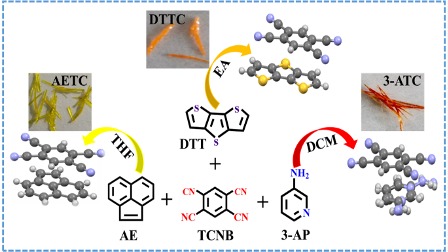
Organic cocrystal engineering refers to the stoichiometric combination of two or more organic molecules through non-covalent intermolecular interactions, but achieving excellent electrical and optical properties remains a challenge due to the lack of clear directions for the rational design of co-crystals. In addition, herein we compare and report these three new cocrystals' chemical and physical properties, crystalline structures and determined response to acid stimuli. This investigation of organic cocrystals contains intermolecular interactions and growth methods, especially the solvent evaporation approach. As a result, we synthesised three new organic cocrystals; among these cocrystals, 3-ATC has the highest response to acid stimuli (different acid fuming). The cocrystal’s response time is also in the order of seconds, which is much faster than that of most other stimuli-responsive cocrystals previously described. 3-ATC is a highly sensitive fluorescence switching exhibited under various acid stimuli. But, the other two cocrystals (AETC and DTTC) are strong enough to resist acid stimuli; this is due to the close face-to-face and mixed stacking patterns with CT and π-π interactions. These three cocrystals exhibited different colours and low-dimensional (1D, 2D) morphology structures.
References
1. S. Sato, H. Nikawa, S. Seki, L. Wang, G. Luo, J. Lu, M. Haranaka, T. Tsuchiya, S. Nagase, T. Akasaka, Angew. Chemie - Int. Ed. (2012), 51, 1589–1591.
2. T. Wakahara, P. D’Angelo, K. Miyazawa, Y. Nemoto, O. Ito, N. Tanigaki, D.D.C. Bradley, T.D. Anthop ou los, J. Am. Chem. Soc. (2012), 134, 7204–7206.
3. N. Schultheiss, A. Newman, , Cryst. Growth &Design. (2009), 9, 2950–2967.
4. J. Zhang, H. Geng, T.S. Virk, Y. Zhao, J. Tan, C.A. Di, W. Xu, K. Singh, W. Hu, Z. Shuai, Y. Liu, D. Zhu, Adv. Mater. (2012), 24, 2603–2607.
5. H. Dong, H. Zhu, Q. Meng, X. Gong, W. Hu, Chem. Soc. Rev. (2012), 41, 1754–1808.
6. S.K. Park, J.H. Kim, T. Ohto, R. Yamada, A.O.F. Jones, D.R. Whang, I. Cho, S. Oh, S.H. Hong, J.E. Kwon, J.H. Kim, Y. Olivier, R. Fischer, R. Resel, J. Gierschner, H. Tada, S.Y. Park, Adv. Mater. (2017), 29, 201701346.
7. B. Zhou, Q. Zhao, L. Tang, D. Yan, Chem. Commun. (2020), 56, 7698–7701.
8. L. Sun, W. Zhu, W. Wang, F. Yang, C. Zhang, S. Wang, X. Zhang, R. Li, H. Dong, W. Hu, Angew. Chemie - Int. Ed. (2017), 56, 7831–7835.
9. M. Jiang, S. Li, C. Zhen, L. Wang, F. Li, Y. Zhang, W. Dong, X. Zhang, W. Hu, Front. Optoelectron. (2022), 15, 1–10.
10. J. Jin, S. Wu, Y. Ma, C. Dong, W. Wang, X. Liu, H. Xu, G. Long, M. Zhang, J. Zhang, W. Huang, ACS Appl. Mater. Interfaces. (2020), 12, 19718–19726.
11. Y.L. Lei, Y. Jin, D.Y. Zhou, W. Gu, X.B. Shi, L.S. Liao, S.T. Lee, Adv. Mater. (2012), 24, 5345–5351.
12. D. Khan, M.A.B.A , Zhang Xiaotao, Muhammad Hasnain Jameel, uhammad S.B.R. and M.A. MBajaber, Micro Nano Syst. Lett. (2023), 11:24, 2- 9.
13. S. Li, D. Yan, ACS Appl. Mater. Interfaces. (2018), 10, 22703–22710.
14. H. Jiang, C. Kloc, MRS Bull. (2013), 38, 28–33.
15. D. Braga, L. Maini, F. Grepioni, Chem. Soc. Rev. (2013), 42, 7638–7648.
16. M. Jiang, C. Zhen, S. Li, X. Zhang, W. Hu, Front. Chem. (2021), 9, 1–16.
17. H. wenping zhu weigang, zhen yonggang, Dong huanli, Fu hongbing, Prog. Chem. (2014), 26, 1292–1306.
18. Y.L. Lei, L.S. Liao, S.T. Lee, J. Am. Chem. Soc. (2013), 135, 3744–3747.
19. Y. Liu, Q. Zeng, B. Zou, Y. Liu, B. Xu, W. Tian, Angew. Chemie - Int. Ed. (2018), 57, 15670–15674.
20. L. Sun, W. Zhu, F. Yang, B. Li, X. Ren, X. Zhang, W. Hu, Phys. Chem. Chem. Phys. (2018), 20, 6009–6023.
21. L. Sun, Y. Wang, F. Yang, X. Zhang, W. Hu, Adv. Mater. (2019), 31, 1–22.
22. Y. Liu, A. Li, S. Xu, W. Xu, Y. Liu, W. Tian, B. Xu, Angew. Chemie - Int. Ed. (2020), 59, 15098–15103.
23. W. Hu, H. Zhang, K. Salaita, H. Sirringhaus, SmartMat. (2020), 1, 1014.
24. D. Jérome, A. Mazaud, M. Ribault, K. Bechgaard, D. Jérome, A. Mazaud, M. Ribault, K. Bechgaard, HAL. (2008), 23, 1730.
25. Y. Zhai, S. Li, J. Li, S. Liu, T.D. James, J.L. Sessler, Z. Chen, Nat. Commun. (2023), 14, 1–10.
Downloads
Published
License
Copyright (c) 2026 Darya khan Hassand, Nawrooz Ali Zahedi, Abdul Samad Hamid, Mohammad Sharif Stanikzai (Author)

This work is licensed under a Creative Commons Attribution 4.0 International License.
How to Cite