Neutrosophic Modelling of Qubit Uncertainty in Noisy Quantum Computing Systems
DOI:
https://doi.org/10.64060/JESTT3i22Keywords:
Ambiguous Quantum States, Neutrosophic Logic, Noisy Quantum Systems, Quantum Circuits, Quantum Computing, Uncertainty ModelingAbstract
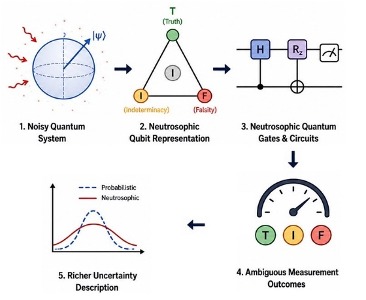
Quantum computing exploits superposition and entanglement to perform computations beyond the capabilities of classical machines. However, practical quantum systems operate under substantial environmental noise, measurement uncertainty, and decoherence, leading to ambiguous or partially determined quantum states. Conventional probabilistic descriptions capture stochastic behaviour but do not explicitly represent indeterminacy arising from incomplete information or measurement ambiguity. In this work, we introduce a neutrosophic representation of qubit states that integrates principles of Neutrosophic Logic with the mathematical framework of Quantum Computing. In the proposed model, a qubit is characterised by three independent parameters representing truth, indeterminacy, and falsity. This formulation enables explicit representation of ambiguous quantum states and uncertain measurement outcomes. We extend the neutrosophic formalism to quantum gate operations and analyse how the model captures uncertainty propagation in quantum circuits. Through theoretical examples and graphical analysis, we demonstrate that neutrosophic representation provides a richer description of uncertainty compared with conventional probabilistic approaches. The proposed framework offers a conceptual pathway for improved modelling of noisy intermediate-scale quantum devices and may contribute to the development of uncertainty-aware quantum computing architectures.
References
1. Ladd, T.D., F. Jelezko, R. Laflamme, Y. Nakamura, C. Monroe, and J.L. O’Brien, Quantum computers. nature. (2010).464(7285) 45-53.
2. Fauseweh, B., Quantum many-body simulations on digital quantum computers: State-of-the-art and future challenges. Nature Communications. (2024).15(1) 2123.
3. Saffman, M., Quantum computing with neutral atoms. National Science Review. (2019).6(1) 24-25.
4. Proctor, T., K. Young, A.D. Baczewski, and R. Blume-Kohout, Benchmarking quantum computers. Nature Reviews Physics. (2025).7(2) 105-118.
5. Nandhini, S., H. Singh, and U. Akash, An extensive review on quantum computers. Advances in Engineering Software. (2022).174103337.
6. Latten, T.M., M. Sand, and P.E. Vermaas, From Practice To Theory: Three Types of Influence of Quantum Technology on Quantum Mechanics and its Foundations. Foundations of Science. (2025)1-26.
7. Rietsche, R., C. Dremel, S. Bosch, L. Steinacker, M. Meckel, and J.-M. Leimeister, Quantum computing. Electronic Markets. (2022).32(4) 2525-2536.
8. Memon, Q.A., M. Al Ahmad, and M. Pecht, Quantum computing: Navigating the future of computation, challenges, and technological breakthroughs. Quantum Reports. (2024).6(4) 627-663.
9. Gill, S.S., O. Cetinkaya, S. Marrone, D. Claudino, D. Haunschild, L. Schlote, H. Wu, C. Ottaviani, X. Liu, and S.P. Machupalli, Quantum computing: Vision and challenges, in Quantum computing. 2025, Elsevier. p. 19-42.
10. Sood, V. and R.P. Chauhan, Archives of Quantum Computing: Research Progress and Challenges: V. Sood, RP Chauhan. Archives of Computational Methods in Engineering. (2024).31(1) 73-91.
11. Wang, Y., J.E. Kim, and K. Suresh, Opportunities and challenges of quantum computing for engineering optimization. Journal of Computing and Information Science in Engineering. (2023).23(6) 060817.
12. Herzallah, R. and A. Belfakir, From certainty to chance: probabilistic insights into quantum control. The European Physical Journal D. (2024).78(5) 63.
13. Paraskevas, A., Extended Event Calculus using Neutrosophic Logic: Method, Implementation, Analysis, Recent Progress and Future Directions. Neutrosophic Systems with Applications. (2024).1438-49.
14. Firdous, A. and H.K. Maryam, Neutrosophic Logic Reveals Ontological Indeterminacy in Quantum Systems. Journal of Engineering, Science and Technological Trends. (2025).2(3)
15. Biard, H., E. Moreno-Pineda, M. Ruben, E. Bonet, W. Wernsdorfer, and F. Balestro, Increasing the Hilbert space dimension using a single coupled molecular spin. Nature communications. (2021).12(1) 4443.
16. Soiguine, A., The 3-Sphere Instead of Hilbert Space. Journal of Applied Mathematics and Physics. (2022).102733-2742.
17. Filatov, S. and M. Auzinsh, Towards two bloch sphere representation of pure two-qubit states and unitaries. Entropy. (2024).26(4) 280.
18. Iaconis, J., S. Johri, and E.Y. Zhu, Quantum state preparation of normal distributions using matrix product states. npj Quantum Information. (2024).10(1) 15.
19. Tomaz, A.A., R.S. Mattos, and M. Barbatti, The quantum measurement problem: a review of recent trends. Philosophical Magazine. (2025)1-38.
20. Dyte, H.E., G. Gillard, S. Manna, S.F. Covre da Silva, A. Rastelli, and E.A. Chekhovich, Is wave function collapse necessary? explaining quantum nondemolition measurement of a spin qubit within linear evolution. Physical Review Letters. (2024).132(16) 160804.
21. Zenchuk, A.I., W. Qi, A. Kumar, and J. Wu, Matrix manipulations via unitary transformations and ancilla-state measurements. arXiv preprint arXiv:2311.11329. (2023)
22. Kasirajan, V., The quantum superposition principle and bloch sphere representation, in Fundamentals of Quantum Computing: Theory and Practice. 2021, Springer. p. 75-104.
23. Just, B., Quantum gates on one qubit, in Quantum Computing Compact: Spooky Action at a Distance and Teleportation Easy to Understand. 2023, Springer. p. 69-82.
24. Podoshvedov, S.A., Elementary quantum gates in different bases. Quantum Information Processing. (2016).15(10) 3967-3993.
25. Rau, A.R.P., G. Selvaraj, and D. Uskov, Four-level and two-qubit systems, subalgebras, and unitary integration. Physical Review A. (2005).71(6) 062316. 10.1103/PhysRevA.71.062316
26. Marceaux, J. and A. Rau, Mapping qubit algebras to combinatorial designs: JP Marceaux, ARP Rau. Quantum Information Processing. (2020).19(2) 49.
27. Fellous-Asiani, M., J.H. Chai, R.S. Whitney, A. Auffèves, and H.K. Ng, Limitations in quantum computing from resource constraints. PRX Quantum. (2021).2(4) 040335.
28. Desdentado, E., C. Calero, M.Á. Moraga, and F. García, Quantum computing software solutions, technologies, evaluation and limitations: a systematic mapping study: E. Desdentado et al. Computing. (2025).107(5) 110.
29. Al Adeh, F.F., Natural limitations of quantum computing. Int J Swarm Intel Evol Comput. (2017).6(152) 2.
30. Ajagekar, A. and F. You, Quantum computing for energy systems optimization: Challenges and opportunities. Energy. (2019).17976-89.
31. Zhou, Y., E.M. Stoudenmire, and X. Waintal, What limits the simulation of quantum computers? Physical Review X. (2020).10(4) 041038.
32. Pramanik, S., Single-valued neutrosophic set: An overview. Transdisciplinarity. (2022)563-608.
33. Fowler, A.G., Time-optimal quantum computation. arXiv preprint arXiv:1210.4626. (2012)
34. Klimov, P.V., A. Bengtsson, C. Quintana, A. Bourassa, S. Hong, A. Dunsworth, K.J. Satzinger, W.P. Livingston, V. Sivak, and M.Y. Niu, Optimizing quantum gates towards the scale of logical qubits. Nature Communications. (2024).15(1) 2442.
35. Colnaghi, T., G.M. DʼAriano, S. Facchini, and P. Perinotti, Quantum computation with programmable connections between gates. Physics Letters A. (2012).376(45) 2940-2943.
36. Bley, J., E. Rexigel, A. Arias, N. Longen, L. Krupp, M. Kiefer-Emmanouilidis, P. Lukowicz, A. Donhauser, S. Küchemann, and J. Kuhn, Visualizing entanglement in multiqubit systems. Physical Review Research. (2024).6(2) 023077.
37. Grigoryan, E., S. Kumar, and P.R. Pinheiro, A review on models and applications of quantum computing. Quantum Reports. (2025).7(3) 39.
38. Gu, X., J. Fernández-Pendás, P. Vikstål, T. Abad, C. Warren, A. Bengtsson, G. Tancredi, V. Shumeiko, J. Bylander, and G. Johansson, Fast multiqubit gates through simultaneous two-qubit gates. PRX Quantum. (2021).2(4) 040348.
39. Liu, W.Q., H.R. Wei, and L.C. Kwek, Universal Quantum Multi‐Qubit Entangling Gates with Auxiliary Spaces. Advanced Quantum Technologies. (2022).5(5) 2100136.
Downloads
Published
Issue
Section
Categories
License
Copyright (c) 2026 Muhammad Raza Sheikh (Author)

This work is licensed under a Creative Commons Attribution 4.0 International License.
How to Cite