Nature-Derived Polymers for Next-Generation Sustainable Electronics
DOI:
https://doi.org/10.64060/JESTT3i23Keywords:
Biodegradable electronics, Biopolymer nanocomposites, Flexible electronics, Green electronics, Natural polymers, Sustainable electronics, Transient electronics, Wearable sensorsAbstract
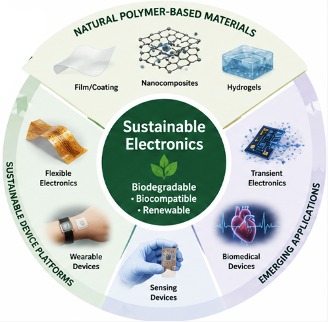
The rapid growth of modern electronic technologies has led to a significant increase in electronic waste, posing major environmental and sustainability challenges. Most conventional electronic devices rely on petroleum-based polymers that are non-biodegradable and environmentally persistent, creating an urgent need for sustainable material alternatives. Natural polymers derived from renewable biomass have emerged as promising candidates for next-generation sustainable electronics due to their biodegradability, biocompatibility, abundance, and low environmental impact. This perspective highlights recent progress in natural polymer-based electronic materials, including polysaccharide-based polymers, protein-based polymers, and natural polymer nanocomposites. Their applications in flexible and wearable electronics, transient electronics, and sustainable sensing devices are discussed. Key strategies such as molecular engineering, nanocomposite design, and green processing methods are explored to improve electrical performance and stability. Major challenges, including limited conductivity, moisture sensitivity, thermal stability, and device integration, are also addressed, along with future opportunities for developing fully biodegradable and environmentally friendly electronic systems.
References
1. Thacharodi, A., P. Singh, R. Meenatchi, Z. Tawfeeq Ahmed, R.R. Kumar, N. V, S. Kavish, M. Maqbool, and S. Hassan, Revolutionizing healthcare and medicine: The impact of modern technologies for a healthier future—A comprehensive review. Health Care Science. (2024).3(5) 329-349.
2. Wang, P., M. Hu, H. Wang, Z. Chen, Y. Feng, J. Wang, W. Ling, and Y. Huang, The evolution of flexible electronics: from nature, beyond nature, and to nature. Advanced Science. (2020).7(20) 2001116.
3. Madsen, K.E., M.T. Flavin, and J.A. Rogers, Materials advances for distributed environmental sensor networks at scale. Nature Reviews Materials. (2026).11(1) 26-49.
4. Yu, P.-J., Y.-C. Lin, and W.-C. Chen, Review of bioderived and biodegradable polymers/block-copolymers and their biomedical and electronic applications. Polymer Journal. (2025).57(3) 233-247.
5. Ates, B., S. Koytepe, A. Ulu, C. Gurses, and V.K. Thakur, Chemistry, structures, and advanced applications of nanocomposites from biorenewable resources. Chemical reviews. (2020).120(17) 9304-9362.
6. Heacock, M., C.B. Kelly, K.A. Asante, L.S. Birnbaum, Å.L. Bergman, M.-N. Bruné, I. Buka, D.O. Carpenter, A. Chen, and X. Huo, E-waste and harm to vulnerable populations: a growing global problem. Environmental health perspectives. (2015).124(5) 550.
7. Parvez, S.M., Electronic waste is a public health crisis that demands urgent action. Nature Human Behaviour. (2025).9(11) 2215-2216.
8. Sharma, B.K., A. Jha, D. Bhalani, S.A. Pillai, S. Pal, K. Patil, and K. Nagaraj, Advancements in bio-resource-based polymers and composites: sustainable alternatives to non-biodegradable plastics for a greener future: A review. Current Green Chemistry. (2025)
9. Kothawade, S.N., V.V. Pande, J. Suryawanshi, A. Kumar, P. Kumar, and A. Kumar, Biodegradable and Non-Biodegradable Sustainable Biomaterials, in Advances in Sustainable Biomaterials. 2024, CRC Press. p. 92-116.
10. Kamran, F., H. Afshar, and F. Shahi, Recent advances and applications of sustainable and recyclable polymers. Polymer Engineering & Science. (2025).65(8) 3845-3879.
11. Dey, S., G. Veerendra, P.A. Babu, A.P. Manoj, and K. Nagarjuna, Degradation of plastics waste and its effects on biological ecosystems: A scientific analysis and comprehensive review. Biomedical Materials & Devices. (2024).2(1) 70-112.
12. Rahimi, A. and J.M. García, Chemical recycling of waste plastics for new materials production. Nature Reviews Chemistry. (2017).1(6) 0046.
13. Law, K.L. and R. Narayan, Reducing environmental plastic pollution by designing polymer materials for managed end-of-life. Nature Reviews Materials. (2022).7(2) 104-116.
14. Silva, A.C., A.J. Silvestre, C. Vilela, and C.S. Freire, Natural polymers-based materials: A contribution to a greener future. Molecules. (2021).27(1) 94.
15. Samir, A., F.H. Ashour, A.A. Hakim, and M. Bassyouni, Recent advances in biodegradable polymers for sustainable applications. Npj Materials Degradation. (2022).6(1) 68.
16. Wu, L., X. Shi, and Z.S. Wu, Recent advancements and perspectives of biodegradable polymers for supercapacitors. Advanced Functional Materials. (2023).33(16) 2211454.
17. Teixeira, S.C., N.O. Gomes, T.V. de Oliveira, P. Fortes-Da-Silva, N.d.F.F. Soares, and P.A. Raymundo-Pereira, Review and Perspectives of sustainable, biodegradable, eco-friendly and flexible electronic devices and (Bio) sensors. Biosensors and Bioelectronics: X. (2023).14100371.
18. Ozlu, B., M.B. Ahmed, R.M. Muthoka, Z. Wen, Y. Bea, J.H. Youk, Y. Lee, M.H. Yoon, and B.S. Shim, Naturally derived electrically active materials for eco-friendly electronics. Materials Today Advances. (2024).21100470.
19. Gonçalves, R., J. Serra, A. Reizabal, D. Correia, L. Fernandes, R. Brito-Pereira, E. Lizundia, C. Costa, and S. Lanceros-Méndez, Biobased polymers for advanced applications: Towards a sustainable future. Progress in Polymer Science. (2025).162101934.
20. Li, Z. and Z. Lin, Recent advances in polysaccharide‐based hydrogels for synthesis and applications. Aggregate. (2021).2(2) e21.
21. Sahu, A., M. Adnan Raza, N. Khatoon, M.K. Sharma, and Ajazuddin, Polysaccharide-based polymers for designing thermoresponsive hydrogels for treating wound healing. ACS Applied Bio Materials. (2025).8(12) 10549-10575.
22. Shaghaleh, H., X. Xu, and S. Wang, Current progress in production of biopolymeric materials based on cellulose, cellulose nanofibers, and cellulose derivatives. RSC advances. (2018).8(2) 825-842.
23. Ye, Y., L. Yu, E. Lizundia, Y. Zhu, C. Chen, and F. Jiang, Cellulose-based ionic conductor: an emerging material toward sustainable devices. Chemical Reviews. (2023).123(15) 9204-9264.
24. Klemm, D., B. Heublein, H.P. Fink, and A. Bohn, Cellulose: fascinating biopolymer and sustainable raw material. Angewandte chemie international edition. (2005).44(22) 3358-3393.
25. Suginta, W., P. Khunkaewla, and A. Schulte, Electrochemical biosensor applications of polysaccharides chitin and chitosan. Chemical reviews. (2013).113(7) 5458-5479.
26. Song, J., H. Liu, Z. Zhao, P. Lin, and F. Yan, Flexible organic transistors for biosensing: devices and applications. Advanced Materials. (2024).36(20) 2300034.
27. Chauhan, S. and A. Thakur, Chitosan-based biosensors-A comprehensive Review. Materials Today: Proceedings. (2023)
28. Xiang, H., Z. Li, H. Liu, T. Chen, H. Zhou, and W. Huang, Green flexible electronics based on starch. npj Flexible Electronics. (2022).6(1) 15.
29. Teng, K., Q. An, Y. Chen, Y. Zhang, and Y. Zhao, Recent development of alginate-based materials and their versatile functions in biomedicine, flexible electronics, and environmental uses. ACS Biomaterials Science & Engineering. (2021).7(4) 1302-1337.
30. Miserez, A., J. Yu, and P. Mohammadi, Protein-based biological materials: molecular design and artificial production. Chemical reviews. (2023).123(5) 2049-2111.
31. Yorke, S.K., Z. Yang, E.G. Wiita, A. Kamada, T.P. Knowles, and M.J. Buehler, Design and sustainability of polypeptide material systems. Nature Reviews Materials. (2025).10(10) 750-768.
32. Wen, D.-L., D.-H. Sun, P. Huang, W. Huang, M. Su, Y. Wang, M.-D. Han, B. Kim, J. Brugger, and H.-X. Zhang, Recent progress in silk fibroin-based flexible electronics. Microsystems & nanoengineering. (2021).7(1) 35.
33. Huang, W., S. Ling, C. Li, F.G. Omenetto, and D.L. Kaplan, Silkworm silk-based materials and devices generated using bio-nanotechnology. Chemical Society Reviews. (2018).47(17) 6486-6504.
34. Alipal, J., N.M. Pu'Ad, T.C. Lee, N. Nayan, N. Sahari, H. Basri, M. Idris, and H. Abdullah, A review of gelatin: Properties, sources, process, applications, and commercialisation. Materials Today: Proceedings. (2021).42240-250.
35. Liu, X., C. Zheng, X. Luo, X. Wang, and H. Jiang, Recent advances of collagen-based biomaterials: Multi-hierarchical structure, modification and biomedical applications. Materials Science and Engineering: C. (2019).991509-1522.
36. Zhang, X., J. Liu, L. Li, X. Zheng, K. Tang, and Y. Pei, Collagen‐Based Flexible Electronic Devices for Electrochemical Energy Storage and Sensing. Macromolecular Rapid Communications. (2023).44(10) 2200977.
37. Gao, D., J. Lv, and P.S. Lee, Natural polymer in soft electronics: opportunities, challenges, and future prospects. Advanced Materials. (2022).34(25) 2105020.
38. Cui, X., M. Wu, X. Liu, B. He, Y. Zhu, Y. Jiang, and Y. Yang, Engineering organic polymers as emerging sustainable materials for powerful electrocatalysts. Chemical Society Reviews. (2024).53(3) 1447-1494.
39. Rouf, T.B. and J.L. Kokini, Biodegradable biopolymer–graphene nanocomposites. Journal of Materials Science. (2016).51(22) 9915-9945.
40. Sharma, S., B. Sharma, and P. Jain, Graphene based biopolymer nanocomposites in sensors, in Graphene Based Biopolymer Nanocomposites. 2020, Springer. p. 273-286.
41. Zhang, X., W. Lu, G. Zhou, and Q. Li, Understanding the mechanical and conductive properties of carbon nanotube fibers for smart electronics. Advanced Materials. (2020).32(5) 1902028.
42. Fenta, E.W. and B.A. Mebratie, Advancements in carbon nanotube-polymer composites: Enhancing properties and applications through advanced manufacturing techniques. Heliyon. (2024).10(16)
43. Metz, K.M., S.E. Sanders, J.P. Pender, M.R. Dix, D.T. Hinds, S.J. Quinn, A.D. Ward, P. Duffy, R.J. Cullen, and P.E. Colavita, Green synthesis of metal nanoparticles via natural extracts: the biogenic nanoparticle corona and its effects on reactivity. ACS Sustainable Chemistry & Engineering. (2015).3(7) 1610-1617.
44. Musa, A.A., A. Bello, S.M. Adams, A.P. Onwualu, V.C. Anye, K.A. Bello, and I.I. Obianyo, Nano-enhanced polymer composite materials: a review of current advancements and challenges. Polymers. (2025).17(7) 893.
45. Hui, Z., L. Zhang, G. Ren, G. Sun, H.D. Yu, and W. Huang, Green flexible electronics: natural materials, fabrication, and applications. Advanced Materials. (2023).35(28) 2211202.
46. Li, W., Q. Liu, Y. Zhang, C.a. Li, Z. He, W.C. Choy, P.J. Low, P. Sonar, and A.K.K. Kyaw, Biodegradable materials and green processing for green electronics. Advanced materials. (2020).32(33) 2001591.
47. Baeg, K.J. and J. Lee, Flexible electronic systems on plastic substrates and textiles for smart wearable technologies. Advanced Materials Technologies. (2020).5(7) 2000071.
48. Xu, K., Y. Lu, and K. Takei, Multifunctional skin‐inspired flexible sensor systems for wearable electronics. Advanced Materials Technologies. (2019).4(3) 1800628.
49. Min, J., Y. Jung, J. Ahn, J.G. Lee, J. Lee, and S.H. Ko, Recent advances in biodegradable green electronic materials and sensor applications. Advanced Materials. (2023).35(52) 2211273.
50. Alam, M.W., S. Islam Bhat, H.S. Al Qahtani, M. Aamir, M.N. Amin, M. Farhan, S. Aldabal, M.S. Khan, I. Jeelani, and A. Nawaz, Recent progress, challenges, and trends in polymer-based sensors: a review. Polymers. (2022).14(11) 2164.
51. Wang, C., T. Yokota, and T. Someya, Natural biopolymer-based biocompatible conductors for stretchable bioelectronics. Chemical Reviews. (2021).121(4) 2109-2146.
52. Shaji, S., A. Anna, S. Kiran, A. Aboobaker, A.J. Varghese, P. Nancy, L. Ravindran, and S. Thomas, Review on sustainable flexible electronics: exploring the potential of chitosan, cellulose starch, silk fibroin and gelatin. Discover Polymers. (2025).2(1) 19.
53. Fu, K.K., Z. Wang, J. Dai, M. Carter, and L. Hu, Transient electronics: materials and devices. Chemistry of Materials. (2016).28(11) 3527-3539.
54. Han, W.B., J.H. Lee, J.W. Shin, and S.W. Hwang, Advanced materials and systems for biodegradable, transient electronics. Advanced Materials. (2020).32(51) 2002211.
55. Fan, X., B. Jiao, X. Zhou, W. Zhang, and Z. Ouyang, Miniaturization of Mass Spectrometry Systems: An Overview of Recent Advancements and a Perspective on Future Directions. Analytical Chemistry. (2025).97(17) 9111-9125.
56. Stephen, M., A. Nawaz, S.Y. Lee, P. Sonar, and W.L. Leong, Biodegradable materials for transient organic transistors. Advanced Functional Materials. (2023).33(6) 2208521.
57. Mirzajani, H., P. Zolfaghari, S. Akbari Nakhjavani, B.Y. Koca, M. Khodapanahandeh, and H. Urey, Transient implantable electronics for postsurgery preventive medicine. Advanced Functional Materials. (2025).35(3) 2413324.
58. Jamshidi, R., M. Taghavimehr, Y. Chen, N. Hashemi, and R. Montazami, Transient electronics as sustainable systems: from fundamentals to applications. Advanced Sustainable Systems. (2022).6(2) 2100057.
59. Nath, N., S. Chakroborty, D.P. Vishwakarma, G. Goga, A.S. Yadav, and R. Mohan, Recent advances in sustainable nature-based functional materials for biomedical sensor technologies. Environmental Science and Pollution Research. (2024).31(46) 57289-57313.
60. Kaushal, J.B., P. Raut, and S. Kumar, Organic electronics in biosensing: a promising frontier for medical and environmental applications. Biosensors. (2023).13(11) 976.
61. Mamun, M.A.A. and M.R. Yuce, Recent progress in nanomaterial enabled chemical sensors for wearable environmental monitoring applications. Advanced Functional Materials. (2020).30(51) 2005703.
62. Norrrahim, M.N.F., V.F. Knight, N.M. Nurazzi, M.A. Jenol, M.S.M. Misenan, N. Janudin, N.A.M. Kasim, M.F.A. Shukor, R.A. Ilyas, and M.R.M. Asyraf, The frontiers of functionalized nanocellulose-based composites and their application as chemical sensors. Polymers. (2022).14(20) 4461.
63. Panigrahi, P.K., B. Chandu, and N. Puvvada, Recent advances in nanostructured materials for application as gas sensors. ACS omega. (2024).9(3) 3092-3122.
64. Raghav, G., S. Moolayadukkam, N.R. Thomas, and G. George, Two‐Dimensional Nanomaterials‐Based Polymer Nanocomposites for Gas and Volatile Organic Compound Sensing. Two‐Dimensional Nanomaterials‐Based Polymer Nanocomposites: Processing, Properties and Applications. (2024)713-741.
65. Dutta, P. and G. Gupta, Environmental gas sensors based on electroactive hybrid organic–inorganic nanocomposites using nanostructured materials. Physical Chemistry Chemical Physics. (2022).24(47) 28680-28699.
66. Arman Kuzubasoglu, B., Recent studies on the humidity sensor: A mini review. ACS Applied Electronic Materials. (2022).4(10) 4797-4807.
67. Zhao, L., Y. Zhou, J. Zhang, H. Liang, X. Chen, and H. Tan, Natural polymer-based hydrogels: From polymer to biomedical applications. Pharmaceutics. (2023).15(10) 2514.
68. Kamoun, E.A., M. Elsabahy, A.M. Mohamed Elbadry, E.B. Abdelazim, A.A. Mohsen, M. A. Aleem, H. Gao, N.G. Eissa, I. Elghamry, and S.A. Salim, Recent progress of polymer-based biosensors for cancer diagnostic applications: natural versus synthetic polymers. ACS omega. (2025).10(9) 8816-8831.
69. Shaheen, A., N. Anwar, F. Chen, Y. Chan, H. Xie, and S.L. Lee, Materials interface engineering: impact of interfacial molecular orientation on organic electronic devices. Advanced Functional Materials. (2025).35(47) 2505173.
70. Zeng, H., Y. Xie, T. Liu, Z. Chu, E. Dempsey, and W. Jin, Conductive polymer nanocomposites: recent advances in the construction of electrochemical biosensors. Sensors & Diagnostics. (2024).3(2) 165-180.
71. Yang, J., Y. Chen, L. Zhao, J. Zhang, and H. Luo, Constructions and properties of physically cross-linked hydrogels based on natural polymers. Polymer Reviews. (2023).63(3) 574-612.
72. Asih, G.I.N., A.F. Rafryanto, S. Hartati, X. Jiang, A. Anggraini, A. Yudhowijoyo, and J. Jiang, Recent advances of polymer nanocomposites in emerging applications. Composite Functional Materials. (2025).1(1) 20250105.
73. Wang, M., Z. Deng, Y. Guo, and P. Xu, Engineering functional natural polymer-based nanocomposite hydrogels for wound healing. Nanoscale Advances. (2023).5(1) 27-45.
74. Shubhadarshinee, L., P. Mohapatra, S. Behera, B.R. Jali, P. Mohapatra, and A.K. Barick, Review on synthesis and characterization of metal nanoparticles doped carbon nanofillers based nanohybrids reinforced polyaniline nanocomposites. Polymer-Plastics Technology and Materials. (2024).63(8) 1011-1035.
75. Afzal, U., K. Wang, J. Liang, Z. Ma, Y. Wang, J. Wu, A. Fatima, L. Zhang, and Z. Wang, Chemical engineering for advanced flexible sensors: Novel carbon-metal oxide nanocomposites with superior multi-sensing behavior. Sensors and Actuators B: Chemical. (2025).431137449.
76. Wang, Y., S. Lu, W. He, S. Gong, Y. Zhang, X. Zhao, Y. Fu, and Z. Zhu, Modeling and characterization of the electrical conductivity on metal nanoparticles/carbon nanotube/polymer composites. Scientific Reports. (2022).12(1) 10448.
77. Wang, S., Z. Luo, J. Liang, J. Hu, N. Jiang, J. He, and Q. Li, Polymer nanocomposite dielectrics: understanding the matrix/particle interface. ACS nano. (2022).16(9) 13612-13656.
78. Khdier, H.M., K.A.F. Husham, W.M. Shali, and H.A. Al-Atabi. Interfacial effects on mechanical, thermal and electrical properties of polymer-based nanocomposites: a review. in Annales de Chimie. Science des Materiaux. 2024. International Information and Engineering Technology Association (IIETA).
79. El Itawi, H., S. Fadlallah, F. Allais, and P. Perré, Green assessment of polymer microparticles production processes: a critical review. Green Chemistry. (2022).24(11) 4237-4269.
80. Mondal, A., R.K. Singh, and A. Sinhamahapatra, Green and sustainable separation processes for environmental and chemical engineering, in Advances in separation sciences. 2025, Elsevier. p. 457-479.
81. Khan, M., M.F.A.D. Refati, M.M.R. Arup, M.A. Islam, and M.H. Mobarak, Conductive polymer‐based electronics in additive manufacturing: Materials, processing, and applications. Advances in Polymer Technology. (2025).2025(1) 4234491.
82. Tan, P., H. Wang, F. Xiao, X. Lu, W. Shang, X. Deng, H. Song, Z. Xu, J. Cao, and T. Gan, Solution-processable, soft, self-adhesive, and conductive polymer composites for soft electronics. Nature communications. (2022).13(1) 358.
Downloads
Published
Issue
Section
Categories
License
Copyright (c) 2026 Aqsa Nadeem, Asim Ullah (Author)

This work is licensed under a Creative Commons Attribution 4.0 International License.
How to Cite