Role of Pectinases and Carbohydrate-Degrading Enzymes in Biosensing Applications
DOI:
https://doi.org/10.64060/JESTT3i25Keywords:
Biosensing, Carbohydrate-Active Enzymes, Enzyme Engineering, Nanomaterials, PectinaseAbstract
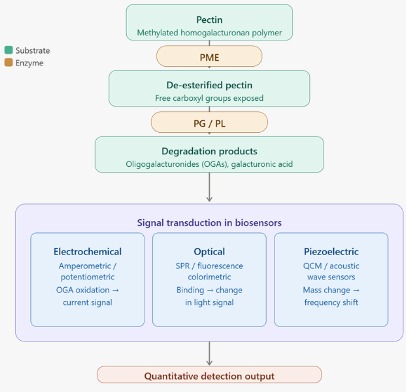
Enzyme-based biosensors have emerged as powerful analytical platforms for transforming specific biochemical interactions into measurable signals, enabling rapid, sensitive, and selective monitoring across healthcare, food safety, environmental analysis, and industrial biotechnology. However, current enzyme biosensing research has predominantly focused on oxidoreductases, while carbohydrate-active enzymes (CAZymes) remain comparatively underexplored despite their exceptional substrate specificity and catalytic diversity. This review provides a comprehensive overview of carbohydrate-degrading enzyme-based biosensors, highlighting their fundamental mechanisms, sensing strategies, and future technological opportunities. Particular emphasis is placed on pectinases, including pectin methylesterase, polygalacturonase, and pectin lyase, which offer unique capabilities for detecting pectin degradation, plant physiological changes, food quality deterioration, and environmental processes. The catalytic principles of these enzymes, their production approaches, and their integration with electrochemical, optical, piezoelectric, and colourimetric transduction systems are systematically discussed. Furthermore, advanced immobilisation approaches involving nanomaterials, microfluidic architectures, and hybrid enzyme–nanozyme systems are examined to address challenges associated with enzyme instability, sensitivity, matrix interference, and reproducibility. Emerging concepts including artificial intelligence-assisted biosensing, wearable sensing platforms, multiplex detection, and sustainable biodegradable sensor designs are also explored as pathways toward next-generation intelligent biosensors. Despite significant progress, practical translation remains limited by substrate variability, large-scale manufacturing challenges, and insufficient standardisation. Future advances in enzyme engineering, smart data analysis, and integrated sensing technologies are expected to establish robust, portable, and environmentally sustainable biosensing platforms. This review provides critical insights into the development of advanced CAZyme-based biosensors and their potential role in shaping future intelligent analytical systems.
References
1. Gao, W., et al., Recent advances in biosensors: Structure, principles, classification, and application in bio-manufacturing. Methods, 2025. 242: p. 123-142.
2. Sharma, S., R. Butola, and J. Kumar, Transforming Industry: The Role of Biosensors in Enhancing Efficiency, Safety, and Sustainability. ECS Journal of Solid State Science and Technology, 2025. 14(5): p. 057001.
3. Guo, J., et al., Effect of deep eutectic solvents on the activity and stability of cellulases and pectinases. ACS omega, 2023. 8(48): p. 45678-45686.
4. Khor, S.M., et al., Challenges and strategies in developing an enzymatic wearable sweat glucose biosensor as a practical point-of-care monitoring tool for type II diabetes. Nanomaterials, 2022. 12(2): p. 221.
5. Elgiddawy, N. and H.M.E.-S. Azzazy, Carbohydrate-based biosensors for enhanced pathogen detection. Analytical and Bioanalytical Chemistry, 2025: p. 1-22.
6. Eivazzadeh-Keihan, R., et al., Recent advances on biomedical applications of pectin-containing biomaterials. International journal of biological macromolecules, 2022. 217: p. 1-18.
7. Wijayanti, S.D., L. Tsvik, and D. Haltrich, Recent advances in electrochemical enzyme-based biosensors for food and beverage analysis. Foods, 2023. 12(18): p. 3355.
8. Wang, X., J. Zhou, and H. Wang, Bioreceptors as the key components for electrochemical biosensing in medicine. Cell Reports Physical Science, 2024. 5(2).
9. Khaleque, M.A., et al., Bioreceptor modified electrochemical biosensors for the detection of life threating pathogenic bacteria: a review. RSC advances, 2024. 14(39): p. 28487-28515.
10. Assudani, P.J., et al., Biosensing technologies for foodborne pathogen detection and healthcare: principles, emerging materials, and intelligent platforms. Microchimica Acta, 2026. 193(4): p. 231.
11. Singh, R., et al., Advancements in glucose biosensors: Innovations for wearable and real-time monitoring. Talanta, 2025: p. 129045.
12. Chen, K., et al., Exploring nucleic acid nanozymes: a new frontier in biosensor development. Biosensors, 2025. 15(3): p. 142.
13. Zhao, J., et al., The advancement of biosensor design and construction utilizing biomolecular motors. Synthetic and Systems Biotechnology, 2025. 10(2): p. 543-554.
14. Hussain, A., et al., Recent Advances in Integrating Graphene into Polymeric Nanocomposite Hydrogels for Biomedical Applications. Macromolecular Bioscience, 2026. 26(2): p. e00553.
15. Malode, S.J., et al., Bio-based nanomaterials for smart and sustainable nano-biosensing and therapeutics. Industrial Crops and Products, 2025. 234: p. 121603.
16. Khumngern, S. and I. Jeerapan, Synergistic convergence of materials and enzymes for biosensing and self-sustaining energy devices towards on-body health monitoring. Communications Materials, 2024. 5(1): p. 135.
17. Melo, R.L.F., et al., A comprehensive review on enzyme-based biosensors: advanced analysis and emerging applications in nanomaterial-enzyme linkage. International Journal of Biological Macromolecules, 2024. 264: p. 130817.
18. Kausaite-Minkstimiene, A., et al., An amperometric enzyme–nanozyme biosensor for glucose detection. Biosensors, 2025. 15(8): p. 545.
19. Kumar, A. and P. Maiti, based sustainable biosensors. Materials Advances, 2024. 5(9): p. 3563-3586.
20. Nazreen, A., et al. Biopolymers-based Electrochemical Sensors: An Overview of Synthesis and Applications. in Acta Biol. Forum. 2024.
21. Guoqiang, G., et al., Recent advances in glucose monitoring utilizing oxidase electrochemical biosensors integrating carbon-based nanomaterials and smart enzyme design. Frontiers in Chemistry, 2025. 13: p. 1591302.
22. Williams, A., et al., Biosensors for public health and environmental monitoring: the case for sustainable biosensing. ACS sustainable chemistry & engineering, 2024. 12(28): p. 10296-10312.
23. Sun, G., et al., Immobilization of enzyme electrochemical biosensors and their application to food bioprocess monitoring. Biosensors, 2023. 13(9): p. 886.
24. Han, Y., J. Wei, and W. Feng, Hybrid of glucose oxidase and enzyme-like Cu&Ce: Efficient glucose scavenging and generation of hydroxyl, hydroperoxyl, and superoxide radicals for wound healing. Materials Today Bio, 2025. 32: p. 101888.
25. Jung, H.H., et al., Wearable electrochemical sensors for real-time monitoring in diabetes mellitus and associated complications. 2024.
26. Harun-Or-Rashid, M., et al., Advances in electrochemical sensors for real-time glucose monitoring. Sensors & Diagnostics, 2024. 3(6): p. 893-913.
27. Yan, Y., et al., Bacterial cellulose as a promising biodegradable bioplastic for sustainability. Nature Communications, 2026.
28. Zahedi, A., R. Liyanapathirana, and K. Thiyagarajan, Biodegradable and renewable antennas for green iot sensors: a review. IEEE Access, 2024. 12: p. 189749-189775.
29. Gokhale, N.A., S.N. Joglekar, and S. Panda, Life cycle assessment of enzymatic and non-enzymatic electrochemical sensors: A comparative study using glucose oxidase and metal nano-catalysts. Journal of Cleaner Production, 2025. 522: p. 146327.
30. Ayoib, A., Hybrid nanomaterials in biosensors for advanced point-of-care diagnostics: DNA-, enzyme-, or immunosensor-based, for healthcare, in Hybrid-nanomaterials: Fabrication, characterization and applications. 2024, Springer. p. 123-153.
31. Fan, Y.-F., Z.-B. Guo, and G.-B. Ge, Enzyme-based biosensors and their applications. 2023, MDPI. p. 476.
32. Jiao, B., Applications of Electrochemical Biosensors across Medical, Environmental and Food Safety Fields. MedScien, 2025. 1(5).
33. Mousavian, Z., et al., Recent Advances in Development of Biosensors for Monitoring of Airborne Microorganisms. Iranian Journal of Biotechnology, 2024. 22(2): p. e3722.
34. Upadhaya, A., et al., Nanoparticle-Enabled Portable Biosensors for Early Detection and Monitoring of Non-Communicable Diseases: A Focus on Diabetes, Cardiovascular, and Cancer Diagnostics. Biosensors and Bioelectronics: X, 2025: p. 100675.
35. Huang, C.-W., et al., A review of biosensor for environmental monitoring: principle, application, and corresponding achievement of sustainable development goals. Bioengineered, 2023. 14(1): p. 58-80.
36. Bains, R.K., et al., Advances in the understanding and exploitation of carbohydrate-active enzymes. Current Opinion in Chemical Biology, 2024. 80: p. 102457.
37. Kaur, D., et al., Pectinases as promising green biocatalysts having broad‐spectrum applications: Recent trends, scope, and relevance. Biotechnology and Applied Biochemistry, 2023. 70(5): p. 1663-1678.
38. Lzaod, S. and T. Dutta, Recent advances in the development of oxidoreductase-based biosensors for detection of phenolic antioxidants in food and beverages. ACS omega, 2022. 7(51): p. 47434-47448.
39. Wardman, J.F. and S.G. Withers, Carbohydrate-active enzyme (CAZyme) discovery and engineering via (Ultra) high-throughput screening. RSC Chemical Biology, 2024. 5(7): p. 595-616.
40. Patel, V.B., S. Chatterjee, and A.S. Dhoble, A review on pectinase properties, application in juice clarification, and membranes as immobilization support. Journal of Food Science, 2022. 87(8): p. 3338-3354.
41. Kurup, C.P. and M.U. Ahmed, Nanozymes towards personalized diagnostics: a recent progress in biosensing. Biosensors, 2023. 13(4): p. 461.
42. Abrantes-Coutinho, V.E., et al., Systematic review on lectin-based electrochemical biosensors for clinically relevant carbohydrates and glycoconjugates. Colloids and Surfaces B: Biointerfaces, 2021. 208: p. 112148.
43. Roman-Benn, A., et al., Pectin: An overview of sources, extraction and applications in food products, biomedical, pharmaceutical and environmental issues. Food Chemistry Advances, 2023. 2: p. 100192.
44. Hrmova, M. and J.G. Schwerdt, Molecular mechanisms of processive glycoside hydrolases underline catalytic pragmatism. Biochemical Society Transactions, 2023. 51(3): p. 1387-1403.
45. Cannac, N., et al., A QCM-D-based continuous assay for the study of the enzymatic degradation of insoluble calcium-polygalacturonate. Carbohydrate Polymers, 2025. 364: p. 123759.
46. Bykhovsky, D., Coherence time evaluation in indoor optical wireless communication channels. Sensors, 2020. 20(18): p. 5067.
47. Dong, Y., et al., Enzyme-responsive controlled-release materials for food preservation and crop protection-A review. International Journal of Biological Macromolecules, 2024. 254: p. 128051.
48. Abd El-Aziz, N.M., et al., RETRACTED ARTICLE: Enhancement of novel Endo-polygalacturonase expression in Rhodotorula mucilaginosa PY18: insights from mutagenesis and molecular docking. Microbial Cell Factories, 2023. 22(1): p. 252.
49. Gallemí, M., et al., Dual role of pectin methyl esterase activity in the regulation of plant cell wall biophysical properties. Frontiers in Plant Science, 2025. 16: p. 1612366.
50. Yadav, K., et al., Recent insights into microbial pectin lyases: a review. Process Biochemistry, 2023. 134: p. 199-217.
51. Mallick, P., et al., Revisiting interactions between polygalacturonases and polygalacturonase-inhibiting proteins and their effects on plant health: a review. Frontiers in Plant Science, 2025. 16: p. 1691420.
52. Stanek-Wandzel, N., et al., Evaluation of cellulase, pectinase, and hemicellulase effectiveness in extraction of phenolic compounds from grape pomace. International journal of molecular sciences, 2024. 25(24): p. 13538.
53. Li, P., et al., Improvement of optimum pH and specific activity of pectate lyase from Bacillus RN. 1 using loop replacement. Frontiers in Bioengineering and Biotechnology, 2023. 11: p. 1242123.
54. Chandel, V., et al., Current advancements in pectin: Extraction, properties and multifunctional applications. Foods, 2022. 11(17): p. 2683.
55. Rößling, A.-K., et al., Pectin methylesterase activity is required for RALF1 peptide signalling output. Elife, 2024. 13: p. RP96943.
56. Zhang, H. and F.-Q. Yang, A paper-based lateral flow strip assay based on enzyme-mediated pectin viscosity change for the determination of polygalacturonase activity. Microchemical Journal, 2023. 186: p. 108322.
57. Alqahtani, Y.S., et al., Production and purification of pectinase from Bacillus subtilis 15A-B92 and its biotechnological applications. Molecules, 2022. 27(13): p. 4195.
58. Pathan, S.U., et al., Enzymes as indispensable markers in disease diagnosis. Bioanalysis, 2024. 16(10): p. 485-497.
59. Singh, R., et al., A review on recent trends and future developments in electrochemical sensing. ACS omega, 2024. 9(7): p. 7336-7356.
60. Naresh, V. and N. Lee, A review on biosensors and recent development of nanostructured materials-enabled biosensors. Sensors, 2021. 21(4): p. 1109.
61. Chen, C. and J. Wang, Optical biosensors: An exhaustive and comprehensive review. Analyst, 2020. 145(5): p. 1605-1628.
62. Zhou, J., et al., Recent advances in design and application of nanomaterials-based colorimetric biosensors for agri-food safety analysis. ACS omega, 2023. 8(49): p. 46346-46361.
63. Pohanka, M., Piezoelectric chemosensors and biosensors in medical diagnostics. Biosensors, 2025. 15(3): p. 197.
64. Skládal, P., Piezoelectric biosensors: shedding light on principles and applications. Microchimica Acta, 2024. 191(4): p. 184.
65. Sonowal, K., P.P. Borthakur, and K. Pathak, Advances in Enzyme-Based Biosensors: Emerging Trends and Applications. Engineering Proceedings, 2025. 106(1): p. 5.
66. Sadani, K., et al., Enzymatic optical biosensors for healthcare applications. Biosensors and Bioelectronics: X, 2022. 12: p. 100278.
67. Majer-Baranyi, K., A. Székács, and N. Adányi, Application of electrochemical biosensors for determination of food spoilage. Biosensors, 2023. 13(4): p. 456.
68. Li, D., et al., Ripening induced degradation of pectin and cellulose affects the far infrared drying kinetics of mangoes. Carbohydrate Polymers, 2022. 291: p. 119582.
69. Navarro-López, D.E., et al., Nanocatalytic performance of pectinase immobilized over in situ prepared magnetic nanoparticles. Heliyon, 2023. 9(8).
70. Said, N.S. and W.Y. Lee, Pectin-based active and smart film packaging: a comprehensive review of recent advancements in antimicrobial, antioxidant, and smart colorimetric systems for enhanced food preservation. Molecules, 2025. 30(5): p. 1144.
71. Liu, Y., et al., A highly sensitive, accurate, and stable method for measuring pectin depolymerase activity. Food Chemistry, 2025. 463: p. 141229.
72. Nazari-Vanani, R. and M. Negahdary, Recent advances in electrochemical aptasensors and genosensors for the detection of pathogens. Environmental Research, 2024. 243: p. 117850.
73. Gao, S., et al., Magnetic nanoparticle‐based immunosensors and aptasensors for mycotoxin detection in foodstuffs: An update. Comprehensive Reviews in Food Science and Food Safety, 2024. 23(1): p. e13266.
74. Guan, Y., et al., Recent advances in microbial whole-cell biosensors for detecting food contaminants: a review. Food Control, 2025: p. 111674.
75. Bergman, G.Ö., et al., Engineering chimeric signaling proteins for microbial whole-cell biosensors: from design to deployment. Trends in Biotechnology, 2025.
76. Feng, Y., et al., Advancing food safety surveillance: rapid and sensitive biosensing technologies for foodborne pathogenic bacteria. Foods, 2025. 14(15): p. 2654.
77. Basu, S. and G. Bisker, Near‐Infrared Fluorescent Single‐Walled Carbon Nanotubes for Biosensing. Small, 2025. 21(26): p. 2502542.
78. Wang, F., et al., Application of immobilized enzymes in juice clarification. Foods, 2023. 12(23): p. 4258.
79. Hasanah, U., et al., Construction of a hydrogel pectin-based triglyceride optical biosensor with immobilized lipase enzymes. Biosensors, 2019. 9(4): p. 135.
80. Zhao, M., et al., Advances in Pectinase Engineering for Food Bioprocessing: Novel Sources, Mechanisms, and Optimization Strategies. Journal of Agricultural and Food Chemistry, 2025. 73(37): p. 23078-23097.
81. Mustafa, F., S. Liebich, and S. Andreescu, Nanoparticle-based amplification for sensitive detection of β-galactosidase activity in fruits. Analytica Chimica Acta, 2021. 1186: p. 339129.
82. Zhao, Z., et al., Recent advances in MXene-based electrochemical sensors. Biosensors, 2025. 15(2): p. 107.
83. Ali, M., et al., Unlocking the Potential of MXene‐Based Electrochemical Biosensors: A Review of Biofunctionalization Strategies and Biosensing Principles. Advanced Materials Technologies, 2026. 11(12): p. e02120.
84. Fakhr, M.H., et al., Recent advances in wearable electrochemical biosensors towards technological and material aspects. Biosensors and Bioelectronics: X, 2024. 19: p. 100503.
85. Zhu, S., et al., AI-assisted molecular biosensors: design strategies for wearable and real-time monitoring. International Journal of Molecular Sciences, 2026. 27(7): p. 3305.
86. Abdel-Mageed, H.M., Frontiers in nanoparticles redefining enzyme immobilization: a review addressing challenges, innovations, and unlocking sustainable future potentials. Micro and Nano Systems Letters, 2025. 13(1): p. 7.
87. Baruah, A., et al., Biomedical applications of graphene-based nanomaterials: recent progress, challenges, and prospects in highly sensitive biosensors. Discover Nano, 2024. 19(1): p. 103.
88. Zhang, J., et al., Emerging biosensors integrated with microfluidic devices: a promising analytical tool for on-site detection of mycotoxins. npj Science of Food, 2025. 9(1): p. 84.
89. Weston, M., et al., Anthocyanin-based sensors derived from food waste as an active use-by date indicator for milk. Food Chemistry, 2020. 326: p. 127017.
90. Bhatlawande, A.R., et al., Unlocking the future of smart food packaging: biosensors, IoT, and nano materials: AR Bhatlawande et al. Food Science and Biotechnology, 2024. 33(5): p. 1075-1091.
91. Meliana, C., et al., Biosensor in smart food traceability system for food safety and security. Bioengineered, 2024. 15(1): p. 2310908.
92. Ayenimo, J.G. and S.B. Adeloju, Amperometric detection of glucose in fruit juices with polypyrrole-based biosensor with an integrated permselective layer for exclusion of interferences. Food chemistry, 2017. 229: p. 127-135.
93. Lipińska, W., K. Grochowska, and K. Siuzdak, Enzyme immobilization on gold nanoparticles for electrochemical glucose biosensors. Nanomaterials, 2021. 11(5): p. 1156.
94. Abdullah, A., et al., Microfluidic based impedance biosensor for pathogens detection in food products. Electrophoresis, 2019. 40(4): p. 508-520.
95. Wang, B., D. Huang, and Z. Weng, Recent advances in polymer-based biosensors for food safety detection. Polymers, 2023. 15(15): p. 3253.
96. Bucur, B., et al., Advances in enzyme-based biosensors for pesticide detection. Biosensors, 2018. 8(2): p. 27.
97. Valenzuela-Amaro, H.M., et al., Emerging applications of nanobiosensors in pathogen detection in water and food. Biosensors, 2023. 13(10): p. 922.
98. Gan, Q., et al., Advancing lignocellulosic conversion though biosensor-enabled metabolic engineering. Green Chemistry, 2025. 27(33): p. 9862-9873.
99. Salek Maghsoudi, A., et al., Recent advances in nanotechnology-based biosensors development for detection of arsenic, lead, mercury, and cadmium. International Journal of Nanomedicine, 2021: p. 803-832.
100. Pontius, K., et al., Automated electrochemical glucose biosensor platform as an efficient tool toward on-line fermentation monitoring: novel application approaches and insights. Frontiers in Bioengineering and Biotechnology, 2020. 8: p. 436.
101. Yang, L., et al., A biosensor based on oriented immobilization of an engineered l-glutamate oxidase on a screen-printed microchip for detection of l-glutamate in fermentation processes. Food Chemistry, 2023. 405: p. 134792.
102. Waly, Y., et al., Evolution of Biosensors and Current State-of-the-Art Applications in Diabetes Control. Biosensors, 2026. 16(1): p. 39.
103. Parihar, M., et al., Point-of-care biosensors for infectious disease diagnosis: recent updates and prospects. RSC advances, 2025. 15(36): p. 29267-29283.
104. Ondevilla, N.A.P., et al., A point-of-care electrochemical biosensor for the rapid and sensitive detection of biomarkers in murine models with LPS-induced sepsis. Biosensors and Bioelectronics, 2024. 254: p. 116202.
105. Han, Q., et al., Graphene biodevices for early disease diagnosis based on biomarker detection. ACS sensors, 2021. 6(11): p. 3841-3881.
106. GeGen, S., et al., Advances in aptamer-based electrochemical biosensors for disease diagnosis: integration of DNA and nanomaterials. Nanoscale Horizons, 2025. 10(11): p. 2668-2687.
107. Ansari, S.A., et al., Recent updates on stabilization of recombinant enzymes via nanotechnology-based approaches. Discover Food, 2024. 4(1): p. 159.
108. Wang, J., Y. Zeng, and W. Wang, Recent Advances in Enzyme Activity Assay Methods: A Systematic Review of Emerging Technologies and Applications. Analytical Chemistry, 2026.
109. Abdullahi, H.Y., et al., Spotlight on pectinase: a comprehensive review of large-scale production strategies. Critical Reviews in Biotechnology, 2026: p. 1-21.
110. Rahimnejad, M., R. Abd Alsaheb, and M. Atyia, Current developments in biosensors for monitoring environmental quality: A critical review. 2025.
111. Sivakumar, S., et al., Bioengineered Nano-sorbents: Microbial Allies in Pollutant Sequestration, in Nano-microbiology for Sustainable Development. 2025, Springer. p. 331-372.
112. Yusuf, M. and M. Shahid, Biotechnology Approaches in Textile Technology: Progress and Trends. 2025: CRC Press.
113. Malzacher, S., et al., The STRENDA Biocatalysis Guidelines for cataloguing metadata. Nature Catalysis, 2024. 7(12): p. 1245-1249.
114. Zahra, H., et al., From nature to industry: harnessing the power of pectinase towards potential biotechnological applications. Int. J. Biol. Biotech., 2024. 21(1): p. 17-35.
115. Mor, R., A review on development of enzymatic biosensors for industrial applications. World journal of advanced Research and Reviews, 2024. 23(1): p. 2582-2590.
Downloads
Published
Issue
Section
Categories
License
Copyright (c) 2026 Rahmat Ullah (Author)

This work is licensed under a Creative Commons Attribution 4.0 International License.
How to Cite