Accelerated Fixed Point Algorithms for Convex Optimization Using Extreme Learning Machine Models
DOI:
https://doi.org/10.64060/JESTT3i32Keywords:
Accelerated fixed point algorithm, nonexpansive mappings, common fixed point, convex minimizationAbstract
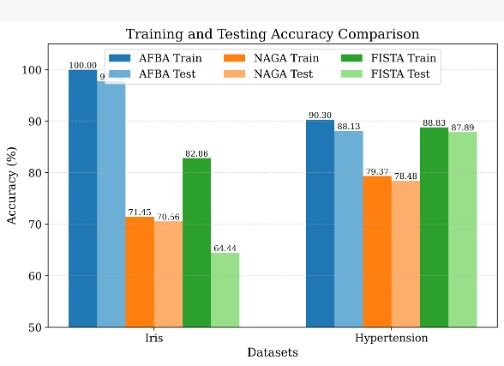
In this paper, a common fixed point of a countable set of nonexpansive mappings in Hilbert space. Under appropriate regulatory circumstances, the weak convergence theorems are formulated. Nonsmoothed convex minimization problems, which are expressed as the union of two suitable convex lower semicontinuous functions, are tackled by applying the proposed method. The subsequent method provides a viable answer to structured convex optimization problems that arise in many engineering and scientific settings; it is constructed within the forward-backwards splitting paradigm. Also, using an extreme learning machine model with l1-regularization, we show that it works well for machine learning classification tasks. Improving forecast accuracy through rapid iterative refinement, the proposed method deftly computes output weights by tackling the basic convex optimization problem. Its effectiveness, durability, and improved classification accuracy compared to existing methods are confirmed by numerical experiments on many benchmark datasets.
References
1. S. Boyd, L. Vandenberghe, Convex Optimization, Cambridge University Pass, innovative York, 2004
2. H.H. Bauschke and P.L. Combettes, Convex Analysis and Monotone Operator Theory in Hilbert Spaces, Springer, innovative York, 2011.
3. W. R. Mann, Mean value methods in iteration, Proc. Amer. Math. Soc. 4(1953),506–510.
4. S. Ishikawa, Fixed points by an innovative iteration method, Proc. Amer. Math. Soc. 44 (1974), 147-150.
5. R. P. Agarwal, D. O’Regan and D. R. Sahu. Iterative construction of fixed point of nearly asymptotically nonexpansive mappings, J. Nonlinear Convex Anal., 8(1) (2007), 61–79.
6. K. Aoyama, Y. Kimura, W. Takahashi and M. Toyada, Approximation of common fixed points of a countable family of nonexpansive mappings in a Banach space, Nonlinear Anal. 67 (2007), 2350–2360.
7. W. Takahashi, Viscosity approximation methods for countable family of nonexpansive mappings in Banach spaces, Nonlinear Anal. 70 (2009), 719–734.
8. C. Klin-eam and S. Suantai, Strong convergence of composite iterative schemes for a countable family of nonexpansive mappings in Banach spaces, Nonlinear Analysis, 73 (2010), 431-439.
9. B. Polyak, Some methods of speeding up the convergence of iteration methods, USSR Computational Mathematics and Mathematical Physics. 4(5) (1964), 1 – 17.
10. Beck and M. Teboulle, A fast iterative shrinkage-thresholding Algorithms for linear inverse problems, SIAM Journal on Imaging Sciences. 2(1) (2009), 183–202.
11. P. Thongsri, S. Suantai, innovative Accelerated fixed point Algorithms with applications to regression and classification Problems, Thai J. Math. 18(4) (2020), 2001–2011.
12. L. Bussaban, S. Suantai and A. Kaewkhao, A parallel inertial S-iteration forward-backward Algorithms for regression and classification problems, Carpathian J.Math. 36(1) 2020, 35-44.
13. W. Takahashi, Introduction to nonlinear and convex analysis, Yokohama Publishers, Yokohama (2009).
14. K. Tan and H.K. Xu, Approximating fixed points of nonexpansive mappings by the Ishikawa iteration process, J. Math. Anal. Appl., 178(2) (1993), pp. 301-308.
Downloads
Published
Issue
Section
Categories
License
Copyright (c) 2026 Natasha Seemab, Suthep Suantai, Muhammad Jamshed Abbass (Author)

This work is licensed under a Creative Commons Attribution 4.0 International License.
How to Cite