The Regulatory Principles Involved in the New Neutrosophic Integrals and Their Operational Outcomes
DOI:
https://doi.org/10.64060/ANMI1V1i2Keywords:
Neutrosophic integrals, Neutrosophic functions, Improper neutrosophic integrals, Classical counterparts, UncertaintyAbstract
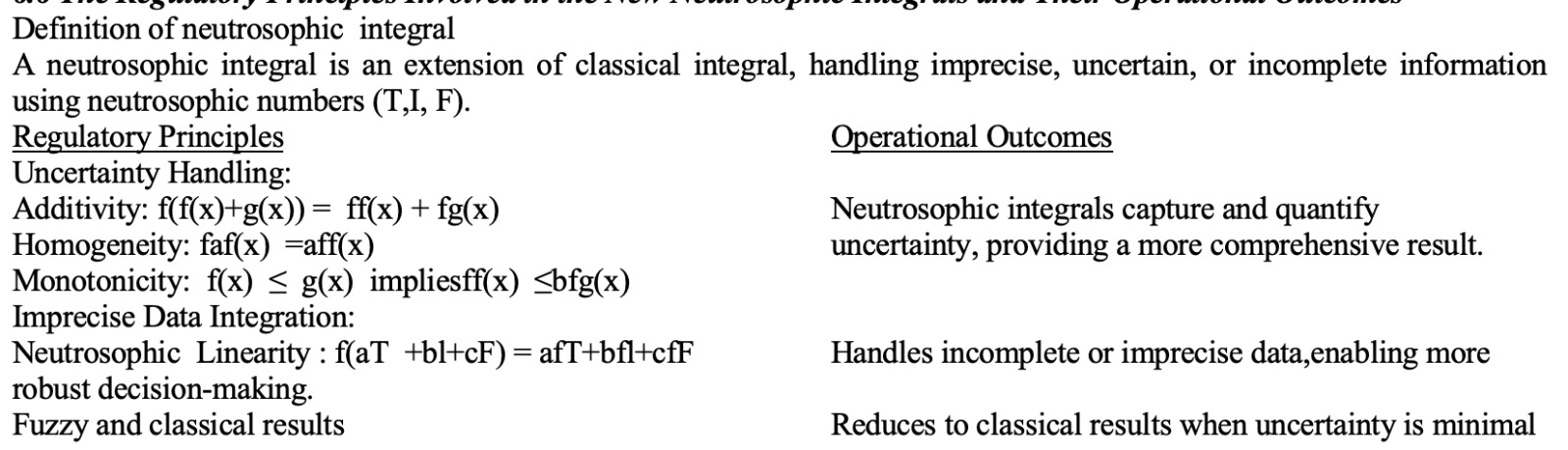
Classical mathematical analysis is built on precise and deterministic concepts, where quantities, limits, and operations are assumed to be exactly known. However, many real-life phenomena involve uncertainty, vagueness, indeterminacy, and incomplete information, which cannot be adequately handled using classical or even fuzzy mathematical frameworks alone. The main aim of this study is to examine the concept of improper neutrosophic integrals, with emphasis on their definitions, types, and convergence properties. Specifically, this study is to present the foundational concepts of neutrosophic logic and neutrosophic calculus, investigate conditions for convergence and divergence of improper neutrosophic integrals, solve illustrative examples involving different classes of neutrosophic functions, and finally, to compare improper neutrosophic integrals with their classical counterparts.
References
1. Usama Afzal and Muhammad Aslam (2026)ArtificialInteligencewith Neutrosophic Statistics from Nano to Nature, Cambridge Scholars Publishing
2. AboElHamd1, E., Saleh, H. M. S. M., & El-Khodary, I. (2021). Neutrosophic logic theory and applications. Neutrosophic Sets and Systems, 41, 30.
3. Florentin, S. (1999). Neutrosophy: Neutrosophic probability, set, and logic. American Research Press.
4. Giri, S. K., Garai, T., & Islam S. (2023). Multi-item economic production quantity model under single valued bipolar neutrosophic environment based on possibilistic theory. Journal of Intelligent & Fuzzy Systems, 44(5), 7059–7072.
5. Garai, T., Garg, H., & Roy, T. K. (2020). A ranking method based on possibility mean for multi-attribute decision making with single valued neutrosophic numbers. Journal of Ambient Intelligence and Humanized Computing, 11, 5245–5258.
6. Garai, T., Dalapati S., Garg, H., & Roy, T. K. (2020). Possibility mean, variance and standard deviation of single-valued neutrosophic numbers and its applications to multi-attribute decision-making problems. Soft Computing, 24(24), 18795–18809.
7. Garai, T. & Garg, H. (2021) Possibilistic multiattribute decision making for water resource management problem under single-valued bipolar neutrosophic environment. International journal of intelligent systems, 37(8), 5031-5058.
8. Garai, T. & Garg, H. (2022) Multi-criteria decision making of COVID-19 vaccines (in India) based on ranking interpreter technique under single valued bipolar neutrosophic environment. Expert Systems with Applications, 208, 118160
9. Garai, T. & Garg, H. (2022) Multi-criteria decision making of water resource management problem (in Agriculture field, Purulia district) based on possibility measures under generalized single valued non- linear bipolar neutrosophic environment. Expert Systems with Applications, 205(2016), 117715
10. Garai, T., Garg, H., & Biswas, G. (2023) A fraction ranking-based multi-criteria decision-making method for water resource management under bipolar neutrosophic fuzzy environment. Arti_cial Intelligence Review, 56(12), 14865–14906.
11. Florentin, S., &Smarandache, F. (2015). Neutrosophic Algebraic Structures and their Applications. Education Publishing.
12. Ganguly, A., & Mandal, A. (2020). Applications of neutrosophic matrices in decision making problems. Journal of Intelligent & Fuzzy Systems, 39(2), 1781–1790.
13. Adesina, Adebisi Sunday and Damilola, OgunmuyiwaSodiq (2025) "Fundamentals of the New Neutrosophic Matrices," Neutrosophic Systems with Applications: Vol. 25: Iss. 9, Article 2. DOI: https://doi.org/10.63689/2993-7159.1295
14. Garai, T., Garg, H., & Biswas, G. (2023) A fraction ranking-based multi-criteria decision-making method for water resource management under bipolar neutrosophic fuzzy environment. Arti_cial Intelligence Review, 56(12), 14865–14906.
15. Ganguly, A., & Mandal, A. (2020). Applications of neutrosophic matrices in decision making problems. Journal of Intelligent & Fuzzy Systems, 39(2), 1781–1790.
16. Smarandache, F. (2005). Neutrosophic Set: A Generalization of the Intuitionistic Fuzzy Set.
17. Smarandache, F. (2013). Introduction to Neutrosophic Measure, Integral, and Probability.
18. Abdel-Basset, M., et al. (2019). Neutrosophic theory and applications.
19. Rudin, Walter, (1976) Principles of mathematical analysis. (International series in pure and applied mathematics) QA300.R8 1976 515 75-17903 ISBN 0-07-054235-X
20. Cauchy’s Cours d’analyse, An Annotated Translation http://www.springer.com/series/4142
Downloads
Published
Issue
Section
License
Copyright (c) 2026 DR.ADEBISI SUNDAY ADESINA (Author)

This work is licensed under a Creative Commons Attribution 4.0 International License.
How to Cite