|
Editor in Chief:
|
Dr. Broumi Said
|
|
Email/Contact:
|
anmi@journals.scopua.com
|
|
ISSN(e):
|
|
|
DOI:
|
10.64060/ANMI
|
|
Frequency:
|
Quarterly
|
|
Publisher:
|
Aims & Scope
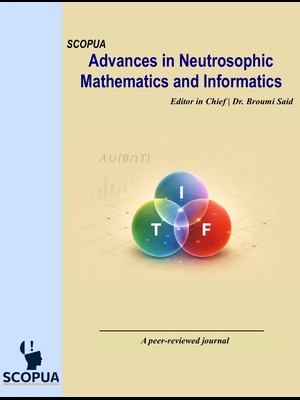 |
Advances in Neutrosophic Mathematics and Informatics (ANMI) is an international, peer-reviewed journal dedicated to the advancement of theoretical, computational, and applied research in neutrosophic mathematics and informatics. The journal aims to provide a specialized platform for disseminating high-quality research that addresses uncertainty, indeterminacy, and inconsistency in complex mathematical and computational systems.
ANMI welcomes original research articles, review papers, and methodological studies that contribute to the development of neutrosophic theories, models, and algorithms. Core areas of interest include neutrosophic sets, neutrosophic logic, neutrosophic algebra, and neutrosophic topology, as well as their integration with applied mathematics, optimization, and numerical analysis. The journal also emphasizes the role of informatics in implementing neutrosophic concepts through computational algorithms, intelligent systems, and data-driven methodologies.
In addition to theoretical contributions, ANMI strongly encourages applied research that demonstrates real-world applications of neutrosophic approaches in areas such as artificial intelligence, soft computing, decision-making systems, data analytics, engineering, and interdisciplinary sciences. Studies that combine neutrosophic mathematics with fuzzy systems, rough sets, machine learning, and hybrid intelligent models are particularly welcome. Application domains of special interest include medical diagnosis, environmental monitoring, financial risk assessment, cybersecurity, and smart manufacturing.
By bridging the gap between mathematical theory and computational practice, ANMI aims to foster interdisciplinary collaboration among mathematicians, computer scientists, engineers, and applied researchers. The journal aspires to become a leading scholarly outlet for innovative research on uncertainty modeling and intelligent computation, supporting both academic advancement and practical problem-solving in emerging scientific and technological domains.