Effect of Despotic Leadership on Creativity: Mediating Role of Psychological Distress and Moderating Role of Neuroticism in the Hospitality Sector
DOI:
https://doi.org/10.64060/IJPSSDV2i14Keywords:
Despotic Leadership, Employee Creativity, Psychological Distress, Neuroticism, Hospitality SectorAbstract
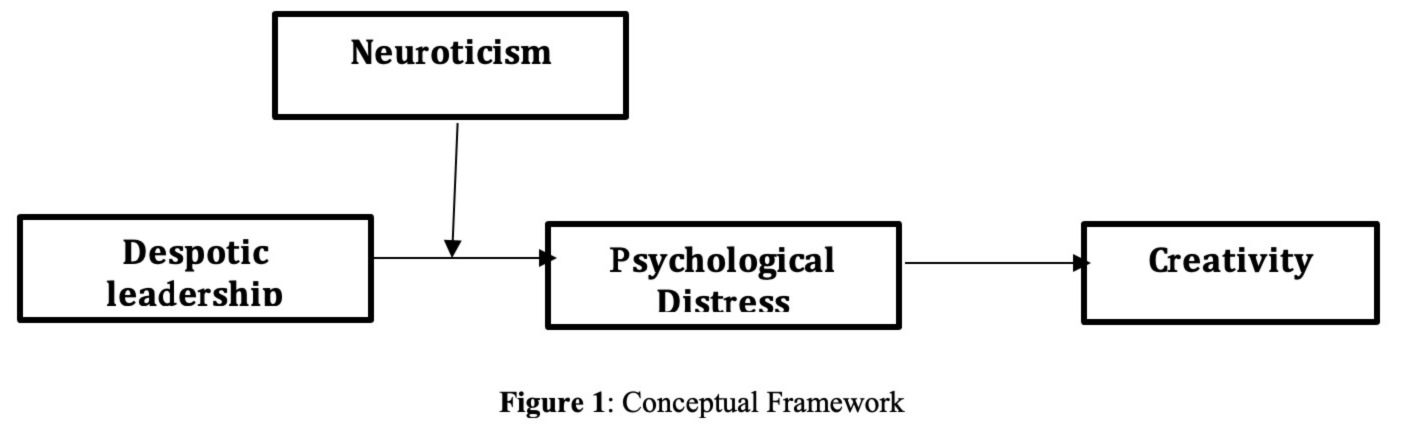
This study examines the effect of despotic leadership on employee creativity in the hospitality sector, with a particular focus on the mediating role of psychological distress and the moderating role of neuroticism. In service-oriented industries such as hospitality, employee creativity is essential for delivering innovative services and enhancing customer satisfaction. However, destructive leadership styles, particularly despotic leadership, may undermine employees’ ability to perform creatively. Drawing on the Componential Theory of Creativity and Situational Stress Theory, this study proposes a moderated mediation model to explain the underlying mechanisms influencing creativity. A quantitative research design was adopted, and data were collected from 250 employees working in the hospitality sector. The data were analyzed using SPSS and structural equation modeling techniques. The findings reveal that despotic leadership has a significant negative effect on employee creativity and a positive effect on psychological distress. Psychological distress was found to partially mediate the relationship between despotic leadership and creativity, indicating that employees experiencing higher levels of distress are less likely to engage in creative behaviors. Furthermore, neuroticism significantly moderates the relationship between despotic leadership and psychological distress, such that employees with higher levels of neuroticism experience stronger negative effects. The moderated mediation analysis further confirms that the indirect effect of despotic leadership on creativity is stronger at higher levels of neuroticism. This study contributes to the literature by integrating leadership, psychological, and personality factors into a comprehensive framework and offers practical implications for improving leadership practices and employee well-being in the hospitality sector.
References
Albashiti, B., Hamid, Z., & Aboramadan, M. (2021). Fire in the belly: The impact of despotic leadership on employees’ work-related outcomes in the hospitality setting. International Journal of Contemporary Hospitality Management, 33(10), 3564–3584.
Chu, Q., Wang, X., Yao, R., Fan, J., Li, Y., Nie, F., & Tang, Q. (2022). Childhood trauma and current depression among Chinese university students: A moderated mediation model of cognitive emotion regulation strategies and neuroticism. BMC Psychiatry, 22(1), 90.
Cui, P., Yang, M., Hu, H., Cheng, C., Chen, X., Shi, J., & Zhang, H. (2024). The impact of caregiver burden on quality of life in family caregivers of patients with advanced cancer: A moderated mediation analysis of the role of psychological distress and family resilience. BMC Public Health, 24(1), 817.
Emmerling, F., Peus, C., & Lobbestael, J. (2023). The hot and the cold in destructive leadership: Modeling the role of arousal in explaining leader antecedents and follower consequences of abusive supervision versus exploitative leadership. Organizational Psychology Review, 13(3), 237–278.
Fang, Y., Luo, J., Boele, M., Windhorst, D., Van Grieken, A., & Raat, H. (2024). Parent, child, and situational factors associated with parenting stress: A systematic review. European Child & Adolescent Psychiatry, 33(6), 1687–1705.
Haque, A., Fernando, M., & Caputi, P. (2021). Responsible leadership and employee outcomes: A systematic literature review, integration and propositions. Asia-Pacific Journal of Business Administration, 13(3), 383–408.
Huzar, U., Paska, M., & Radzimovska, O. (2023). Practical aspect of hospitality staff creativity. Baltic Journal of Economic Studies, 9(2), 104–109.
Im, E. O., & Meleis, A. I. (2021). A situation-specific theory of Korean immigrant women’s menopausal transition. In Situation specific theories: Development, utilization, and evaluation in nursing (pp. 101–113). Springer.
Jia, N., Luo, X., Fang, Z., & Liao, C. (2024). When and how artificial intelligence augments employee creativity. Academy of Management Journal, 67(1), 5–32.
Kabangire, J., & Korir, J. (2023). Innovation and creativity in hospitality management. Journal of Hospitality and Tourism, 3(3), 20–41.
Kukkonen, T., & Bolden, B. (2022). Nurturing creativity in the visual arts classroom: Understanding teacher strategies through Amabile's componential theory. Canadian Review of Art Education, 49(1), 46–62.
Mader, N., Arslan, R. C., Schmukle, S. C., & Rohrer, J. M. (2023). Emotional (in)stability: Neuroticism is associated with increased variability in negative emotion after all. Proceedings of the National Academy of Sciences, 120(23), e2212154120.
Mehmood, K., Ullah, U., Usman, M., Abbas, A., & Han, S. (2024). Despotic leadership and followers’ creativity: Exploring the combined effects of power distance and psychological safety. BMC Psychology, 12(1), 728.
Mehraein, V., Visintin, F., & Pittino, D. (2023). The dark side of leadership: A systematic review of creativity and innovation. International Journal of Management Reviews, 25(4), 740–767.
Mukarram, A., Hussain, S., & Khan, M. A. (2021). A brief overview of despotic leadership research. International Review of Management and Business Research, 10(1), 10–11.
Nilsen, F. A., Bang, H., & Røysamb, E. (2024). Personality traits and self-control: The moderating role of neuroticism. PLOS ONE, 19(8), e0307871.
Ouyang, X., Liu, Z., & Gui, C. (2021). Creativity in the hospitality and tourism industry: A meta-analysis. International Journal of Contemporary Hospitality Management, 33(10), 3685–3704.
Saira, S., Mansoor, S., & Ali, M. (2021). Transformational leadership and employee outcomes: The mediating role of psychological empowerment. Leadership & Organization Development Journal, 42(1), 130–143.
Satici, B., Kayis, A. R., & Griffiths, M. D. (2023). Exploring the association between social media addiction and relationship satisfaction: Psychological distress as a mediator. International Journal of Mental Health and Addiction, 21(4), 2037–2051.
Stănescu, D. F., & Romașcanu, M. C. (2024). The influence of AI anxiety and neuroticism in attitudes toward artificial intelligence. European Journal of Sustainable Development, 13(4), 191.
Zhang, C., Xiao, S., Lin, H., Shi, L., Zheng, X., Xue, Y., & Xue, B. (2022). The association between sleep quality and psychological distress among older Chinese adults: A moderated mediation model. BMC Geriatrics, 22(1), 35.
Zheng, W., Li, X., & Ben, S. (2025). Structural equation modeling of determining factors in musical creativity: An extended model based on componential theory of creativity. BMC Psychology, 13(1), 1090.
Zhou, X., Rasool, S. F., Yang, J., & Asghar, M. Z. (2021). Exploring the relationship between despotic leadership and job satisfaction: The role of self-efficacy and leader–member exchange. International Journal of Environmental Research and Public Health, 18(10), 5307.
Żywiołek, J., Tucmeanu, E. R., Tucmeanu, A. I., Isac, N., & Yousaf, Z. (2022). Nexus of transformational leadership, employee adaptiveness, knowledge sharing, and employee creativity. Sustainability, 14(18), 11607.
Downloads
Published
Issue
Section
License
Copyright (c) 2026 Khadija Dawood Rizwan (Author)

This work is licensed under a Creative Commons Attribution 4.0 International License.