Impact of Generative AI Adoption on Micro and Small Enterprises in Emerging Economies
DOI:
https://doi.org/10.64060/IJPSSDV2i12Keywords:
Generative AI, Micro and Small Enterprises, Emerging Economies, AI Adoption, Revenue GrowthAbstract
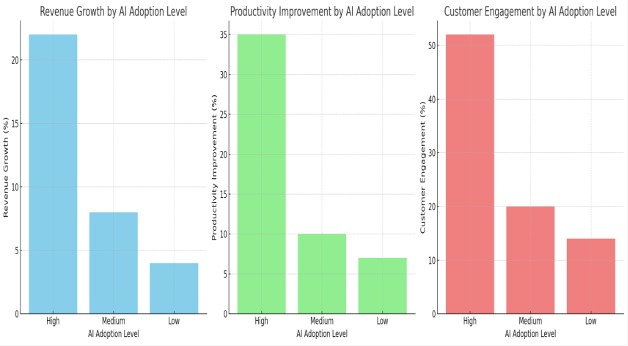
This study investigates the impact of generative artificial intelligence (AI) adoption on the performance of micro and small enterprises (MSEs) in emerging economies. As AI technologies continue to evolve, they present significant opportunities for MSEs to enhance efficiency, productivity, and customer engagement. However, MSEs in emerging economies often face challenges in adopting these technologies due to financial constraints, lack of technical expertise, and limited access to infrastructure. Using a quantitative approach, the study surveys 300 MSEs in India, Nigeria, and Egypt, examining the relationship between AI adoption and key business performance metrics such as revenue growth, productivity, and customer engagement. The results reveal a strong positive correlation between AI adoption and improvements in business performance, with high AI adoption associated with substantial gains in all three metrics. Regression analysis further confirms that AI adoption is a significant predictor of business success, explaining a large portion of the variance in performance outcomes. However, the study also identifies significant barriers to AI adoption, including financial limitations and technological readiness. These findings have important implications for both MSEs and policymakers, highlighting the need for supportive policies and initiatives to foster AI adoption in emerging economies.
References
Adams, D. (2024). Leveraging technology and data Abrokwah-Larbi, K., & Awuku-Larbi, Y. (2024). The impact of artificial intelligence in marketing on the performance of business organizations: Evidence from SMEs in an emerging economy. Journal of Entrepreneurship in Emerging Economies, 16(4), 1090–1117.
Abuhassna, H., Yahaya, N., Zakaria, M. A. Z. M., Zaid, N. M., Samah, N. A., Awae, F., & Alsharif, A. H. (2023). Trends on using the technology acceptance model (TAM) for online learning: A bibliometric and content analysis. International Journal of Information and Education Technology, 13(1), 131–142.
Adegbuyi, A., Noor, S., & Adeniyi, A. O. (2024). Role of artificial intelligence on small and medium-sized enterprises (SMEs) management in Southwest Nigeria. International Journal of Entrepreneurship Technology and Innovation, 1(1), 11–28.
Anand, J., McDermott, G., Mudambi, R., & Narula, R. (2021). Innovation in and from emerging economies: New insights and lessons for international business research. Journal of International Business Studies, 52(4), 545–559.
Bapat, G., Mahindru, R., Kumar, A., Rroy, A. D., Bhoyar, S., & Vaz, S. (2024). Leveraging ChatGPT for empowering MSMEs: A paradigm shift in problem solving. Engineering Proceedings, 59(1), 197.
Bharadiya, J. (2023). The impact of artificial intelligence on business processes. European Journal of Technology, 7(2), 15–25.
Chen, S., & Guo, Q. (2024). Fintech and MSEs innovation: An empirical analysis. arXiv preprint arXiv:2407.17293.
Fajri, F., Perdana, K. A., Manurung, D. U., Dharmawan, P. K. N., & Dewi, N. G. (2024). The role of early adoption of artificial intelligence in supporting the growth of micro and ultra-micro enterprises in Indonesia: Challenges and opportunities. Jurnal Akuntansi dan Bisnis, 10(2), 133–143.
Fitriyani, F. (2024, December). Artificial intelligence: Micro, small and medium enterprises shortcut going next level. In Proceedings of the International E-Conference on Management & Small Medium Enterprise (pp. 27–42).
García-Vidal, G., Sánchez-Rodríguez, A., Guzmán-Vilar, L., Pérez-Campdesuñer, R., & Martínez-Vivar, R. (2025). Entropy-based assessment of AI adoption patterns in micro and small enterprises: Insights into strategic decision-making and ecosystem development in emerging economies. Information, 16(9), 770.
García-Vidal, G., Sánchez-Rodríguez, A., Guzmán-Vilar, L., Pérez-Campdesuñer, R., & Martínez-Vivar, R. (2025). Entropy-based assessment of AI adoption patterns in micro and small enterprises: Insights into strategic decision-making and ecosystem development in emerging economies. Information, 16(9), 770.
Gupta, V. (2024). An empirical evaluation of a generative artificial intelligence technology adoption model from entrepreneurs’ perspectives. Systems, 12(3), 103.
Han, J. H., & Sa, H. J. (2022). Acceptance of and satisfaction with online educational classes through the technology acceptance model (TAM): The COVID-19 situation in Korea. Asia Pacific Education Review, 23(3), 403–415.
Ilham, B. U., & Muawwal, A. (2024). Utilization of artificial intelligence technology to support micro business marketing (Study of MSEs assisted by PLUT South Sulawesi). In International Summit on AI-Driven Education & Management Excellence (p. 37).
Katterbauer, K., Syed, H., Cleenewerck, L., Özbay, R. D., & Yılmaz, S. (2024). Impact of generative AI on fintech in Africa. Yildiz Social Science Review, 10(1), 43–53.
Khan, S., & Haleem, A. (2021). Investigation of circular economy practices in the context of emerging economies: A CoCoSo approach. International Journal of Sustainable Engineering, 14(3), 357–367.
Lutfiani, N., Sembiring, I., Setyawan, I., Setiawan, A., Rahardja, U., & Sulistio, S. (2025). Exploring the relationship between artificial intelligence and business performance. IJCCS (Indonesian Journal of Computing and Cybernetics Systems), 19(1), 1–12.
Mannuru, N. R., Shahriar, S., Teel, Z. A., Wang, T., Lund, B. D., Tijani, S., & Vaidya, P. (2025). Artificial intelligence in developing countries: The impact of generative artificial intelligence (AI) technologies for development. Information Development, 41(3), 1036–1054.
Mutanga, M. B., Revesai, Z., & Msane, J. (2024). Adoption and impact of generative AI: Perspectives from South African tech entrepreneurs. Business & IT, 14(2), 11–22.
Natasia, S. R., Wiranti, Y. T., & Parastika, A. (2022). Acceptance analysis of NUADU as e-learning platform using the Technology Acceptance Model (TAM) approach. Procedia Computer Science, 197, 512–520.
Patwa, N., Sivarajah, U., Seetharaman, A., Sarkar, S., Maiti, K., & Hingorani, K. (2021). Towards a circular economy: An emerging economies context. Journal of Business Research, 122, 725–735.
Rubab, S. A. (2023). Impact of AI on business growth. The Business and Management Review, 14(2), 229–236.
Soni, V. (2023). Impact of generative AI on small and medium enterprises’ revenue growth: The moderating role of human, technological, and market factors. Reviews of Contemporary Business Analytics, 6(1), 133–153.
Strzelecki, A., Pańkowska, M., & Rizun, M. (2024, December). Generative AI adoption and use by micro-enterprises: Validation of the measurement instrument. In International Conference on Marketing and Technologies (pp. 77–91). Singapore: Springer Nature Singapore.
Uula, M. M., & Avedta, S. (2023). Technology Acceptance Model (TAM) on banking: A review. Islamic Marketing Review, 2(1).
Downloads
Published
Issue
Section
License
Copyright (c) 2026 Sadaf Nawaz (Author)

This work is licensed under a Creative Commons Attribution 4.0 International License.