
Modelling Wind Speed at Ikeja Station using Skewed Statistical Distributions
DOI:
https://doi.org/10.64060/JASR.v2i1.1Keywords:
Climate changee, Data visualization, Meteorologists, Precautionary measures, Temperature variationsAbstract
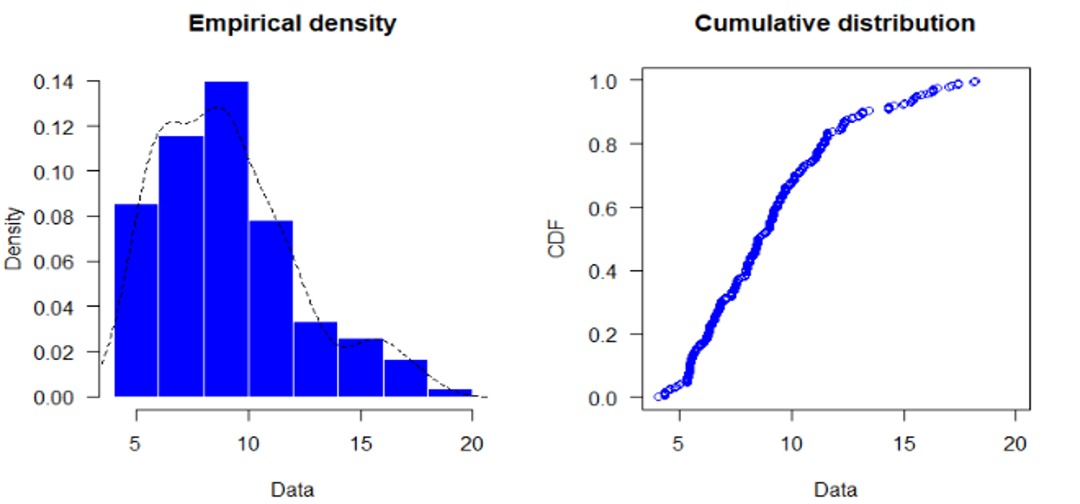
Wind speed, a key atmospheric parameter, results from the movement of air from high- to low-pressure regions driven primarily by temperature variations. This study modelled the wind speed (m/s) of Ikeja, Lagos State, using data from 2000 to 2020 through statistical techniques such as descriptive statistics, data visualization, and goodness-of-fit (GOF) tests, including chi-square, Kolmogorov-Smirnov, Anderson-Darling, and Cramer-von Mises analysis. Three positively skewed distributions, Gamma, Weibull, and Log-normal, were evaluated. Descriptive analysis indicated that the dataset was predominantly right-skewed (Skp > 0). The GOF results show that the Weibull distribution provides the best representation of the wind speed data (p=0.02), followed by the distributions of Log-normal and Gamma. The Weibull parameter (α > 1) further confirmed its suitability for the data. The findings suggest that Ikeja may experience higher wind speeds in the future, emphasizing the need for precautionary measures to mitigate potential damage to infrastructure and property. This study provides valuable insights for meteorologists and urban planners in anticipating and managing climate-related risks in the city.
References
Abbasi, S., & Abbasi, T. (2016). Impact of wind-energy generation on climate: A rising spectre. Renewable and Sustainable Energy Reviews, 59, 1591-1598.
Afanasyeva, S., Saari, J., Kalkofen, M., Partanen, J., & Pyrhönen, O. (2016). Technical, economic and uncertainty modelling of a wind farm project. Energy Conversion and Management, 107, 22-33.
Afolabi, S. A. (2020). Modelling of Water Pollutants with Weibull and Lognormal Distribution: A Case Study of Oyo State, Nigeria.
Ajayi, O. (2013). Sustainable energy development and environmental protection: The case of five West African Countries. Renew. Sustain. Energy Rev, 26, 532-539.
Akgül, F. G., Şenoğlu, B., & Arslan, T. (2016). An alternative distribution to Weibull for modeling the wind speed data: Inverse Weibull distribution. Energy Conversion and Management, 114, 234-240.
Aweda, F., & Samson, T. (2024). Statistical Analysis of wind speed characteristics using the Weibull distribution at selected African stations. J. Sustain. Energy, 3(3), 187-197.
Chang, T.-J., Chen, C.-L., Tu, Y.-L., Yeh, H.-T., & Wu, Y.-T. (2015). Evaluation of the climate change impact on wind resources in Taiwan Strait. Energy Conversion and Management, 95, 435-445.
Chaturvedi, A., Bhatti, M. I., Bapat, S. R., & Joshi, N. (2025). Modeling wind speed data using the generalized positive exponential family of distributions. Modeling Earth Systems and Environment, 11(2), 98.
Kollu, R., Rayapudi, S. R., Narasimham, S., & Pakkurthi, K. M. (2012). Mixture probability distribution functions to model wind speed distributions. International Journal of energy and environmental engineering, 3(1), 27.
Lencastre, P., Yazidi, A., & Lind, P. G. (2024). Modeling wind-speed statistics beyond the Weibull distribution. Energies, 17(11), 2621.
Masseran, N. (2015). Markov chain model for the stochastic behaviors of wind-direction data. Energy Conversion and Management, 92, 266-274.
Murphy, E., Huang, W., Bessac, J., Wang, J., & Kotamarthi, R. (2025). Joint modeling of wind speed and wind direction through a conditional approach. Environmetrics, 36(3), e70011.
Ogunjo, S. (2025). Wind energy characterization using multifractal formalism at two different altitudes in a tropical country. Modeling Earth Systems and Environment, 11(1), 63.
Downloads
Published
Issue
Section
License
Copyright (c) 2025 SCOPUA Journal of Applied Statistical Research

This work is licensed under a Creative Commons Attribution 4.0 International License.
How to Cite