Critical Review on the Phase Change Properties of VO₂: Influence of Synthesis Methods and Transition Mechanisms
DOI:
https://doi.org/10.64060/jestt.v2i2.2Keywords:
Defect chemistry, Mott transition, Phase-change materials, Thermochromic materialsAbstract
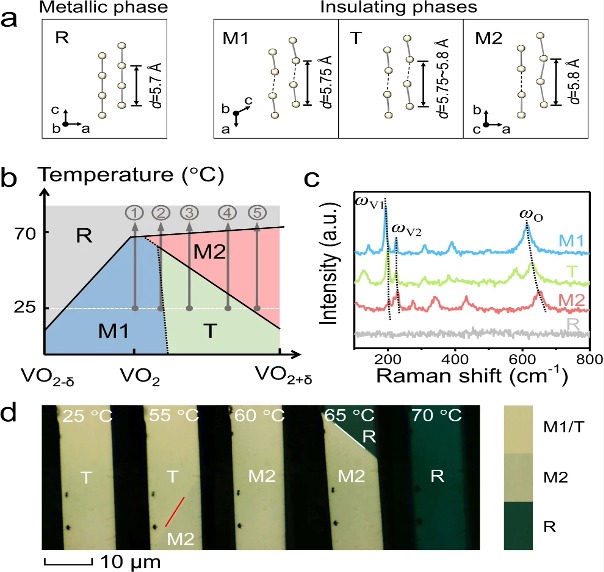
Vanadium dioxide (VO₂) is a strongly correlated material that exhibits a reversible metal-insulator transition (MIT) near room temperature (~68°C), accompanied by a structural phase transition from a monoclinic (M1, insulating) to a tetragonal rutile (R, metallic) phase. This unique property makes VO₂ a promising candidate for applications in smart windows, optoelectronic switches, and thermal sensors. However, the phase transition characteristics, such as transition temperature, hysteresis width, and optical/electrical contrast, are highly dependent on the synthesis method. This review critically examines the impact of different synthesis techniques (e.g., chemical vapour deposition, sol-gel, sputtering, pulsed laser deposition, and hydrothermal synthesis) on the phase transition properties of VO₂. A comparative analysis is presented, highlighting how stoichiometry, strain, defects, and doping influence the MIT. Additionally, the fundamental chemistry governing the phase transition is discussed, with a focus on electron correlation effects and lattice dynamics. A comprehensive comparison table summarises the synthesis methods, their effects on phase transition properties, and key challenges.
References
1. Li, Z., Z. Zhang, and X. Zhou, Chemical Modulation of Metal–Insulator Transition toward Multifunctional Applications in Vana-dium Dioxide Nanostructures. Small, 2023. 19(44): p. 2305234.
2. Zhang, Y., et al., Recent progress on vanadium dioxide nanostruc-tures and devices: Fabrication, properties, applications and per-spectives. Na-nomaterials, 2021. 11(2): p. 338.
3. Kumar, A., et al., A comprehensive review on synthesis, phase transi-tion, and applications of VO2. Journal of Superconductivity and Novel Magnetism, 2024. 37(3): p. 475-498.
4. Cao, X., et al., Challenges and opportunities toward real applica-tion of VO2-based smart glazing. Matter, 2020. 2(4): p. 862-881.
5. Afzal, U., et al., Chemical Engineering for Advanced Flexible Sen-sors: Novel Carbon-Metal Oxide Nanocomposites with Superior Multi-Sensing Behavior. Sensors and Actuators B: Chemical, 2025: p. 137449.
6. Liu, Y., et al., An interesting functional phase change material VO2: response to multivariate control and extensive applications in op-tics and electronics. Advanced Electronic Materials, 2024. 10(4): p. 2300699.
7. Hong, W.-K., et al., Metal‐insulator phase transition in quasi‐one‐dimensional VO2 structures. Journal of Nanomaterials, 2015. 2015(1): p. 538954.
8. Haddad, E., et al., Review of the VO2 smart material applications with emphasis on its use for spacecraft thermal control. Frontiers in Materials, 2022. 9: p. 1013848.
9. Davenport, M.A., Investigation of structural changes in vanadium con-taining transition metal oxides. 2020: The University of Ala-bama.
10. Whittaker, L., Synthesis, characterization and phase transitions of single-crystalline vanadium (IV) oxide nanostructures. 2011: State University of New York at Buffalo.
11. Eyert, V., The metal‐insulator transitions of VO2: A band theoreti-cal approach. Annalen der Physik, 2002. 514(9): p. 650-704.
12. Hu, P., et al., Vanadium oxide: phase diagrams, structures, synthesis, and applications. Chemical Reviews, 2023. 123(8): p. 4353-4415.
13. Li, M., et al., Hydrothermal synthesis of VO2 polymorphs: ad-vantages, challenges and prospects for the application of energy ef-ficient smart windows. Small, 2017. 13(36): p. 1701147.
14. Zhang, L., et al., VO2 (A) nanorods: One-pot synthesis, formation mech-anism and thermal transformation to VO2 (M). Ceramics Inter-national, 2018. 44(16): p. 19301-19306.
15. Yu, J., et al., Recent Advances on Pulsed Laser Deposition of Large‐Scale Thin Films. Small Methods, 2024. 8(7): p. 2301282.
16. Muratore, C., A.A. Voevodin, and N.R. Glavin, Physical vapor depo-sition of 2D Van der Waals materials: a review. Thin Solid Films, 2019. 688: p. 137500.
17. Guo, B., et al., Direct synthesis of high-performance thermal sensi-tive VO2 (B) thin film by chemical vapor deposition for using in un-cooled infrared detectors. Journal of Alloys and Compounds, 2017. 715: p. 129-136.
18. Wen, C., et al., A review of the preparation, properties and applica-tions of VO2 thin films with the reversible phase transition. Frontiers in Mate-rials, 2024. 11: p. 1341518.
19. Pouget, J.-P., Basic aspects of the metal–insulator transition in vanadium dioxide VO $ _ {2} $: a critical review. Comptes Rendus. Physique, 2021. 22(1): p. 37-87.
20. Shi, R., et al., Phase management in single-crystalline vanadium dioxide beams. Nature Communications, 2021. 12(1): p. 4214.
21. Shao, Z., et al., Recent progress in the phase-transition mechanism and modulation of vanadium dioxide materials. NPG Asia Materials, 2018. 10(7): p. 581-605.
22. Valakh, M.Y., et al., Variation of the metal-insulator phase transi-tion temperature in VO2: An overview of some possible implementa-tion methods. Semicond. Physics, Quantum Electronics & Optoelec-tronics, 2024. 27(2): p. 136.
23. Hiroi, Z., Structural instability of the rutile compounds and its rele-vance to the metal–insulator transition of VO2. Progress in Solid State Chemis-try, 2015. 43(1-2): p. 47-69.
24. Zhang, J., et al., Evolution of structural and electrical properties of oxy-gen-deficient VO2 under low temperature heating process. ACS applied materials & interfaces, 2017. 9(32): p. 27135-27141.
25. Yang, Y., et al., Thickness effects on the epitaxial strain states and phase transformations in (001)-VO2/TiO2 thin films. Journal of Ap-plied Phys-ics, 2019. 125(8).
26. Hu, L., et al., Porous W-doped VO 2 films with simultaneously en-hanced visible transparency and thermochromic properties. Journal of Sol-Gel Science and Technology, 2016. 77: p. 85-93.
27. Paik, T., et al., Solution-processed phase-change VO2 metamaterials from colloidal vanadium oxide (VO x) nanocrystals. ACS nano, 2014. 8(1): p. 797-806.
28. Ba, C., et al., Fabrication of high-quality VO2 thin films by ion-assisted dual ac magnetron sputtering. ACS Applied Materials & In-terfaces, 2013. 5(23): p. 12520-12525.
29. Barimah, E.K., et al., Infrared optical properties modulation of VO2 thin film fabricated by ultrafast pulsed laser deposition for thermo-chromic smart window applications. Scientific Reports, 2022. 12(1): p. 11421.
30. Vernardou, D., M.E. Pemble, and D.W. Sheel, The Growth of Ther-mochromic VO2 Films on Glass by Atmospheric‐Pressure CVD: A Com-parative Study of Precursors, CVD Methodology, and Sub-strates. Chem-ical Vapor Deposition, 2006. 12(5): p. 263-274.
31. Mathur, S., et al., Metal–Organic Chemical Vapor Deposition of Metal Oxide Films and Nanostructures. Ceramics Science and Technology, 2013: p. 291-336.
32. Landau, M.V., Sol–gel process. Handbook of Heterogeneous Ca-talysis: Online, 2008: p. 119-160.
33. Chae, B.-G., et al., Highly oriented VO2 thin films prepared by sol-gel deposition. Electrochemical and solid-state letters, 2005. 9(1): p. C12.
34. Popuri, S.R., et al., Rapid hydrothermal synthesis of VO2 (B) and its conversion to thermochromic VO2 (M1). Inorganic chemistry, 2013. 52(9): p. 4780-4785.
35. Fan, L., et al., Growth and phase transition characteristics of pure M-phase VO2 epitaxial film prepared by oxide molecular beam epi-taxy. Applied Physics Letters, 2013. 103(13).
36. Prasadam, V., et al., Study of VO2 thin film synthesis by atomic layer deposition. Materials Today Chemistry, 2019. 12: p. 332-342.
Downloads
Published
Issue
Section
License
Copyright (c) 2025 Journal of Engineering, Science and Technological Trends

This work is licensed under a Creative Commons Attribution 4.0 International License.
How to Cite