Neutrosophic Logic Reveals Ontological Indeterminacy in Quantum Systems
DOI:
https://doi.org/10.64060/jestt.v2i3.3Keywords:
Entanglement, Indeterminacy, Neutrosophic logic, Superposition, Quantum information science, Quantum uncertaintyAbstract
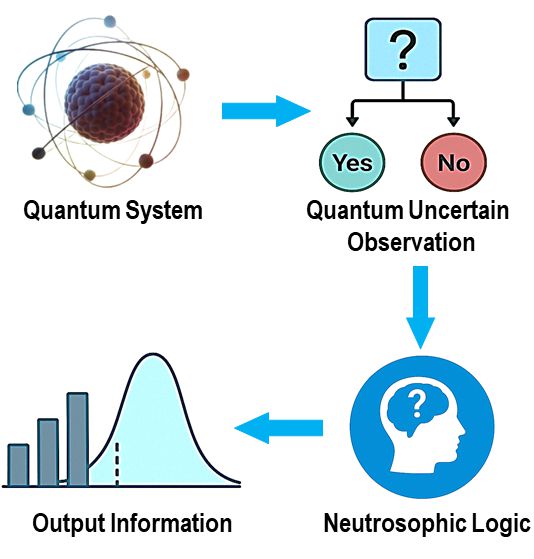
Quantum mechanics reveals a reality where uncertainty is not merely epistemic but ontological, challenging classical logics that rely on determinacy. We introduce neutrosophic logic as a novel framework to formalise this intrinsic indeterminacy. Unlike probability or fuzzy systems, neutrosophy treats truth (T), falsity (F), and indeterminacy (I) as independent dimensions, enabling a richer representation of quantum superposition, entanglement, and measurement collapse. We show that neutrosophic triplets capture the undefined yet real state of qubits before observation and provide a coherent description of entangled correlations beyond probabilistic models. This approach offers a unifying formalism that accommodates both structural indeterminacy and outcome probabilities, bridging foundational debates in quantum theory with practical advances in quantum computation and information science. By explicitly integrating indeterminacy into mathematical modelling, neutrosophy advances our understanding of quantum reality and suggests new avenues for experimental validation and quantum technology design.
References
1. Berta, Mario, et al. "The uncertainty principle in the presence of quantum memory." Nature Physics 6.9 (2010): 659-662.
2. Zhao, Yuan-Yuan, et al. "Experimental study of quantum uncertain-ty from lack of information." npj Quantum Information 8.1 (2022): 64.
3. Oppenheim, Jonathan, and Stephanie Wehner. "The uncertainty principle determines the nonlocality of quantum mechanics." Sci-ence 330.6007 (2010): 1072-1074.
4. Sen, Debashis. "The uncertainty relations in quantum mechanics." Current Science (2014): 203-218.
5. Ozawa, Masanao. "Quantum limits of measurements and uncertainty principle." Quantum Aspects of Optical Communications: Proceed-ings of a Workshop Held at the CNRS, Paris, France 26–28 Novem-ber 1990. Berlin, Heidelberg: Springer Berlin Heidelberg, 2005.
6. Cho, Adrian. "Furtive approach rolls back the limits of quantum uncertainty." (2011): 690-693.
7. Afzal, Usama. "Estimate calculation of discrete energy levels in the hydrogen atom using an indeterministic method." High Energy Den-sity Physics (2025): 101192.
8. Fatima, Adeena, et al. "A Comprehensive Review of Neutrosophic Statistics for Data Analysis in Applied Sciences." Journal of Reliabil-ity and Statistical Studies (2025): 25-40.
9. Smarandache, Florentin, and Maissam Jdid. "An overview of neu-trosophic and plithogenic theories and applications." (2023).
10. Sarkar, Debasmita, and Pankaj Kumar Srivastava. "Recent develop-ment and applications of neutrosophic fuzzy optimization ap-proach." International Journal of System Assurance Engineering and Management 15.6 (2024): 2042-2066.
11. Çevik, A., Topal, S., & Smarandache, F. (2018). Neutrosophic Logic Based Quantum Computing. Symmetry, 10(11), 656. https://doi.org/10.3390/sym10110656
12. Smarandache, Florentin. "Neutrosophic Quantum Theory: Partial Entanglement, Partial Effect of the Observer, and Teleportation." Neutrosophic Sets and Systems 86.1 (2025): 1.
13. Smarandache, Florentin. An introduction to the Neutrosophic proba-bility applied in quantum physics. Infinite Study, 2000.
14. Baghaturia, Iuri, et al. "CRITICAL REVIEW OF FUNDAMENTAL CONCEPTS IN PHYSICS Part 5–“Quantum Superposition”." GSAR J Math Sci. 2025b 4.8: 83-90.
15. Lahiri, Anuradha, Prodyot Kumar Roy, and Bijan Bagchi. "Super-symmetry in quantum mechanics." International Journal of Modern Physics A 5.08 (1990): 1383-1456.
16. Hsu, Stephen DH. "The measure problem in no-collapse (many worlds) quantum mechanics." International Journal of Modern Physics D 26.03 (2017): 1730008.
17. Jordan, Andrew N., and Alexander N. Korotkov. "Uncollapsing the wavefunction by undoing quantum measurements." Contemporary Physics 51.2 (2010): 125-147.
18. Carlesso, Matteo, et al. "Present status and future challenges of non-interferometric tests of collapse models." Nature Physics 18.3 (2022): 243-250.
19. Zhang, Zheshen, et al. "Entanglement-based quantum information technology: a tutorial." Advances in Optics and Photonics 16.1 (2024): 60-162.
20. Yu, Yue. "Advancements in applications of quantum entanglement." Journal of Physics: Conference Series. Vol. 2012. No. 1. IOP Pub-lishing, 2021.
21. Busch, Paul, Teiko Heinonen, and Pekka Lahti. "Heisenberg's uncer-tainty principle." Physics reports 452.6 (2007): 155-176.
22. Coles, Patrick J., et al. "Entropic uncertainty relations and their ap-plications." Reviews of Modern Physics 89.1 (2017): 015002.
23. Aristarhov, Serj. "Heisenberg’s uncertainty principle and particle trajectories." Foundations of Physics 53.1 (2023): 7.
24. Rau, Jochen. "On quantum vs. classical probability." Annals of Physics 324.12 (2009): 2622-2637.
25. Halliwell, Joe, and Qiang Shen. "Linguistic probabilities: theory and application." Soft Computing 13.2 (2009): 169-183.
26. Kindo, Abdoul Azize, et al. "Fuzzy logic approach for knowledge modeling in an Ontology: A review." 2020 IEEE 2nd International Conference on Smart Cities and Communities (SCCIC). IEEE, 2020.
27. Ruspini, Enrique H., James C. Bezdek, and James M. Keller. "Fuzzy clustering: A historical perspective." IEEE Computational Intelli-gence Magazine 14.1 (2019): 45-55.
28. Melliani, Said, and Oscar Castillo, eds. "Recent advances in intui-tionistic fuzzy logic systems and mathematics." (2021).
Downloads
Published
Issue
Section
Categories
License
Copyright (c) 2025 Journal of Engineering, Science and Technological Trends

This work is licensed under a Creative Commons Attribution 4.0 International License.
How to Cite