Hesitant Neutrosophic Network Models for Operations Research: Graphs, Hypergraphs, and Superhypergraphs
DOI:
https://doi.org/10.64060/ANMIV1i23Keywords:
Superhypergraph, Hypergraph, Hesitant Neutrosophic Graph, Hesitant Neutrosophic HyperGraph, Hesitant Neutrosophic SuperHyperGraphAbstract
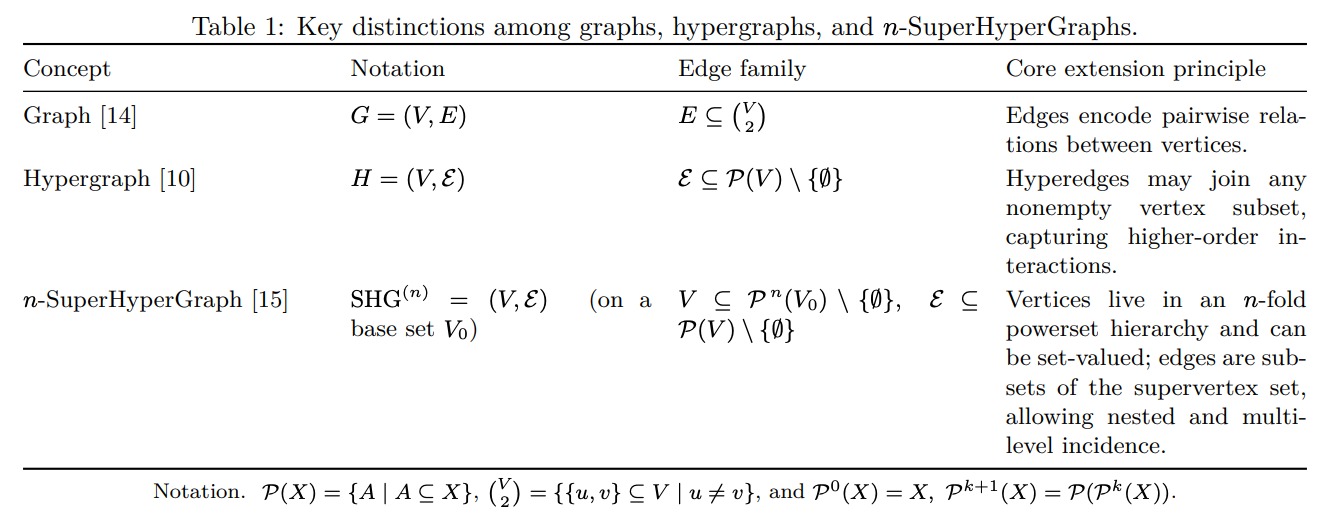
Graphs provide a standard language for representing connectivity via vertices and pairwise edges, yet many real interactions are genuinely higher–order. Hypergraphs capture such multiway relations by allowing each hyperedge to join an arbitrary nonempty vertex subset. To further model nested and hierarchical incidence, SuperHyperGraphs iterate the powerset construction over a finite base set, so that vertices may become set-valued objects across multiple levels. Motivated by uncertainty in modern relational data, we study hesitant neutrosophic sets, in which each element is described by a finite family of admissible truth–indeterminacy–falsity triples. This framework contains hesitant fuzzy sets and single-valued neutrosophic sets as special cases. We then transfer these semantics to network structures by introducing hesitant neutrosophic graphs and extending them to hesitant neutrosophic hypergraphs and hesitant neutrosophic superhypergraphs. The resulting hierarchy offers a unified formalism for representing uncertainty in pairwise, multiway, and multi-level relational systems.
References
[1] Lotfi A Zadeh. Fuzzy sets. Information and control, 8(3):338–353, 1965.
[2] Krassimir T Atanassov and G Gargov. Intuitionistic fuzzy logics. Springer, 2017.
[3] Haibin Wang, Florentin Smarandache, Yanqing Zhang, and Rajshekhar Sunderraman. Single valued neutrosophic sets. Infinite study, 2010.
[4] Florentin Smarandache. A unifying field in logics: Neutrosophic logic. In Philosophy, pages 1–141. American Research Press, 1999.
[5] Azriel Rosenfeld. Fuzzy graphs. In Fuzzy sets and their applications to cognitive and decision processes, pages 77–95. Elsevier, 1975.
[6] Muhammad Akram, Bijan Davvaz, and Feng Feng. Intuitionistic fuzzy soft k-algebras. Mathematics in Computer Science, 7:353–365, 2013.
[7] Said Broumi, Mohamed Talea, Assia Bakali, and Florentin Smarandache. Interval valued neutrosophic graphs. Critical Review, XII, 2016:5–33, 2016.
[8] Fazeelat Sultana, Muhammad Gulistan, Mumtaz Ali, Naveed Yaqoob, Muhammad Khan, Tabasam Rashid, and Tauseef Ahmed. A study of plithogenic graphs: applications in spreading coronavirus disease (covid-19) globally. Journal of ambient intelligence and humanized computing, 14(10):13139–13159, 2023.
[9] Jonathan L Gross, Jay Yellen, and Mark Anderson. Graph theory and its applications. Chapman and Hall/CRC, 2018.
[10] Alain Bretto. Hypergraph theory. An introduction. Mathematical Engineering. Cham: Springer, 1, 2013.
[11] Mohammad Hamidi, Florentin Smarandache, and Elham Davneshvar. Spectrum of superhypergraphs via flows. Journal of Mathematics, 2022(1):9158912, 2022.
[12] Takaaki Fujita and Florentin Smarandache. Representing Higher-Order Networks: A Survey of Graph-Based Frameworks. Neutrosophic Science International Association (NSIA) Publishing House, 2026.
[13] Takaaki Fujita and Florentin Smarandache. HyperGraph and SuperHyperGraph Theory with Applications. Neutrosophic Science International Association (NSIA) Publishing House, 2026.
[14] Reinhard Diestel. Graph theory. Springer (print edition); Reinhard Diestel (eBooks), 2024.
[15] Florentin Smarandache. Extension of HyperGraph to n-SuperHyperGraph and to Plithogenic n-SuperHyperGraph, and Extension of HyperAlgebra to n-ary (Classical-/Neutro-/Anti-) HyperAlgebra. Infinite Study, 2020.
[16] Hu Zhao and Hongying Zhang. On hesitant neutrosophic rough set over two universes and its application. Artificial Intelligence Review, 53:4387 – 4406, 2019.
[17] Run-yu Zhang, Mingyang Yu, and Yan Gao. A multi-attribute VIKOR decision-making method based on hesitant neutrosophic sets. Infinite Study, 2017.
[18] Vicenç Torra and Yasuo Narukawa. On hesitant fuzzy sets and decision. In 2009 IEEE international conference on fuzzy systems, pages 1378–1382. IEEE, 2009.
[19] Vicenç Torra. Hesitant fuzzy sets. International journal of intelligent systems, 25(6):529–539, 2010.
[20] Masoud Ghods, Zahra Rostami, and Florentin Smarandache. Introduction to neutrosophic restricted superhypergraphs and neutrosophic restricted superhypertrees and several of their properties. Neutrosophic Sets and Systems, 50:480–487, 2022.
[21] Said Broumi, Mohamed Talea, Assia Bakali, and Florentin Smarandache. Single valued neutrosophic graphs. Journal of New theory, 10:86–101, 2016.
[22] Muhammad Akram, Sundas Shahzadi, and Arsham Borumand Saeid. Single-valued neutrosophic hypergraphs. viXra, pages 1–14, 2018.
[23] Yongfeng Pang and Wei Yang. Hesitant neutrosophic linguistic sets and their application in multiple attribute decision making. Inf., 9:88, 2018.
[24] Julio Cesar Méndez Bravo, Claudia Jeaneth Bolanos Piedrahita, Manuel Alberto Méndez Bravo, and Luis Manuel PilacuanBonete. Integrating smed and industry 4.0 to optimize processes with plithogenic n-superhypergraphs. Neutrosophic Sets and Systems, 84:328–340, 2025.
Downloads
Published
Issue
Section
License
Copyright (c) 2026 Takaaki Fujita (Author)

This work is licensed under a Creative Commons Attribution 4.0 International License.
How to Cite