Exploring Perceptions of Teachers Toward Entrepreneurship Education at Secondary School Level in Lahore, Pakistan
DOI:
https://doi.org/10.64060/IJPSSD2V1i1Keywords:
Perceptions of Teachers, Entrepreneurship, Education at Secondary School, PakistanAbstract
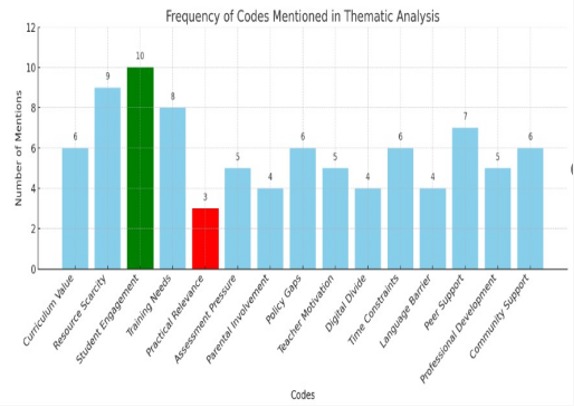
The study is a qualitative research project that examines perceptions of entrepreneurship education at the matric level among secondary school teachers in the province of Lahore, Pakistan, and fills an important gap in the education discourse. Based on the interpretive phenomenological approach, a thematic analysis of semi-structured interviews with 12 teachers across several private and public schools has been conducted. There were seven themes identified: (1) perceptions of curriculum relevance, highlighting its economic value but concerns about applicability; (2) teaching experiences, marked by enthusiasm yet challenges due to novelty; (3) challenges and opportunities, including resource scarcity offset by student engagement; (4) cultural and social influences, such as parental resistance; (5) support and resource needs, emphasizing training and materials; (6) perceived student impact, noting enhanced confidence and career awareness; and (7) balancing academic and entrepreneurial education, constrained by exam- focused systems. Results align with the literature from other parts of the world on the potential of entrepreneurship education, but highlight unique Pakistan challenges, such as cultural factors and limited access to resources. The paper presents practical guidance for curriculum designers, administrators, and policymakers to strengthen teacher support and implementation. Despite its small sample size, it adds a teacher's voice, making it clear that future studies on student giving and long-term effects should be conducted to strengthen Pakistan's entrepreneurship education system.
References
Anning, A. S. (2025). Professional learning facilitators' contribution to sustainable STEM teacher learning in regional contexts. International Journal of Educational Research Open, 8, 100406.
Bibi, S., Hassan, K. H. U., Shah, S. T. A., Akmal, F., & Saqib, M. (2024). Exploring the Perceptions of Teachers on the Impact of Professional Development Programs in Enhancing Teaching Quality. Journal of Asian Development Studies, 13(2), 312-322.
Buerkle, A., O'Dell, A., Matharu, H., Buerkle, L., & Ferreira, P. (2023). Recommendations to align higher education teaching with the UN sustainability goals–A scoping survey. International Journal of Educational Research Open, 5, 100280.
Diepolder, C. S., Huwer, J., & Weitzel, H. (2025). Effects of competence-based sustainable entrepreneurship education on secondary school students’ sustainable entrepreneurial intention. Sustainable Technology and Entrepreneurship, 4(2), 100103.
Esan, D. T., & Bayajidda, K. K. (2021). The perception of parents of high school students about adolescent sexual and reproductive needs in Nigeria: A qualitative study. Public Health in Practice, 2, 100080.
Henry, C., Wu, W., Moberg, K., Singer, S., Gabriel,
B., Valente, R., ... & Fannin, N. (2024). Exploring inclusivity in entrepreneurship education provision: A European study. Journal of Business Venturing Insights, 22, 00494.
Ho, C. S. M., Chiu, S. W. K., & Liu, L. C. K. (2025).
Middle leaders as catalysts for faux comprehension and pseudo-understanding: Teacher sensemaking challenges in curriculum reform. International Journal of Educational Research, 131, 102580.
Ivanov, S., Soliman, M., Tuomi, A., Alkathiri, N. A., & Al-Alawi, A. N. (2024). Drivers of generative AI adoption in higher education through the lens of the Theory of Planned Behaviour. Technology in Society, 77, 102521.
Mahajan, R., Lim, W. M., Kumar, S., & Sareen, M. (2023). COVID-19 and management education: From pandemic to endemic. The International Journal of Management Education, 21(2), 100801.
Martín-Gutiérrez, Á., Miguel, C. F. S., García-Mora,
M. E., & Montero-Pedrera, A. M. (2025). Effectiveness of the PElEO program to develop the entrepreneurial potential of Spanish students in Secondary Education and Vocational Training. Social Sciences & Humanities Open, 11, 101365.
Meng, J., Abed, A. M., Elsehrawy, M. G., Al Agha, A., Abdullah, N., Elattar, S., ... & Assilzadeh, H. (2024). Nano-integrating green and low-carbon concepts into ideological and political education in higher education institutions through K- means clustering. Heliyon, 10(10).
Molefi, R. R., Ayanwale, M. A., Kurata, L., & Chere- Masopha, J. (2024). Do in-service teachers accept artificial intelligence-driven technology? The mediating role of school support and resources. Computers and Education Open, 6, 100191.
Murtadlo, M., Albana, H., Nisa, Y. F., Izazy, N. Q.,
Sumiati, N. T., Dewi, M. S., ... & Henry, C. (2025). Inclusive education in Africa: Transforming higher education in low-income countries. Scientific African, e02708.
Rocha, R. G., do Paço, A., & Alves, H. (2024). Entrepreneurship education for non-business students: A social learning perspective. The International Journal of Management Education, 22(2), 100974.
Romero-Luis, J., Carbonell-Alcocer, A., Gertrudix, M., & Casado, M. D. C. G. (2021). What is the maturity level of circular economy and bioenergy research addressed from education and communication? A systematic literature review and epistemological perspectives. Journal of Cleaner Production, 322, 129007.
San-Martín, P., Fernández-Laviada, A., Pérez, A., & Palazuelos, E. (2021). The teacher of entrepreneurship as a role model: Students' and teachers’ perceptions. The International Journal of Management Education, 19(1), 100358.
Sullivan, S. E., & Al Ariss, A. (2021). Making sense of different perspectives on career transitions: A review and agenda for future research. Human Resource Management Review, 31(1), 100727.
Vedrenne-Gutiérrez, F., del Carmen López-Suero, C., De Hoyos-Bermea, A., Mora-Flores, L. P., Monroy-Fraustro, D., Orozco-Castillo, M. F., ... & Altamirano-Bustamante, M. M. (2024). The axiological foundations of innovation in STEM education–A systematic review and ethical meta-analysis. Heliyon.
Wardana, L. W., Narmaditya, B. S., Wibowo, A., Mahendra, A. M., Wibowo, N. A., Harwida, G., & Rohman, A. N. (2020). The impact of entrepreneurship education and students' entrepreneurial mindset: the mediating role of attitude and self-efficacy. Heliyon, 6(9).
Zarza-Alzugaray, F. J., Gil, D. G., Casanova, O., & Orejudo, S. (2021). A scale to measure educators’ musical skills in early childhood education. Studies in Educational Evaluation, 71, 101085.
Downloads
Published
Issue
Section
License
Copyright (c) 2025 Muhammad Shafqat Rasool , Ali Sajjad, Iqra Mehroush (Author)

This work is licensed under a Creative Commons Attribution 4.0 International License.