Analyzing the Role of Social Media in Shaping Modern English Grammar: A Study of Grammatical Deviations and Innovations in Digital Communication
DOI:
https://doi.org/10.64060/IJPSSDV2i13Keywords:
Social media, Linguistic evolution, English grammar, Online communicationAbstract
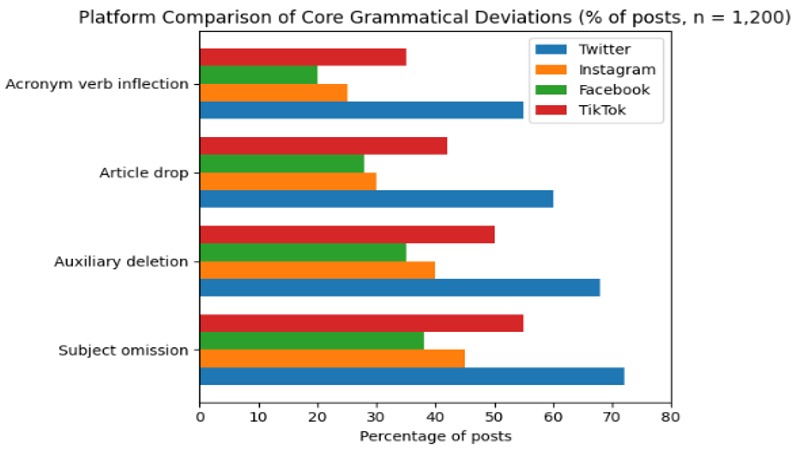
The Study discusses the linguistic shifts with the help of social media and explains the impact of social media platforms, including Twitter, Instagram, TikTok, and Facebook, on English grammar, vocabulary, and syntax. The Study implements a qualitative methodology that explores the areas of semi-structured interviews, content analysis of social media messages, and participant observations to learn about how the users of social media understand and embrace language change. The significant observations suggest that sentence structures are simplified. These grammar and vocabulary innovations indicate the informality of online communication, in which brevity and expressiveness are valued. The analysis shows that the limitations of the platform, the number of characters in the Twitter feed, have a strong impact on grammatical decisions, favoring shorter and more fragmented sentences. Although such changes are welcomed by a large number of users, there is still a concern over the erosion of the formal language standards in an academic and professional setting. This Study highlights the necessity of revised linguistic models that can accommodate the changing character of language in online communication and the implications of these changes to education, language policy, and content production.
References
Ghosh, S. S. (2024). Unraveling Contemporary Language Changes in Online Communication Through Corpus Linguistics. In Exploring Technology-Infused Education in the Post-Pandemic Era (pp. 314-334). IGI Global.
Malik, B., Iftikhar, F., & Gurmani, T. (2025). Transformative impact of Social Media platforms on Language Evolution: Creation and Adoption of Emerging Lexicon. Journal of Arts and Linguistics Studies, 3(1), 249-268.
Umurzakova, K. (2025). Linguistic Variations In Social Media And The Digital Environment: A Study On Contemporary Language Practices. TLEP–International Journal of Multidiscipline, 2(2), 292-299.
Shokhrukh, A. (2024). The Influence of Internet Memes on English Vocabulary and Grammar. University Research Base, 77-85.
Qadri, F. Y., Khan, J., & Mangrio, A. M. (2025). The Role of Social Media in Shaping University Students' Grammar in Academic Writing. Journal for Current Sign, 3(3), 597-615.
Shahbaz, M., Jahan, J., & Haider, A. (2024). WhatsApp Language as a Digital Dialect: Examining the Evolution of Distinct Vocabulary, Grammar, and Conventions. Dialogue Social Science Review (DSSR), 2(5), 453-471.
Makulilo, P. B. (2025). Morphological Productivity and Lexical Innovation in Swahili: Digital Communication and Language Transformation in Social Media Spaces. Language, Technology, and Social Media, 3(2), 231-249.
Alshehri, N. (2025). Linguistic Variation and Change in Online Communities. Journal of Arts, Literature, Humanities and Social Sciences, (116), 360-372.
Ashrafova, I. (2023). Influence of English on Modern French: A Study Based on Mass Media Content. CHEMISTRY SCIENCES, 32.
Shen, Y. (2024, March). Impact of Social Media on the Evolution of English Semantics Through Linguistic Analysis. In Forum for Linguistic Studies (Transferred) (Vol. 6, No. 2, pp. 1184-1184).
Wijesinghe, R., & Samarasinghe, R. (2025). Exploring Language Change in Digital Communication: A Survey of Social Media's Impact.
Downloads
Published
Issue
Section
License
Copyright (c) 2026 Nadia Safeer (Author)

This work is licensed under a Creative Commons Attribution 4.0 International License.