
Power Generalized KM-Transformation for Non-Monotone Failure Rate Distribution
DOI:
https://doi.org/10.64060/JASR.v1i3.1Keywords:
KM-Transformation, PGKM Transformation, Exponential distribution, Bathtub shaped failure rate, ReliabilityAbstract
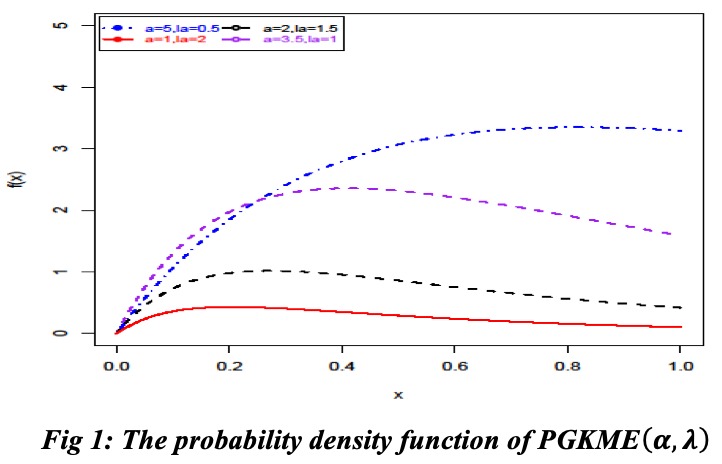
A more useful transformation model, KM Transformation, for reliability and lifetime data analysis is introduced by Kavya & Manoharan (2021). Power generalization technique is the best approach for analysing a parallel system. In this article, we present a new transformation called Power Generalized KM-Transformation (PGKM) to obtain a more appropriate model while monotone and non-monotone behaviour for the failure rate function occurs. We derived the moments, moment generating function, characteristic function, quantiles, etc. for the PGKM transformation of Exponential distribution (PGKME). Distributions of minimum and maximum are obtained. Estimation of parameters of the PGKME distribution is performed via maximum likelihood method, method of moment, and least square estimation method. A simulation study is performed to validate the maximum likelihood estimator (MLE). Analysis of three sets of real data is provided.
Downloads
References
Alkarni S.H.(2015), Extended inverse Lindley distribution: properties and application, Springer Plus., 4: 690.DOI 10.1186/s40064-015-1489-2.
Amrutha, M. & Chacko, V. M. (2024). Power Generalized DUS Transformation of Inverse Kumaraswamy Distribution and Stress-Strength Analysis. Statistics and Applications, 22(2), 323–359.
Anakha, K. K. & Chacko, V. M. (2021). Dus-Kumaraswamy distribution: A bathtub shaped failure rate model. International Journal of Statistics and Reliability Engineering, 8(3), 359-367. Bh
Deepthi K.S and Chacko V.M., An Upside-down Bathtub Shaped Failure rate model using a DUS-Transformation of Lomax distribu-tion;in Cui L., FrenkelI. and Lisnianski A., eds., Stochastic Models in Reliability Engineering, Boca Raton: CRC press, Taylor &Francis Group, 2020: 81-100.
Dimitrakopoulou, T., Adamidis, A. and Loukas, S.,(2007) A Lifetime Distribution With an Upside-Down Bathtub-Shaped Hazard Function, J. IEEE Trans. Relia., 56(2): 308-311. DOI:10.1109/TR.2007.895304.
Efron, B. (1988). Logistic Regression, Survival Analysis, and the Kaplan-Meier Curve. Journal of the American Statistical Associa-tion, 83(402), 414–425.
https://doi.org/10.1080/01621459.1988.10478612
Gauthami, P., & Chacko, V. M. (2021). Dus transformation of inverse Weibull distribution: an upsidedown failure rate model. Reli-ability: Theory & Applications, 16(2 (62)), 58-71.
Glaser, R. E. (1980). Bathtub and Related Failure Rate Characterizations. Journal of the American Statistical Association, 75(371), 667–672. https://doi.org/10.1080/01621459.1980.10477530
Ghitany M.E., Al-Mutairi D.K., Balakrishnan N. and Al-EneziI.(2013), Power Lindley distribution and associated inferenceComp. Stat. and Data Anal., 64(9): 20-33.DOI 10.1016/j.csda.2013.02.026.
Gupta R.D. and Kundu D.(1999), Theory & Methods: Generalized exponential distributions, Australian and New Zealand J. Stat., 41: 173-188. DOI 10.1111/1467-842X.00072.
Kavya P. and Manoharan M., On a generalized lifetime model using DUS transformation;in JoshuaV., Varadhan S., Vishnevsky V.,eds., Applied probability and stochastic processes, infosys science foundation series, Springer, Singapore, 2020.
Kavya, P. and Manoharan, M. (2021) Some Parsimonious Models for Lifetimes and Applications. Journal of Statistical Computa-tion and Simulation, 91, 3693-3708.
https://doi.org/10.1080/00949655.2021.1946064
Kundu, D., Exponentiated exponential distribution. Encyclopaedia of Statistical Sciences, 2ndEdn., Wiley, New York,2004.
Maurya, S. K., Kaushik, A., Singh, S. K., & Singh, U. (2017). A new class of distribution having decreasing, increasing, and bath-tub-shaped failure rate. Communications in Statistics - Theory and Methods, 46(20), 10359–10372. https://doi.org/10.1080/03610926.2016.1235196
Meeker W.Q. and Escobar L.A.,Statistical Methods for Reliability Data. Wiley, New York, 1998.
Murthy D.N.P., Xie M. and Jiang R., Weibull Models. Wiley, New York, 2004.
Nadarajah, S., Bakouch, H.S. & Tahmasbi, R. A generalized Lindley distribution. Sankhya B 73,
331–359 (2011). https://doi.org/10.1007/s13571-011-0025-9
Shaked M. and Shanthikumar J. G., Stochastic Orders. Springer, New York, 2007.
Sharma V.K., Singh S.K. and Singh U.(2014), A new upside-down bathtub shaped hazard rate model for survival data analysis, J. Appl. Math. Comp., 239: 242-253. DOI 10.1016/j.amc.2014.04.048.
Tahir M., Alizadeh M., Mansoor M., Cordeiro G.M., Zubair M.(2016), The Weibull-Power Function Distribution with Applications, Hacettepe J. Math. and Stat., 45: 245-265.DOI 10.15672/HJMS.2014428212.
Thomas, B. & Chacko, V. M. (2021). Power Generalized DUS Transformation of Exponential Distribution. International Journal of Statistics and Reliability Engineering, 9(1), 150-157.
Thomas, B. & Chacko, V. M. (2023). Power Generalized DUS Transformation in Weibull and Lomax Distributions. Reliability: Theory and Applications, 18(1), 368-384.
Downloads
Published
Issue
Section
License
Copyright (c) 2025 SCOPUA Journal of Applied Statistical Research

This work is licensed under a Creative Commons Attribution 4.0 International License.
How to Cite