
An Enhanced Burr Type III Distribution: Simulation Studies and Practical Applications
DOI:
https://doi.org/10.64060/JASR.v1i3.2Keywords:
NEBIII, MEBE, MLEAbstract
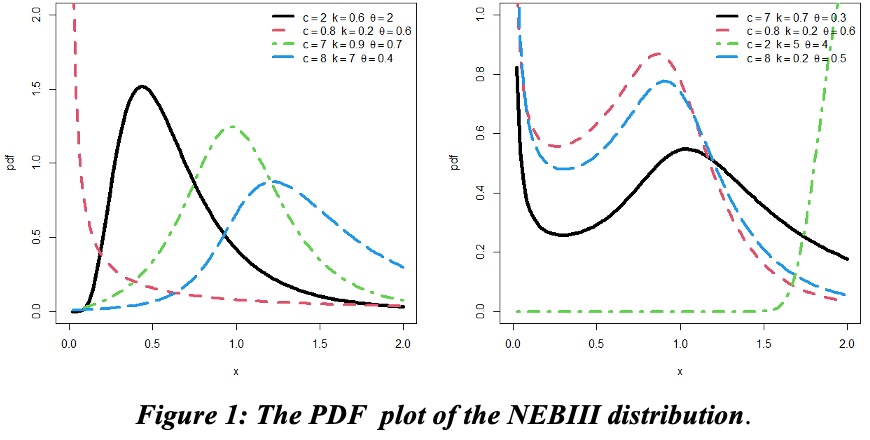
In this paper, we introduce a new three-parameter distribution, the New Exponentiated Burr Type III distribution (NEBIII), which is a member of the Generalized (G)-family of continuous distributions. The mathematical features that are derived include the mode, actuarial measures, order statistics, the analytical forms of the density and hazard functions, and explicit formulations for the moment generating function (MGF). The Maximum Likelihood Estimation (MLE) approach is used to estimate the model parameters. A simulated research with different sample sizes is used to evaluate the estimation's efficacy. The versatility and adaptability of the proposed distribution family are demonstrated on four real-world data sets. Additionally, we examine a Mixture of the Exponential and Exponentiated Burr Type III Distributions, identifying various mathematical characteristics and demonstrating their application to actual data.
Downloads
References
[1] S. Nasiru, P. N. Mwita, and O. Ngesa, “Exponentiated gen- eralized power series family of distributions,” Annals of Data Science, vol. 6, no. 3, pp. 463–489, 2019.
[2] Y. L. Tung, Z. Ahmad, O. Kharazmi, C. B. Ampadu, E. H. Hafez, and S. A. Mubarak, “On a new modification of the Weibull model with classical and Bayesian analysis,” Com- plexity, vol. 2021, Article ID 5574112, 19 pages, 2021.
[3] O. S. Balogun, M. Z. Iqbal, M. Z. Arshad, A. Z. Afify, and P. E. Oguntunde, “A new generalization of Lehmann type-II distribution: theory, simulation, and applications to survival and failure rate data,” Scientific African, vol. 12, e00790, 2021.
[4] Lehmann, E.L. The power of rank tests. Ann. Math. Stat. 1952, 24, 23–43
[5] Murthy, D. N. P. and Jiang R. (1998) Mixture of Weibull distribution parameter characterization of failure date function, pp 47-65, John Wiley and Sons. Ltd
[6] Sultan. K.S, M.A. Ismail, A.S. Al-Moisheer (2006) Mixture of two inverse Weibull distributions Properties and estimation, Comp. Stat. Data Ana. 51, 5377 - 5387.
[7] Kareema Abulkadhum Makhrib (2012) On finite mixture of inverse Weibull distribution, Proc. ICCS- 12, Doha Qatar December 19-22, 2012, Vol.23, 53-60.
[8] Handique, L., Usman, R. M., & Chakraborty, S. (2020). New Extended Burr-III Distribution: Its Properties and Applications. Thailand Statistician, 18(3), 267-280.
[9] Yang, H., Huang, M., Chen, X., He, Z., & Pu, S. (2024). Enhanced real-life data modeling with the modified Burr III odds ratio–G distribution. Axioms, 13(6), 401.
[10] Jamal, F., Nasir, M. A., Tahir, M. H., & Montazeri, N. H. (2017). The odd Burr-III family of distributions. Journal of Statistics Applications and Probability, 6(1), 105-122.
[11] Nkomo, W., Oluyede, B., & Chipepa, F. (2024). The new odd Burr III-G power series class of distributions: properties and applications to censored and uncensored data. International Journal of Mathematical Modelling and Numerical Optimisation, 14(3-4), 109-140.
[12] Deepthy, G. S., Sebastian, N., & Chandra, N. (2023). Applications of Burr III-Weibull quantile function in reliability analysis. Statistical Theory and Related Fields, 7(4), 296-308.
[13] Noori, N., & Khaleel, M. (2025). The Modified Burr-III Distribution Properties, Estimation, Simulation, with Application on Real Data. Iraqi Statisticians journal, 2(special issue for ICSA2025), 225-246.
[14] Burr IW (1942) Cumulative frequency functions. Ann Math Stat 13(2):215–232.
[15] Muhammad, M., & Liu, L. (2022). A new extension of the beta generator of distributions. Mathematica Slovaca, 72(5), 1319–1336.
[16] Muhammad, M., Liu, L., Abba, B., Muhammad, I., Bouchane, M., Zhang, H., et al. (2023). A new extension of the Topp–Leone-family of models with applications to real data. Annals of Data Science, 10(1), 225–250.
[17] Abbas, S., Muhammad, M., Jamal, F., Chesneau, C., Muhammad, I., & Bouchane, M. (2023). A new extension of the Kumaraswamy generated family of distributions with applications to real data. Computation, 11(2), 26.
[18] Lorenz, M. O. (1905). Methods of measuring the concentration of wealth. Publications of the American statistical association, 9(70), 209-219.
[19] Bonferroni C.E. (1930). Elmenti di statistica generale. Libreria Seber, Firenze.
[20] Zenga M.(1984). Argomenti di Statistica, Vita e Pensiero, Milano Methods of measuring the concentration of wealth. Publications of the American statistical association, 9(70), 209-219.
[21] Pietra, G. (1915). Delle relazioni tra gli indici di variabilitā. C. Ferrari.
[22] Barter, H. L. (1988). History and role of order statistics. Communications in Statistics. Theory and Methods, 17(7), 2091–2107.
[23] Shrahili, M., & Kayid, M. (2023). Excess lifetime extropy of order statistics. Axioms, 12(11), 1024
[24] Artzner, P., Delbaen, F., Eber, J. M., & Heath, D. (1999). Coherent measures of risk. Mathematical Finance, 9(3), 203–228.
[25] Murthy, D.N.P., Xie, M. and Jiang, R. (2004) Weibull Models. John Wiley & Sons, New York.
Downloads
Published
Issue
Section
License
Copyright (c) 2025 SCOPUA Journal of Applied Statistical Research

This work is licensed under a Creative Commons Attribution 4.0 International License.
How to Cite