
Impact of Hypertension and Other Comorbidities on Stroke Subtypes among Patients in Anambra State Teaching Hospital Awka, Nigeria
DOI:
https://doi.org/10.64060/JASR.v1i3.7Keywords:
Ischemic stroke, Haemorrhagic stroke, Hypertension; Risk factors, Multinomial logistic regression, EpidemiologyAbstract
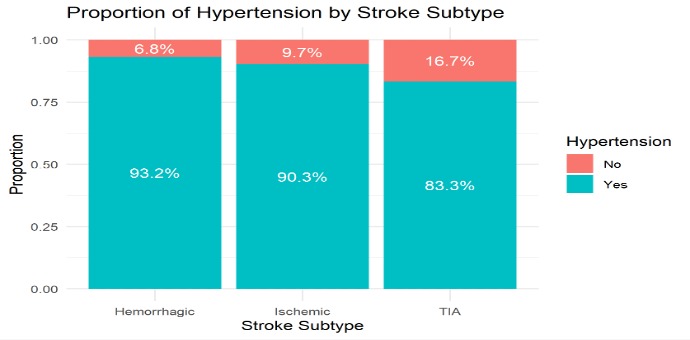
Stroke continues to be a major cause of illness and death. Its occurrence is greatly affected by modifiable risk factors. This study aimed to describe the demographic and clinical characteristics of stroke patients and to explore the relationship between hypertension and stroke subtype. A retrospective cross-sectional analysis of 264 stroke patients was conducted. Continuous variables using means, medians, and interquartile ranges were summarized. Categorical variables were described with frequencies and percentages. The prevalence estimates with 95% confidence intervals (CIs) were calculated. Fisher’s Exact Test assessed the simple association between hypertension and stroke subtype (ischemic, haemorrhagic, transient ischemic attack [TIA]). A multinomial logistic regression model, adjusted for age and gender were applied, to estimate adjusted odds ratios (aORs) with 95% CIs, using ischemic stroke as the reference category. The average age was 59.1 years (SD = 16.3), and mean BMI was 29.9 (SD = 6.36), indicating a predominance of overweight and obesity (BMI ≥ 25). Hypertension was the most common comorbidity (91.3%, 95% CI: 87.2–94.4), followed by hyperlipidaemia (97%) and high cholesterol (35%). Type 2 diabetes (11%) and heart disease (26.9%) were less common. Fisher’s Exact Test showed no statistically significant association between hypertension status and stroke subtype (p = 0.362). Stroke subtype distribution was as follows: ischemic stroke (58.7%), haemorrhagic stroke (39.0%), and transient ischemic attack (TIA) (2.3%). In logistic regression analysis, hypertension was not significantly related to haemorrhagic stroke (aOR = 1.47, 95% CI: 0.58–3.76) or TIA (aOR = 0.55, 95% CI: 0.06–5.22) compared to ischemic stroke. Stroke patients in this group were mostly older, obese, and had high blood pressure. Although hypertension was quite common, it did not significantly vary by stroke subtype, highlighting its role as a universal risk factor across different types of strokes.
References
Adeloye, D., Odeyemi, Y. E., Odukoya, O. O., Chikwendu, C., Oyegoke, A., Opanuga, O. T., Sogbesan, E., Nwachukwu, N. E., Ogunlana, O., Ghaffar, Y. A., and Dewan, M. T. (2023). Epidemiology of stroke in Africa: A systematic review. Journal of Stroke Medicine, 6(1), 13–27.
Akinyemi, R. O., Ovbiagele, B., Adeniji, O. A., Sarfo, F. S., Abd-Allah, F., Adoukonou, T. and Owolabi, M. O. (2022). Stroke in Africa: profile, progress, prospects and priorities. Nature Reviews Neurology, 18(9), 547–562.
Benjamin, E. J., Muntner, P., Alonso, A., Bittencourt, M. S., Callaway, C. W., Carson, A. P. and Virani, S. S. (2023). Heart dis-ease and stroke statistics—2023 update: A report from the American Heart Association. Circulation, 147(8), e93–e621
Ejike, U. C., Ezeani, I. U., Olawumi, H. O., Idoko, E. E., Eze, C. U. and Dunga, K. E. (2022). Prevalence and correlates of meta-bolic syndrome among adults in a Nigerian population: A cross-sectional study. Journal of Diabetes & Metabolic Disorders, 21(1), 233–241.
Feigin, V. L., Stark, B. A., Johnson, C. O., Roth, G. A., Bisignano, C., Abady, G. G. and Murray, C. J. L. (2022). Global, re-gional, and national burden of stroke and its risk factors, 1990–2019: a systematic analysis for the Global Burden of Disease Study 2019. The Lancet Neurology, 20(10), 795–820.
Hosmer, D. W., Lemeshow, S. and Sturdivant, R. X. (2013). Applied Logistic Regression (3rd ed.). John Wiley & Sons.
Ogah, O. S., Okpechi, I., Chukwuonye, I. I., Akinyemi, J. O., Onwubere, B. J., Falase, A. O. and Rayner, B. (2022). Blood pres-sure, prevalence of hypertension and hypertension related complications in Nigerian Africans: A review. World Journal of Cardi-ology, 14(1), 11–24.
Ojji, D. B., Mayosi, B. M., Francis, V., Badri, M. and Cornelius, V. (2019). The role of hypertension in the pathogenesis of heart failure and stroke in sub-Saharan Africa. Journal of the American College of Cardiology, 73(20), 2589–2597.
Owolabi, M. O., Thrift, A. G., Martins, S., Johnson, W., Pandian, J., Abd-Allah, F., Varghese, C., Mahal, A., Yaria, J., Phan, H. T., Roth, G., Gall, S., Beare, R., Hamadeh, R., Kengne, A. P., Guekht, A., Sacco, S., Norrving, B., Davis, S. and N. S. (2022). The burden of stroke in Africa: a systematic review and meta-analysis. The Lancet Neurology, 21(10), 927–937.
R Core Team. (2024). R: A language and environment for statistical computing. R Foundation for Statistical Computing.
Ulasi, I. I., Ijoma, C. K., Onodugo, O. D., Arodiwe, E. B., Ifebunandu, N. A. and Okoye, J. U. (2021). Towards prevention of hy-pertension and cardiovascular disease in Nigeria: a nationwide survey of risk factors. Cardiovascular Journal of Africa, 32(2), 85–91.
Wahab, K. W., Okeke, O. C. and Kayode, K. A. (2023). Young stroke in Sub-Saharan Africa: a systematic review. Journal of Stroke and Cerebrovascular Diseases, 32(6), 107110.
Wilson, E. B. (1927). Probable inference, the law of succession, and statistical inference. Journal of the American Statistical Associa-tion, 22(158), 209–212.
World Health Organization. (2000). Obesity: Preventing and managing the global epidemic (Report of a WHO Consultation, WHO Technical Report Series 894).
Downloads
Published
Issue
Section
License
Copyright (c) 2025 SCOPUA Journal of Applied Statistical Research

This work is licensed under a Creative Commons Attribution 4.0 International License.
How to Cite