
Deep Learning-Based Survival Analysis and Recurrence Prediction in Breast Cancer Patients Using Clinical and Genomic Data
DOI:
https://doi.org/10.64060/JASR.v2i1.4Keywords:
Cox regression, Histopathological, Nottingham-Prognostic-Index, Recurrence, SHAP analysisAbstract
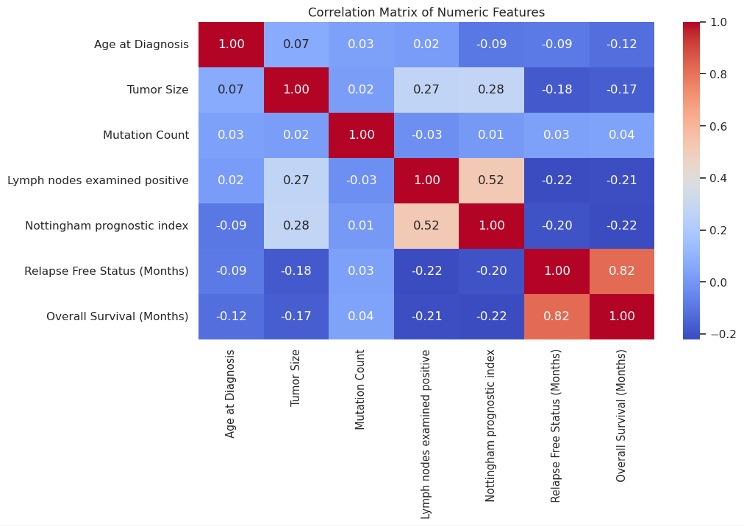
Reliable survival prediction is essential for personalised management of breast cancer, yet conventional models often fail to capture complex interactions among clinical, pathological, and genomic features. This study applied a deep learning framework (DeepSurv) to a cohort of 2,509 breast cancer patients, integrating clinical, histopathological, and genomic data to predict overall survival (OS) and relapse-free survival (RFS). Exploratory analysis revealed a median age at diagnosis of 60.4 years, a median tumour size of 26 mm, and a median of 0 positive lymph nodes, with a relapse rate of ~40%. DeepSurv demonstrated superior predictive performance compared to classical Cox regression, achieving C-index values of 0.7567 (OS) and 0.6495 (RFS) versus 0.7038 (OS) and 0.6403 (RFS) for Cox models. SHAP analysis identified positive lymph nodes, tumour grade, tumour size, age, and Nottingham Prognostic Index (NPI) as the most influential predictors, while mutation count and treatment variables contributed moderately. Survival curves indicated higher individualised survival probabilities with DeepSurv, reflecting improved sensitivity to patient-specific risk patterns. Classical Cox regression performed adequately but exhibited reduced discriminatory power, particularly for RFS. These findings demonstrate that deep learning models can integrate multi-modal data, enhance predictive accuracy, and maintain interpretability, supporting patient stratification and informed clinical decision-making. Future work should incorporate additional molecular and treatment-response data to improve relapse prediction further.
References
Baidoo, T.G. and Rodrigo, H., 2025. Data-driven survival modeling for breast cancer prognostics: A comparative study with machine learning and traditional survival modeling methods. PloS one, 20(4), p.e0318167.
Christensen, E. (1987). Multivariate survival analysis using cox’s regression model. Hepatology, 7 (6).
Chukwu, A. U., & Folorunso, S. (2016). Determinant of flexible Parametric Estimation of Mixture Cure Fraction Model: An Application of Gastric cancer Data. West African Journal of Industrial and Academic Research, 15(1), 139–156. Retrieved from https://www.ajol.info/index.php/wajiar/article/view/138262
Collett, D. (2023). Modelling survival data in medical research. Chapman and Hall/CRC.
Coombes, R.C., Angelou, C., Al-Khalili, Z., Hart, W., Francescatti, D., Wright, N., Ellis, I., Green, A., Rakha, E., Shousha, S. and Amrania, H., 2024. Performance of a novel spectroscopy-based tool for adjuvant therapy decision-making in hormone receptor-positive breast cancer: A validation study. Breast Cancer Research and Treatment, 205(2), pp.349-358.
Fernández-Pacheco, M., Gerken, M., Ignatov, A., Seitz, S., Kowalski, C., Sturm-Inwald, E.C., Hatzipanagiotou, M.E. and Ortmann, O., 2025. Chemotherapy in elderly patients with early breast cancer: a systematic review. Archives of Gynecology and Obstetrics, pp.1-32.
Folorunso, S. A. et al. (2025). Statistical AI Models for Environmental Sustainability: ARIMA, LSTM, and CNN-LSTM in Climate Prediction. In: Nasr, M., Negm, A., Peng, L. (eds) Artificial Intelligence Applications for a Sustainable Environment. Green Chemistry and Sustainable Technology. Springer, Cham. https://doi.org/10.1007/978-3-031-91199-6_15.
Folorunso, Serifat A, Kehinde, Richard O, Folorunso, Morufu A. (2025). Predicting employee retention using artificial intelligence and survival analysis approaches. DOI link: https://doi.org/10.21608/jaiep.2025.431657.1030
Folorunso, Serifat, Alsmadi, Hiba, Kafari, Ala, & Kandasamy, Gok. (2024). Autistic Spectrum Disorder Screening Classification with Machine Learning Approaches. Proceedings of the 2024 International Conference on Information Management and System Applications (IMSA), 372–377. https://doi.org/10.1109/IMSA61967.2024.10652779
Georgiesh, T., Aggerholm-Pedersen, N., Schöffski, P., Zhang, Y., Napolitano, A., Bovee, J.V., Hjelle, Å., Tang, G., Spalek, M., Nannini, M. and Swanson, D., 2022. Validation of a novel risk score to predict early and late recurrence in solitary fibrous tumour. British journal of cancer, 127(10), pp.1793-1798.
Heer, E., Harper, A., Escandor, N., Sung, H., McCormack, V. and Fidler-Benaoudia, M.M., 2020. Global burden and trends in premenopausal and postmenopausal breast cancer: a population-based study. The Lancet Global Health, 8(8), pp.e1027-e1037.
Howard, F.M., Dolezal, J., Kochanny, S. et al. Integration of clinical features and deep learning on pathology for the prediction of breast cancer recurrence assays and risk of recurrence. npj Breast Cancer 9, 25 (2023). https://doi.org/10.1038/s41523-023-00530-5
Liu, Y., He, M., Zuo, W.J., Hao, S., Wang, Z.H. and Shao, Z.M., 2021. Tumor size still impacts prognosis in breast cancer with extensive nodal involvement. Frontiers in Oncology, 11, p.585613.
Łukasiewicz, S., Czeczelewski, M., Forma, A., Baj, J., Sitarz, R., & Stanisławek, A. (2021). Breast cancer—epidemiology, risk factors, classification, prognostic markers, and current treatment strategies—an updated review. Cancers, 13(17), 4287.
Mahmoud, A., Alhussein, M., Aurangzeb, K., & Takaoka, E. (2024). Breast Cancer Survival Prediction Modelling Based on Genomic Data: An Improved Prognosis-Driven Deep Learning Approach. IEEE Access.
Noman, S. M., Fadel, Y. M., Henedak, M. T., Attia, N. A., Essam, M., Elmaasarawii, S., ... & Al-Atabany, W. (2025). Leveraging survival analysis and machine learning for accurate prediction of breast cancer recurrence and metastasis. Scientific Reports, 15(1), 3728.
Ogutu, S., Mohammed, M., and Mwambi, H. (2025). Deep learning models for the analysis of highdimensional survival data with time-varying covariates while handling missing data. Discov Artif Intell 5, 176.
Qiu, X., Gao, J., Yang, J., Hu, J., Hu, W., Kong, L. and Lu, J.J., 2020. A comparison study of machine learning (random survival forest) and classic statistics (cox proportional hazards) for predicting progression in high-grade glioma after proton and carbon ion radiotherapy. Frontiers in oncology, 10, p.551420.
Roblin, E., 2023. Survival Prediction using Artificial Neural Networks on Censored Data (Doctoral dissertation, Université Paris-Saclay).
SA Folorunso., TAO Oluwasola, AU Chukwu and AA Odukogbe . 2021. Estimating the admission lifetime and survival for gynaecological cancers at the University College Hospital, Ibadan using cox regression model. Afr. J. Med. Med. Sci. (2021) 50, 357-364.
Salam, S., Hopkinson, G., Udomboso, C.G., Folorunso, S. (2025). Optimizing the Performance of Diabetes Risk Prediction Using Ensemble Learning Techniques. In: Kumar, A., Swaroop, A., Shukla, P. (eds) Proceedings of Fourth International Conference on Computing and Communication Networks. ICCCN 2024. Lecture Notes in Networks and Systems, vol 1317. Springer, Singapore. https://doi.org/10.1007/978-981-96-3942-7_16
Srivastava, N., Hinton, G., Krizhevsky, A., Sutskever, I., and Salakhutdinov, R. (2014). Dropout: a simple way to prevent neural networks from overfitting. The Journal of Machine Learning Research, 15 (1).
Suwardi Annas, Aswi Aswi, Irwan -, Muth Hair, Mardatunnisa Isnaini, Bobby Poerwanto, Serifat Adedamola Folorunso, Socio-demographic and clinical factors in stroke patients: a survival analysis approach, Commun. Math. Biol. Neurosci., 2025 (2025), Article ID 77
Swanson, K., Wu, E., Zhang, A., Alizadeh, A.A. and Zou, J., 2023. From patterns to patients: Advances in clinical machine learning for cancer diagnosis, prognosis, and treatment. Cell, 186(8), pp.1772-1791.
Tong, L., Mitchel, J., Chatlin, K. et al. Deep learning based feature-level integration of multi-omics data for breast cancer patients survival analysis. BMC Med Inform Decis Mak 20, 225 (2020). https://doi.org/10.1186/s12911-020-01225-8
Tripathi, A., Waqas, A., Venkatesan, K., Yilmaz, Y. and Rasool, G., 2024. Building flexible, scalable, and machine learning-ready multimodal oncology datasets. Sensors, 24(5), p.1634.
Wang, C., Chen, X., Luo, H., Liu, Y., Meng, R., Wang, M., Liu, S., Xu, G., Ren, J. and Zhou, P., 2021. Development and internal validation of a preoperative prediction model for sentinel lymph node status in breast cancer: combining radiomics signature and clinical factors. Frontiers in Oncology, 11, p.754843.
Weth, F.R., Hoggarth, G.B., Weth, A.F., Paterson, E., White, M.P., Tan, S.T., Peng, L. and Gray, C., 2024. Unlocking hidden potential: advancements, approaches, and obstacles in repurposing drugs for cancer therapy. British journal of cancer, 130(5), pp.703-715.
Wiegrebe, S., Kopper, P., Sonabend, R., Bischl, B. and Bender, A., 2024. Deep learning for survival analysis: a review. Artificial Intelligence Review, 57(3), p.65.
Wilkinson, L. and Gathani, T., 2022. Understanding breast cancer as a global health concern. The British journal of radiology, 95(1130), p.20211033.
Xiao, J., Mo, M., Wang, Z., Zhou, C., Shen, J., Yuan, J., He, Y. and Zheng, Y., 2022. The application and comparison of machine learning models for the prediction of breast cancer prognosis: retrospective cohort study. JMIR medical informatics, 10(2), p.e33440.
Yang, X., Qiu, H., Wang, L. and Wang, X., 2023. Predicting colorectal cancer survival using time-to-event machine learning: retrospective cohort study. Journal of Medical Internet Research, 25, p.e44417.
Zehua Wang, Ruichong Lin, Yanchun Li, Jin Zeng, Yongjian Chen, Wenhao Ouyang, Han Li, Xueyan Jia, Zijia Lai, Yunfang Yu, Herui Yao, Weifeng Su, Deep learning-based multi-modal data integration enhancing breast cancer disease-free survival prediction, Precision Clinical Medicine, Volume 7, Issue 2, June 2024, pbae012, https://doi.org/10.1093/pcmedi/pbae012
Zhang, C., Li, N., Zhang, P., Jiang, Z., Cheng, Y., Li, H. and Pang, Z., 2024. Advancing precision and personalized breast cancer treatment through multi-omics technologies. American Journal of Cancer Research, 14(12), p.5614.
Zheng, J., Zeng, B., Huang, B., Wu, M., Xiao, L. and Li, J., 2024. A nomogram with Nottingham prognostic index for predicting locoregional recurrence in breast cancer patients. Frontiers in oncology, 14, p.1398922.
Zuo, D., Yang, L., Jin, Y., Qi, H., Liu, Y., & Ren, L. (2023). Machine learning-based models for the prediction of breast cancer recurrence risk. BMC Medical Informatics and Decision Making, 23(1), 276.
Downloads
Published
Issue
Section
License
Copyright (c) 2026 Serifat Folorunso , Richard Oluwaseun Kehinde , Ibrahim Arionola Fayemi , Sukurat Salam (Author)

This work is licensed under a Creative Commons Attribution 4.0 International License.
How to Cite