Socioeconomic and Demographic Study of the Determinants of Anaemia Prevalence Among Women in Nigeria
DOI:
https://doi.org/10.64060/JASR2V2i1Keywords:
Anaemia, Socio-economic Factors, Nigeria, NDHS, Ordinal RegressionAbstract
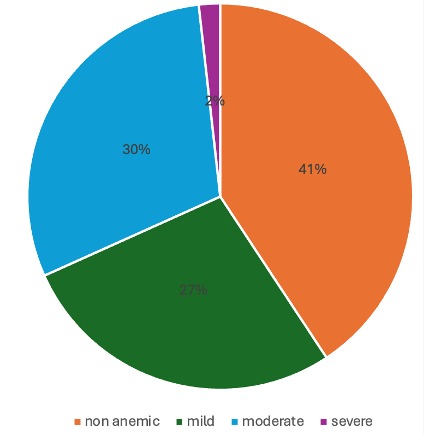
Anaemia remains a significant public health issue among women of reproductive age, especially in developing countries like Nigeria. This study examines the influence of socio-economic and demographic factors on anaemia among women in Nigeria using data from the 2018 Nigeria Demographic and Health Survey (NDHS). Variables analyzed include age, marital status, body mass index (BMI), education level, wealth index, pregnancy status, contraceptive use, region, place of residence, ethnicity, media exposure, and access to improved water. We first used descriptive statistics and Pearson's chi-square tests to explore links between women's anaemia status and key factors like residence, education, and wealth. Variables showing significant associations at this stage were then examined further with a partial proportional odds model, chosen to properly handle the ordered categories of anaemia severity (non-anaemic, mild, moderate, severe). Among the women surveyed, 41% had no anaemia, while 27% showed mild anaemia, 30% moderate anaemia, and 2% severe anaemia. Rural living, lower education evels, poorer household wealth, current pregnancy, lack of improved water access, and certain regional differences all raised the odds of severe anaemia significantly. The study concludes that socio-economic inequalities play a significant role in the burden of anaemia among women in Nigeria. Targeted interventions focusing on education, economic empowerment, and improved healthcare access are essential to reduce anaemia prevalence.
References
Accinelli, R., & Leon-Abarca, J. A. (2020). Age and altitude of residence determine anaemia prevalence in Peruvian 6 to 35 months old children. PLoS ONE, 15.
Adelman, S., Gilligan, D., Konde-Lule, J., & Alderman, H. (2019). School Feeding Reduces Anaemia Prevalence in Adolescent Girls and Other Vulnerable Household Members in a Cluster Randomized Controlled Trial in Uganda. Journal of NutriLife, 149, 659–666.
Agustina, R., Wirawan, F., Sadariskar, A. A., Setianingsing, A. A., Nadiya, K., Prafiantini, E., Asri, E., Purwanti, T., Kusyuniati, S., Karyadi, E., & Raut, M. K. (2021). Associations of Knowledge, Attitude, and Practices toward Anaemia with Anaemia Prevalence and Height-for-Age Z-Score among Indonesian Adolescent Girls. Food and Nutrition Bulletin, 42, S92–S108.
Asghari, S., Mohammadzadegan-Tabrizi, R., Rafraf, M., Sarbakhsh, P., & Babaie, J. (2020). Prevalence and predictors of iron-deficiency anaemia: Women’s health perspective at reproductive age in the suburb of dried Urmia Lake, Northwest of Iran. Journal of Education and Health Promotion, 9.
Assefa E. Multilevel analysis of anaemia levels among reproductive age groups of women in Ethiopia. SAGE Open Med 2021; 9: 0987375
Bolarinwa, O. A., Tessema, Z., Frimpong, J. B., Seidu, A., & Ahinkorah, B. (2021). Spatial distribution and factors associated with modern contraceptive use among women of reproductive age in Nigeria: A multilevel analysis. PLoS ONE, 16.
Correa-Agudelo E, Kim HY, Musuka GN, et al. The epidemiological landscape of anaemia in women of reproductive age in sub-Saharan Africa. Sci Rep 2021; 11(1): 11955. in Nigeria. J Public Health 2022; 44: 111–120.
da Silva, F. A. C., Ferreira, A. L., Pimentel, L., Lyra, C. H. M. M., Hazin-Costa, M. F., Guerra, G., Araújo, A., & Souza, A. I. (2021). The Use of Hydroxyurea During Pregnancy in Sickle Cell Anaemia Women: A Case Series and Literature Review. Journal of Hematology Research.
Effiong, J. O., & Udom, V. B. (2025). Prevalence of anaemia and malaria parasitaemia among pregnant women in Nigeria: A cross-sectional analysis. International Journal of Interdisciplinary Research in Medical and Health Sciences, 12(4), 17–22. https://doi.org/10.5281/zenodo.17514411
Fawole, O., Okedare, O. O., & Reed, E. (2020). Home was not a safe haven: women’s experiences of intimate partner violence during the COVID-19 lockdown in Nigeria. BMC Women’s Health, 21.
Gardner, W., & Kassebaum, N. (2020). Global, Regional, and National Prevalence of Anaemia and Its Causes in 204 Countries and Territories, 1990–2019. Current Developments in Nutrition.
Girum, T., & Wasie, A. (2018). The Effect of Deworming School Children on Anaemia Prevalence: A Systematic Review and Meta-Analysis. Open Nursing Journal, 12, 155–161.
Gona PN, Gona CM, Chikwasha V, et al. Intersection of HIV and anaemia in women of reproductive age: a 10-year analysis of three Zimbabwe demographic health surveys, 2005–2015. BMC Public Health 2021; 21(1): 41
Habyarimana F, Zewotir T, Ramroop S. Prevalence and risk factors associated with anaemia among women of childbearing age in Rwanda. Afr J Reprod Health 2020; 24(2): 141–151. [PubMed] [Google Scholar]
Hailu BA, Laillou A, Chitekwe S, et al. Subnational mapping for targeting anaemia prevention in women of reproductive age in Ethiopia: a coverage-equity paradox. Matern Child Nutr 2021; 2021: e13277. [PMC free article] [PubMed] [Google Scholar]
Hakizimana D, Nisingizwe MP, Logan J, et al. Identifying risk factors of anaemia among women of reproductive age in Rwanda – a cross-sectional study using secondary data from the Rwanda demographic and health survey 2014/2015. BMC Public Health 2019; 19(1): 1662. [PMC free article] [PubMed] [Google Scholar]
Jasim, S., Al-Momen, H., & Al-asadi, F. (2020). Maternal Anaemia Prevalence and Subsequent Neonatal Complications in Iraq. Open Access Macedonian Journal of Medical Sciences, 8, 71–75.
Karami, M., Chaleshgar, M., Salari, N., Akbari, H., & Mohammadi, M. (2022). Global Prevalence of Anaemia in Pregnant Women: A Comprehensive Systematic Review and Meta-Analysis. Maternal and Child Health Journal, 26, 1473–1487.
Keokenchanh, S., Kounnavong, S., Tokinobu, A., Midorikawa, K., Ikeda, W., Morita, A., Kitajima, T., & Sokejima, S. (2021). Prevalence of Anaemia and Its Associate Factors among Women of Reproductive Age in Lao PDR: Evidence from a Nationally Representative Survey. Anaemia, 2021.
Kibret KT, Chojenta C, D’Arcy E, et al. Spatial distribution and determinant factors of anaemia among women of reproductive age in Ethiopia: a multilevel and spatial analysis. BMJ Open 2019; 9(4): e027276.
Kinyoki, D. K., Osgood-Zimmerman, A., Bhattacharjee, N. V., Letournea, L. E. A. D. S. B. K. M. I. D. M. M. S. L.-A. L. E. D., Schaeffer, L. E., Lazzar-Atwood, A., Lu, D., Ewald, S. B., Donkers, K. M., Letourneau, I. D., Collison, M. L., Schipp, M. F., Abajobir, A., Abbasi, S., Abbasi, N., Abbasifard, M., Abbasi-Kangevari, M., Abbastabar, H., Abd-Allah, F., … Hay, S. (2021). Anaemia prevalence in women of reproductive age in low- and middle-income countries between 2000 and 2018. Nature Network Boston, 27, 1761–1782.
Li, H., Xiao, J., Liao, M., Huang, G., Zheng, J., Wang, H., Huang, Q., & Wang, A. (2020). Anaemia prevalence, severity and associated factors among children aged 6–71 months in rural Hunan Province, China: a community-based cross-sectional study. BMC Public Health, 20.
Liyew, A. M., Tesema, G., Alamneh, T. S., Worku, M., Teshale, A. B., Alem, A. Z., Tessema, Z., & Yeshaw, Y. (2021). Prevalence and determinants of anaemia among pregnant women in East Africa; A multi-level analysis of recent Demographic and Health Surveys. PLoS ONE, 16.
Long, J. S., and J. Freese. 2006. Regression Models for Categorical Dependent Variables Using Stata. 2nd ed. College Station, TX: Stata Press.https://en.m.wikipedia.org/wiki/Stata
Majeed, M., Farooq, S., Zaib, S., Niazi, Z., & Rasheed, T. (2022). Prevalence of Anaemia in Pregnant Women. Pakistan Journal of Medical & Health Sciences.
Mayang S, Saskia P, Elviyanti M, Susilowati H, Sugiatmi, Martin WB, Ray Y. Estimating the prevalence of anaemia: A comparison of three method. Bulletin of the World Health Organization, 2001;79:506–511. PMid:11436471, PMCid:2566437
McLean E, Cogswell M, Egli I, et al. Worldwide prevalence of anaemia, WHO vitamin and mineral nutrition information system, 1993–2005. Public Health Nutr 2009; 12(4): 444–454
Nankinga O, Aguta D. Determinants of anaemia among women in Uganda: further analysis of the Uganda demographic and health surveys. BMC Public Health 2019; 19(1): 1757.
Nti J, Afagbedzi S, da-Costa Vroom FB, et al. Variations and determinants of anaemia among reproductive age women in five sub-Saharan Africa countries. Biomed Res Int 2021; 2021: 9957160.
Obayelu, O. A., & Chime, A. C. (2020). Dimensions and drivers of women’s empowerment in rural Nigeria. International Journal of Social Economics, 47, 315–333.
Odimegwu, C., Alabi, O., Wet, N. D., & Akinyemi, J. (2018). Ethnic heterogeneity in the determinants of HIV/AIDS stigma and discrimination among Nigeria women. BMC Public Health, 18.
Omotade, A. A., A.A, O., & J.O, F. (2015). The Contributions of Nigeria Women Towards National Development. International Journal for Innovation Education and Research, 3.
Orpin, J., Papadopoulos, C., & Puthussery, S. (2020). The Prevalence of Domestic Violence Among Pregnant Women in Nigeria: A Systematic Review. Trauma, Violence, & Abuse, 21, 15–3.
Orsango, A., Loha, E., Lindtjørn, B., & Engebretsen, I. (2020). Efficacy of processed amaranth-containing bread compared to maize bread on hemoglobin, anaemia and iron deficiency anaemia prevalence among two-to-five-year-old anemic children in Southern Ethiopia: A cluster randomized controlled trial. PLoS ONE, 15.
Rappaport, A. I., Karakochuk, C. D., Whitfield, K. C., Kheang, K. M., & Green, T. (2017). A method comparison study between two hemoglobinometer models (Hemocue Hb 301 and Hb 201+) to measure hemoglobin concentrations and estimate anaemia prevalence among women in Preah Vihear, Cambodia. International Journal of Laboratory Hematology, 39.
Richard Williams. Generalized ordered logit/partial proportionalodds models for ordinal dependent variables, 2006.
Sharif, N., Das, B., & Alam, A. (2023). Prevalence of anaemia among reproductive women in different social group in India: Cross-sectional study using nationally representative data. PLoS ONE, 18.
Tesema, G., Worku, M., Tessema, Z., Teshale, A. B., Alem, A. Z., Yeshaw, Y., Alamneh, T. S., & Liyew, A. M. (2021). Prevalence and determinants of severity levels of anaemia among children aged 6–59 months in sub-Saharan Africa: A multilevel ordinal logistic regression analysis. PLoS ONE, 16.
Zegeye B, Ahinkorah BO, Ameyaw EK, et al. Determining prevalence of anaemia and its associated factors in Cameroon: a multilevel analysis. Biomed Res Int 2021; 2021: 9912549.n
Downloads
Published
Issue
Section
License
Copyright (c) 2026 Onyenekwe Chukwuenyem E, Oladuti Mercy. O , Adubiaro Dunsin , Onyenekwe Amala Joy (Author)

This work is licensed under a Creative Commons Attribution 4.0 International License.
How to Cite