Review of Judicial Independence and Democracy in Pakistan
DOI:
https://doi.org/10.64060/ICPP.05Keywords:
Judicial Independence, Doctrine of Necessity, Constitutionalism, Martial Law, Democratic GovernanceAbstract
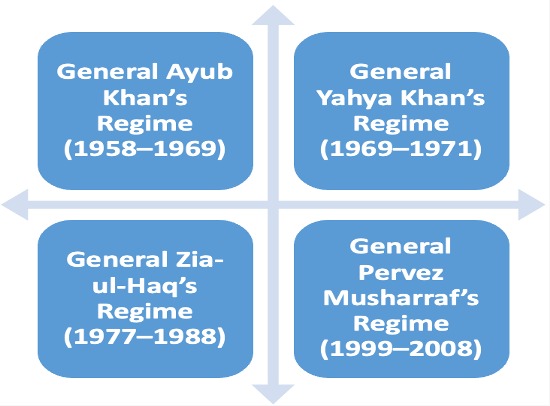
Judicial independence is the backbone of constitutional democracy because it ensures that judges can decide cases without fear, pressure, or political bargaining. In Pakistan, however, this idea has developed in a turbulent constitutional environment shaped by repeated military takeovers, unstable civilian rule, and frequent constitutional disruption. This research examines how Pakistan’s superior judiciary has alternated between complicity and resistance, and how that pattern has affected democratic governance and the rule of law. Using a doctrinal and contextual method, the study traces the historical roots of judicial compromise beginning with Federation of Pakistan v. Maulvi Tamizuddin Khan (PLD 1955 FC 240), where the dissolution of the Constituent Assembly was upheld on technical grounds, an early turning point that later nourished the Doctrine of Necessity. The research shows that necessity jurisprudence gradually became a recurring legal cover for extra-constitutional governance, especially during the regimes of Ayub Khan, Yahya Khan, Zia-ul-Haq, and Pervez Musharraf. In these periods, Provisional Constitutional Orders (PCOs), enforced oaths, and “validation judgments” reshaped courts from constitutional guardians into crisis managers. This study also highlights that threats to judicial independence are not only external. Internal controversies relating to accountability, politicized appointments, seniority disputes, and administrative influence have weakened institutional cohesion and public trust. Further, the research finds that democratic governments have often repeated executive interference through appointment manipulation, political pressure, and resistance to adverse rulings, proving that democratic legitimacy alone does not guarantee constitutional restraint. Finally, the study evaluates contemporary developments, including the Twenty-seventh Constitutional Amendment (2025) and debates around restructuring constitutional adjudication. It concludes that judicial independence is not merely a legal safeguard but a democratic necessity: where courts compromise, constitutional limits collapse. The research recommends transparent appointments, respect for seniority, institutional autonomy, and clear limits on executive interference to rebuild constitutionalism and democratic resilience in Pakistan.
Downloads
References
1. Lamer, A., The rule of law and judicial independence: protecting core values in times of change. UNBLJ, 1996. 45: p. 3.
2. Afzal, J. and C. Yongmei, Federal and provincial legislation regarding ‘Right to Information'for good governance in Pakistan. Discover Global Society, 2023. 1(1): p. 12.
3. Afzal, J., Impact of Enactment of ‘The Prevention of Electronic Crimes Act, 2016’as Legal Support in Pakistan. Academy of Education and Social Sciences Review.
4. Tiwari, S., The Role of the Judiciary in Upholding Democratic Principles. Issue 6 Int'l JL Mgmt. & Human., 2024. 7: p. 539.
5. Nazir, J., Z. Jabeen, and S.U. Khan, THE FUTURE OF CONSTITUTIONAL GOVERNANCE IN PAKISTAN: PROSPECTS AND CHALLENGES. Journal of Religion and Society, 2024. 2(4): p. 126-141.
6. Akhtar, Z., A Legal Paradox: Pakistan's Constitution, Martial Law and State Necessity. Sri Lanka J. Int'l L., 2009. 21: p. 153.
7. Hussain, S., Together without Consensus: Class, Emotions and the Politics of the Rule of Law in the Lawyers' Movement (2007-09) in Pakistan. 2018: City University of New York.
8. Shafiq, H.M.S., et al., Constitutional court appointments mechanism and judicial independence; a study of USA, Maldives, Canada, Germany, Egypt and Pakistan. Pakistani Journal of International Affairs, 2022. 5(2).
9. Afzal, J., Digital Law Enforcement Challenges and Improvement, in Implementation of Digital Law as a Legal Tool in the Current Digital Era. 2024, Springer. p. 47-78.
10. Afzal, J., Implementation of digital law as a legal tool in the current digital Era. 2024: Springer.
11. Paulsen, M.S., The constitution of necessity. Notre Dame L. Rev., 2003. 79: p. 1257.
12. Stavsky, M.M., The doctrine of state necessity in Pakistan. Cornell Int'l LJ, 1983. 16: p. 341.
13. Wolf‐Phillips, L., Constitutional legitimacy: A study of the doctrine of necessity. Third World Quarterly, 1979. 1(4): p. 97-133.
14. Siddique, O., The jurisprudence of dissolutions: Presidential power to dissolve assemblies under the Pakistani constitution and its discontents. Ariz. J. Int'l & Comp. L., 2005. 23: p. 615.
15. Choudhury, Z., The Role of Judiciary in the Constitutional Development of Pakistan (1947-1971). Dhaka Univ. Stud. Part F, 1989. 1: p. 1.
16. Agresto, J., The Supreme Court and constitutional democracy. 1984: Cornell University Press.
17. Aziz, S., The Constitution of Pakistan. 2018.
18. Khan, A., M. Ahmad, and A. Waheed, Pakistan's Journey to Civilian Rule (1958-70): An Analysis of Ayub Era. Global Legal Studies Review, 2016. 1(1): p. 1-8.
19. Gul, S., N.A. Khan, and S.S. Sulehri, THE 1962 CONSTITUTION AND ITS IMPLICATIONS FOR PARTY POLITICS IN PAKISTAN: A STUDY OF CONTROLLED DEMOCRACY UNDER AYUB KHAN. International Research Journal of Islamic Culture and Communication (IRJICC), 2025. 3(3): p. 1-19.
20. Burki, S.J., Rise to Power, in Pakistan Under Bhutto, 1971–1977. 1980, Springer. p. 58-75.
21. Choudhury, Z.I., Roots of Dictatorship in Pakistan, 1954-1971.
22. Burki, S.J., Pakistan under Zia, 1977-1988. Asian Survey, 1988. 28(10): p. 1082-1100.
23. Hussain, M.Z., Islam in Pakistan under Bhutto and Zia-ul-Haq, in Islam, Muslims and the Modern State: Case-Studies of Muslims in Thirteen Countries. 1994, Springer. p. 47-79.
24. Behuria, A.K., How military dominates the political space in Pakistan: A study of Musharraf’s rule (1999-2008). Journal of peace studies, 2009. 16(1-2): p. 76-102.
25. Fatima, Z. and R. Shafique, General Pervez Musharraf: The Political Strategies to Consolidate Power (1999-2008). ACADEMIA International Journal for Social Sciences, 2025. 4(2): p. 1577-1588.
26. Ali, G., P.D.R. Musarrat, and M.S. Azhar, Federalism in Pakistan During Musharraf Regime. Journal of Public Administration and Governance, 2012. 2(3): p. 171-188.
27. Ghias, S.A., Miscarriage of chief justice: judicial power and the legal complex in Pakistan under Musharraf. Law & Social Inquiry, 2010. 35(4): p. 985-1022.
28. Ahmad, S.N., From Martial Law to Martial Law: Politics in the Punjab, 1919-1958. 2019: Routledge.
29. Kureshi, Y., Seeking supremacy: The pursuit of judicial power in Pakistan. 2022: Cambridge University Press.
30. Khan, M.S., Genesis and evolution of public interest litigation in the supreme court of Pakistan: toward a dynamic theory of judicialization. Temp. Int'l & Comp. LJ, 2014. 28: p. 285.
31. Hussain, F., The judicial system of Pakistan. 2011: Supreme Court of Pakistan Pakistan.
32. Islam, N., Democracy and governance in Pakistan's fragmented society. International Journal of Public Administration, 2001. 24(12): p. 1335-1355.
33. Zemans, F.K., The accountable judge: guardian of judicial independence. S. Cal. L. Rev., 1998. 72: p. 625.
34. Khan, H., Developing Liberal Jurisprudence in Pakistan: Role of Justice AR Cornelius. Policy Perspectives, 2020. 17(1): p. 129-139.
35. Abbas, N., Constitutional crisis of Pakistan: A historical study. Pakistan Journal of International Affairs, 2023. 6(2).
36. Jamali, N.H., et al., A Comparative Analysis of the Right to a Fair Trial in Pakistan in Context with ICCPR's Set out Standards. Beijing L. Rev., 2024. 15: p. 231.
37. Geyh, C.G., To Legitimacy and Beyond: A Reform Agenda to Restore Public Confidence in the Federal Courts. Law & Contemp. Probs., 2024. 87: p. 1.
38. Panhwar, S.H., Benazir Bhutto Selected Speeches 1989–2007. 2009, Location unknown: Self Published.
39. Landau, D., Political institutions and judicial role in comparative constitutional law. Harv. Int'l LJ, 2010. 51: p. 319.
40. King, J.A., Institutional approaches to judicial restraint. Oxford journal of legal studies, 2008. 28(3): p. 409-441.
41. Fletcher, W.A., The discretionary constitution: Institutional remedies and judicial legitimacy. The Yale Law Journal, 1982. 91(4): p. 635-697.
42. Cardozo, B.N., The nature of the judicial process. Vol. 21. 1921: Yale University Press.
43. Resnik, J., Managerial judges. Harv. L. Rev., 1982. 96: p. 374.
44. Qaiser, M.N., A. Warraich, and M.S. Jamil, THE ROLE OF THE JUDICIAL COMMISSION: JUDICIAL INDEPENDENCE IN PAKISTAN POST-26TH AMENDMENT. International Journal of Social Sciences Bulletin, 2025. 3(4): p. 684-696.
45. Munir, B., A.N. Khan, and D.N. Ahmed, Judicial Activism, Selectivism, and Executive's Functional Space: A Critical Appreciation in the Context of Pakistan. Journal of Research Society of Pakistan, 2021. 58(1): p. 28-35.
46. Khan, A., I. Naseem, and M. Inamullah, Constitutional Dynamics and Judicial Autonomy in South Asia: A Comparative Study of Pakistan and its Neighbors. Al Manhal Research Journal, 2025. 5(1).
47. Lee, H.P., Judiciaries in Crisis—Some Comparative Perspectives. Federal Law Review, 2010. 38(3): p. 371-389.
48. Rosenthal, M., G. Barzilai, and A. Meydani, Judicial review in a defective democracy: Judicial nominations and judicial review in constitutional courts. Journal of Law and Courts, 2021. 9(1): p. 137-157.
49. Collett, T.S., Judicial independence and accountability in an age of unconstitutional constitutional amendments. Loy. U. Chi. LJ, 2009. 41: p. 327.
50. Shah, A., Making federalism work: the 18th constitutional amendment. 2012: World Bank, Washington, DC.
51. Geyh, C.G., Judicial independence, judicial accountability, and the role of constitutional norms in congressional regulation of the courts. Ind. LJ, 2003. 78: p. 153.
52. Ali, R.N., Independence of Judiciary in Pakistan: An analysis of 18th & 19th Constitutional Amendments. Journal of Social Sciences Review, 2021. 1(2): p. 1-12.
53. Bromo, F., Early parliamentary dissolutions and judicial review: lessons from comparative cases. Comparative Legal History, 2025: p. 1-21.
54. Kavelidze, E., Vote of No-Confidence as the Form of Government's Political Responsibility. J. Law, 2014: p. 52.
Downloads
Published
Issue
Section
License
Copyright (c) 2026 Anees Amjad (Author)

This work is licensed under a Creative Commons Attribution 4.0 International License.
How to Cite