A Systematic Review of Machine Learning and Explainable AI in Breast Cancer Detection and Diagnosis: From Black-Box Models to Interpretable Clinical Decision Support Systems
DOI:
https://doi.org/10.64060/ICPP.01Keywords:
Breast Cancer Detection, Image Processing, Clinical Decision Support Machine-Learning, Explainable AI, Computer aided diagnosis(CAD)Abstract
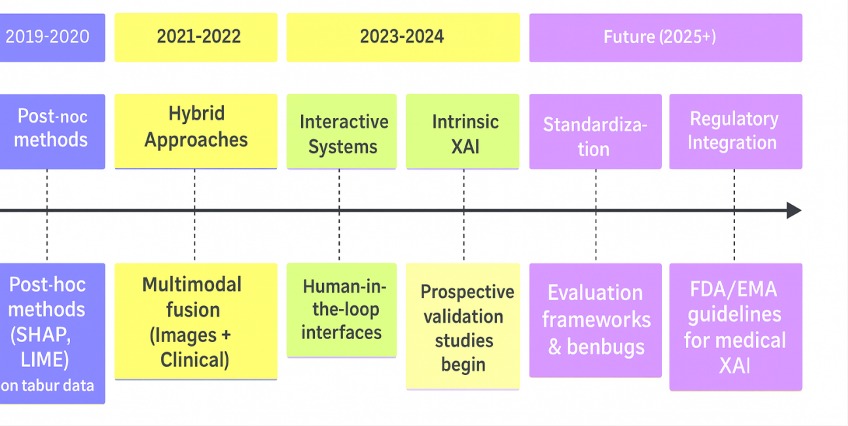
Breast cancer is one of the major causes of cancer-related deaths in women across the world. Timely and proper diagnosis is paramount to the higher survival. The recent developments in machine learning (ML) and deep learning (DL) have demonstrated impressive potential in breast cancer detection yet the black-box character restricts the clinical application. Explainable Artificial Intelligence (XAI) has become an essential area that can eliminate this gap by ensuring that AI decisions can be clearly read and trusted by clinicians. This systematic review is based on the results of recent research (20192025) on the use of ML/XAI in breast cancer detection that covers imaging and genomic and clinical data. We also review methodological trends, measure of performance, interpretability methods and clinical integration issues. We have seen in our review that there is a distinct transition to human-centered interpretable systems with ensemble methods, hybrid AI approaches, and visual analytics in the lead no longer performance-driven models. It is also through these studies that we find significant gaps in research, and what should be pursued in the future is to use a combination of data modalities, like mammography and patient history and/or genomic markers, to ensemble the best approaches towards accuracy and contextual explanation. Moreover, as noted in the review, post-hoc explanation methods such as SHAP and LIME are still predominant, but the focus on constructing naturally understandable models of clinical safety is also increasing. The main challenges remain the standardization of evaluation measures to explain, the computational complexity of the complex XAI models, and the necessity to develop and test XAI in clinical contexts to promote further uptake and patient outcomes through essential clinician-in-the-loop validation and evaluation.This review concludes that in the future, it is necessary to focus on making models inherently interpretable, develop XAI in a clinician-in-the-loop and conduct robust trials to help transition XAI to reliable clinical use and promote more adoption and better patient outcomes.
Downloads
References
1. Abdullakutty, F., Y. Akbari and S. Al-maadeed. n.d. Histopathology in focus : a review on explainable multi-modal approaches for breast cancer diagnosis.
2. Abdullakutty, F., Y. Akbari, S. Al-maadeed and L.G. Jun. n.d. Advancing Histopathology-Based Breast Cancer Diagnosis : Insights into Multi-Modality and. 1–31.
3. Ai, E. 2024. A New Computer-Aided Diagnosis System for Breast Cancer Detection from Thermograms Using Metaheuristic Algorithms.
4. Ai, E., M. Ahmed, T. Bibi, R.A. Khan and S. Nasir. n.d. Enhancing Breast Cancer Diagnosis in Mammography : Evaluation and Integration of Convolutional Neural Networks. 1–18.
5. Alhussen, A., M. Anul, A. Ahmad, R. Kumar and S. Kadry. 2025. XAI-RACapsNet : Relevance aware capsule network-based breast cancer detection using mammography images via explainability O-net ROI segmentation. 261.
6. Bai, S., S. Nasir, R.A. Khan, S. Arif, A. Meyer and B. Lyon. n.d. Breast Cancer Diagnosis : A Comprehensive Exploration of Explainable Artificial Intelligence ( XAI ) Techniques.
7. Explainable AI-Driven Clinical Thermography for Breast Cancer Detection Objectives. n.d.
8. Ghasemi, A. and A.S. Nejad. 2024. Explainable artificial intelligence in breast cancer detection and risk prediction : A systematic scoping review. 1–22.
9. Giammarco, M.D.I., C. Vitulli, S. Cirnelli and B. Masone. 2025. Explainable Deep Learning for Breast Cancer Classification and Localization. 6:1–18.
10. Gurmessa, D. and W. Jimma. 2024. Explainable machine learning for breast cancer diagnosis from mammography and ultrasound images : a systematic review. 1–10.
11. Guzm, R., J.R. Guzm, M. Torres, D.A. May, J. Ruiz, O.G. Ibarra, G. Avi and A. Gonz. 2013. Digital Image Processing Technique for Breast Cancer Detection. 1519–1531.
12. Habeeb, Z.Q., B. Vuksanovic and I.Q. Al-zaydi. 2023. Breast Cancer Detection Using Image Processing and Machine Learning. 11:1–8.
13. Hussain, S.M., D. Buongiorno, N. Altini, F. Berloco, B. Prencipe, M. Moschetta, V. Bevilacqua and A. Brunetti. 2022. applied sciences Shape-Based Breast Lesion Classification Using Digital Tomosynthesis Images : The Role of Explainable Artificial Intelligence.
14. Ijaz, M.F. 2024. Editorial : Recent Advances in Deep Learning and Medical Imaging for Cancer Treatment. 9–13.
15. Jaglan, P. 2019. Breast Cancer Detection Techniques : Issues and Challenges. J. Inst. Eng. Ser. B, doi: 10.1007/s40031-019-00391-2.
16. Kashif, M., K.R. Malik and S. Jabbar. 2020. Application of machine learning and image processing for detection of breast cancer. Elsevier Inc.
17. Lamy, J., B. Sekar, G. Guezennec, J. Bouaud and B. Séroussi. 2019. Arti fi cial Intelligence In Medicine Explainable arti fi cial intelligence for breast cancer : A visual case-based reasoning approach. Artif. Intell. Med. 94:42–53.
18. Luerken, L., M. Dollinger, A. Goetz, K. Utpatel, M.C. Doppler, J.B. Weiss, W. Uller, A. Ignee, N. Verloh and M. Haimerl. 2023. Diagnostic Accuracy of Indocyanine Green Clearance Test for Different Stages of Liver Fibrosis and Cirrhosis. 4–11.
19. Manojee, K.S. and A.R. Kannan. 2025. Patho-Net : enhancing breast cancer classification using deep learning and explainable artificial intelligence. 15:754–768.
20. Massafra, R., A. Fanizzi, N. Amoroso, S. Bove, M.C. Comes, D. Pomarico, V. Didonna, S. Diotaiuti, L. Galati, F. Giotta, D. La Forgia, A. Latorre, A. Lombardi, A. Nardone, M.I. Pastena, C.M. Ressa, L. Rinaldi, P. Tamborra, A. Zito, A.V. Paradiso, R. Bellotti and V. Lorusso. n.d. Analyzing breast cancer invasive disease event classification through explainable artificial intelligence.
21. Mehdy, M.M., P.Y. Ng, E.F. Shair, N.I. Saleh and C. Gomes. 2017. Artificial Neural Networks in Image Processing for Early Detection of Breast Cancer. 2017.
22. Munshi, R.M., L. Cascone, N. Alturki, O. Saidani, A. Alshardan and M. Umer. 2024. A novel approach for breast cancer detection using optimized ensemble learning framework and XAI. Image Vis. Comput. 142:104910.
23. Oztekin, P.S., O. Katar, T. Omma and S. Erel. 2024. Comparison of Explainable Arti fi cial Intelligence Model and Radiologist Review Performances to Detect. 2051–2068.
24. Papanastasopoulos, Z., R.K. Samala, H. Chan, L. Hadjiiski, M.A. Helvie and C.H. Neal. 2020. Explainable AI for medical imaging : deep-learning CNN ensemble for classification of estrogen receptor status from breast MRI. 11314:1–8.
25. Prodan, M. and E. Paraschiv. 2023. applied sciences Applying Deep Learning Methods for Mammography Analysis and Breast Cancer Detection.
26. Rashi, A. 2022. Minimum relevant features to obtain AI explainable system for predicting breast cancer in WDBC. 6:1312–1326.
27. Rezaei, Z. 2021. A review on image-based approaches for breast cancer detection , segmentation , and classification. Expert Syst. Appl. 182:115204.
28. Sadoughi, F., Z. Kazemy, F. Hamedan, L. Owji and T.T. Azadboni. 2018. Artificial intelligence methods for the diagnosis of breast cancer by image processing : a review Artificial intelligence methods for the diagnosis of breast cancer by image processing : a review. , doi: 10.2147/BCTT.S175311.
29. Saeidnia, H.R. 2025. Conceptual Model for Breast Cancer Diagnosis Using Machine Learning on Mammogram Data.
30. Sahni, P. and N. Mittal. n.d. Breast Cancer Detection Using Image Processing Techniques. Springer Singapore.
Downloads
Published
Issue
Section
License
Copyright (c) 2026 Nimra Razzaq, Awais Rasool , Phool Fatima (Author)

This work is licensed under a Creative Commons Attribution 4.0 International License.
How to Cite