Neutrosophic-Plithogenic Dynamical Systems: Foundations, Stability, Partial and Refined Attractors / Neutrals / Repellers, and Chaos
DOI:
https://doi.org/10.64060/ANMIV1i25Keywords:
Neutrosophy, Plithogeny, Dynamical Systems, Partial Attractors, Partial Neutrals, Partial Repellers, Refined Attractors, Refined Neutrals, Refined Repellers, Stability, Chaos, Lyapunov ExponentsAbstract
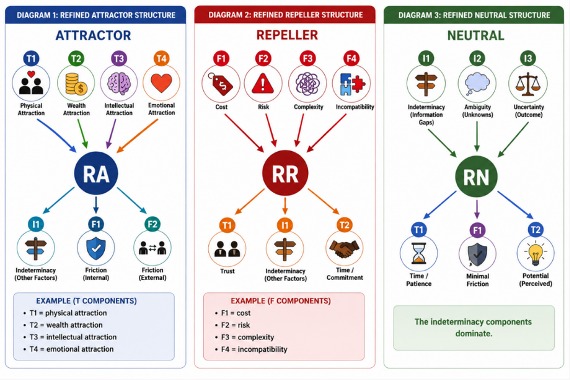
Classical dynamical systems describe the evolution of states through deterministic or stochastic laws. However, many real-world systems involve uncertainty, contradiction, incompleteness, and indeterminacy that cannot be adequately represented within traditional frameworks. This paper introduces Neutrosophic-Plithogenic Dynamical Systems (NPDS), extending classical dynamics through neutrosophic states and plithogenic contradiction structures. A system state is represented by the neutrosophic triple <T, I, F>, where T, I, and F denote truth, indeterminacy, and falsehood components. Plithogenic attributes and contradiction degrees are then incorporated into the dynamics. New concepts are introduced, including neutrosophic attractors, neutrosophic repellers, neutrosophic neutral sets, neutrosophic partial attractors, neutrosophic partial repellers, neutrosophic Lyapunov exponents, and neutrosophic chaos measures. The resulting framework provides a natural mathematical representation for systems whose behavior is simultaneously attractive, neutral, and repulsive. Applications to scientific theory evolution, social systems, economics, artificial intelligence, and complex decision processes are discussed. The concepts of Partial Attractors, Partial Neutrals, Partial Repellers and respectively of Refined Attractors, Refined Neutrals, Refined Neutral Sets, were introduced by F.Smarandache in 2026, and they are richer and closer to reality than the ordinary classical versions of Attractors, Repellers.
References
1. Alligood, K. T., Sauer, T. D., & Yorke, J. A. (1996). Chaos: An introduction to dynamical systems. Springer.
2. Devaney, R. L. (2018). An introduction to chaotic dynamical systems (2nd ed.). CRC Press.
3. Hirsch, M. W., Smale, S., & Devaney, R. L. (2013). Differential equations, dynamical systems, and an introduction to chaos (3rd ed.). Academic Press.
4. Katok, A., & Hasselblatt, B. (1995). Introduction to the modern theory of dynamical systems. Cambridge University Press.
5. Lorenz, E. N. (1963). Deterministic nonperiodic flow. Journal of the Atmospheric Sciences, 20(2), 130–141.
6. Lyapunov, A. M. (1992). The general problem of the stability of motion (A. T. Fuller, Trans.). (Original work published 1892) International Journal of Control, 55(3), 531–534. https://doi.org/10.1080/00207179208934253
7. Ott, E. (2002). Chaos in dynamical systems (2nd ed.). Cambridge University Press.
8. Robinson, C. (1999). Dynamical systems: Stability, symbolic dynamics, and chaos (2nd ed.). CRC Press.
9. Smarandache, Florentin (2006). A unifying field in logics: Neutrosophic logic, neutrosophy, neutrosophic set, neutrosophic probability and statistics (6th ed.). InfoLearnQuest. https://fs.unm.edu/eBook-Neutrosophics6.pdf
10. Smarandache, F. (2013). n-Valued refined neutrosophic logic and its applications in physics. Progress in Physics, 9(2), 143–146.
11. Smarandache, Florentin (2013). Introduction to Neutrosophic Measure, Neutrosophic Integral, and Neutrosophic Probability. Craiova, Romania: Sitech & Education Publishing. https://fs.unm.edu/NeutrosophicMeasureIntegralProbability.pdf
12. Smarandache, Florentin (2014). Introduction to Neutrosophic Statistics. Craiova, Romania: Sitech & Education Publishing, 2014. https://fs.unm.edu/NeutrosophicStatistics.pdf
13. Smarandache, Florentin (2016). Neutrosophic Overset, Neutrosophic Underset, and Neutrosophic Offset: Similarly for Neutrosophic Over-/Under-/Off-Logic, Probability, and Statistics. Brussels: Pons Editions. https://fs.unm.edu/NeutrosophicOversetUndersetOffset.pdf
14. Smarandache, Florentin (2017). Plithogeny, Plithogenic Set, Logic, Probability, and Statistics. Pons, 2017. https://fs.unm.edu/Plithogeny.pdf
15. Smarandache, Florentin (2019). “Refined Neutrosophic Crisp Set (RNCS).” In Nidus Idearum, Vol. VII, 3rd ed., 114–116. Pons, 2019. https://fs.unm.edu/RefinedNeutrosophicCrispSet.pdf
16. Smarandache, F. (2021). Introduction to Plithogenic Logic as generalization of MultiVariate Logic. Neutrosophic Sets and Systems, 45, 1–7.
17. Strogatz, S. H. (2018). Nonlinear dynamics and chaos: With applications to physics, biology, chemistry, and engineering (2nd ed.). CRC Press.
18. Zadeh, L. A. (1965). Fuzzy sets. Information and Control, 8(3), 338–353.
19. Atanassov, K. T. (1986). Intuitionistic fuzzy sets. Fuzzy Sets and Systems, 20(1), 87–96.
Downloads
Published
Issue
Section
License
Copyright (c) 2026 Florentin Smarandache (Author)

This work is licensed under a Creative Commons Attribution 4.0 International License.
How to Cite