The ICT-Based Food Security Management of Pakistan
DOI:
https://doi.org/10.64060/ICPP.09Keywords:
Food Security, Information and Communication Technology, Agri-Food System, Autoregressive Distributed Lag (ARDL), Sustainable Agriculture, Digital TransformationAbstract
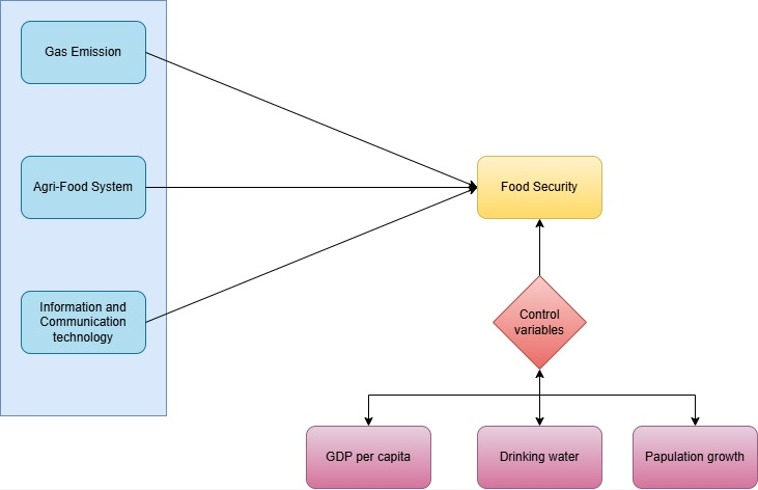
Food security remains a critical development challenge for Pakistan, exacerbated by population pressures, climate vulnerabilities, and systemic inefficiencies within its agrarian economy. In the current research, there is a research question that examines the use of Information and Communication Technology (ICT) as a game changer in terms of advancing food security, other vital determinants such as the agri-food system, greenhouse gas emission, GDP per capita, drinking water provision, and population growth. It is affirmed using the annual data from 2001 to 2023, and with the development of a model of Autoregressive Distributed Lag (ARDL), as a result of the assessment showed that there is indeed a stable long-run co-integrating relationship between the variables. The findings prove that ICT, the agri-food system, and GDP per capita have great positive impacts on long-run food security, and gas emissions are also positively correlated as well, which indicates that there is a complex association between them and agricultural output. The first one is that in the short run, when the error-correction mechanism is efficient, it implies that the adjustment to the equilibrium following a shock is fast. The results highlight the need to have a strategic approach to digital innovation, an effective food value chain, and sustainable economic policies in order to develop a resilient food system. The paper ends by making recommendations on specific investments in ICT infrastructures, climate-sensitive agriculture, and inclusive development to guarantee Pakistan's sustainable food security in the view of changing environmental and demographic conditions.
Downloads
References
1. Yaseen, M., et al., Implementation of Neutrosophic Logic for Food Security and Agricultural Productivity Analysis in South Asian Countries. Neutrosophic Sets and Systems, 2025. 93(1): p. 22.
2. Ahmad, M. and U. Farooq, The state of food security in Pakistan: Future challenges and coping strategies. The Pakistan Development Review, 2010: p. 903-923.
3. Afzal, M.A., J. Afzal, and Z. Nishtar, Mega Hydropower Projects and Sustainable Development of Pakistan. Journal of Engineering, Science and Technological Trends, 2024. 1(2).
4. Afzal, J. and Z. Nishtar, A substantial study on history of climate change in south asia for sustainable development. Journal of History and Social Sciences, 2023. 14(1): p. 101-112.
5. El Bilali, H. and M.S. Allahyari, Transition towards sustainability in agriculture and food systems: Role of information and communication technologies. Information processing in agriculture, 2018. 5(4): p. 456-464.
6. Nwafor, S., et al., Role of Information and Communication Technologies towards Sustainability Transitions in Agriculture and Food Systems. Nigeria Agricultural Journal, 2022. 53(2): p. 40-45.
7. Bibi, A. and J. Afzal, Review of Smart Edible Films and Coatings for Perishable Foods and Future of Smart Packaging. Journal of Engineering, Science and Technological Trends, 2025. 2(1).
8. Ramsey, R., et al., Food insecurity among adults residing in disadvantaged urban areas: potential health and dietary consequences. Public health nutrition, 2012. 15(2): p. 227-237.
9. Shah, U.S. and A. Dahal, Biotechnology Innovation and Commercialization. Biotechnology Innovation and Commercialization, 2011: p. 45.
10. Mbaya, A.K., The Role of Information and Communication Technology (Ict) in Market Information Access Among Smallholder Potato Farmers in Buuri Sub County, Meru County. A Case Study of Viazisoko Digital Platform. 2023, University of Nairobi.
11. Van der Vorst, J., A. Beulens, and P. van Beek, Innovations in logistics and ICT in food supply chain networks, in Innovation in agri-food systems. 2005, Wageningen Academic. p. 245-292.
12. Magesa, M.M., Linking rural farmers to markets using ICTs. 2015: CTA.
13. Farsund, A.A., C. Daugbjerg, and O. Langhelle, Food security and trade: Reconciling discourses in the Food and Agriculture Organization and the World Trade Organization. Food Security, 2015. 7(2): p. 383-391.
14. Ecker, O. and C. Breisinger, The food security system: A new conceptual framework. 2012.
15. Yaro, J.A., Theorizing food insecurity: building a livelihood vulnerability framework for researching food insecurity. Norsk Geografisk Tidsskrift-Norwegian Journal of Geography, 2004. 58(1): p. 23-37.
16. Zhang, W., et al., Systems thinking: an approach for understanding'eco-agri-food systems'. 2018.
17. Rivera-Ferre, M.G., Framing of agri-food research affects the analysis of food security: The critical role of the social sciences. International Journal of sociology of Agriculture and Food, 2012. 19(2): p. 162-175.
18. Ingram, J., P. Ericksen, and D. Liverman, Food security and global environmental change. 2012: Routledge.
19. Ingram, J., A food systems approach to researching food security and its interactions with global environmental change. Food security, 2011. 3(4): p. 417-431.
20. Dragulanescu, P.N., Some theories of environmental sustainability. Revista Română de Statistică nr, 2013: p. 15.
21. Yazdanparast, M., et al., Development of a water security conceptual model by combining human-environmental system (HES) and system dynamic approach. Water Resources Management, 2023. 37(4): p. 1695-1709.
22. Jepson, W., et al., Advancing human capabilities for water security: A relational approach. Water Security, 2017. 1: p. 46-52.
23. Jere, N.J. and M.S. Maharaj, Evaluating the influence of information and communications technology on food security. South African Journal of Information Management, 2017. 19(1): p. 1-7.
24. Agunyai, S.C. and V. Ojakorotu, Data-Driven Innovations and Sustainability of Food Security: Can Asymmetric Information Be Blamed for Food Insecurity in Africa? Sustainability, 2024. 16(20): p. 8980.
25. Giovannini, E. and T. Rondinella, Going beyond GDP: theoretical approaches, in Handbook of research on economic and social well-being. 2018, Edward Elgar Publishing. p. 1-51.
26. Ros, J., Development theory and the economics of growth. 2001: University of Michigan Press.
27. Caldwell, J.C., et al., Demographic transition theory. 2006: Springer.
Downloads
Published
Issue
Section
License
Copyright (c) 2026 Shehar Bano, Muhammad Adeel Afzal, Aqsa Nadeem , Narmin Nezamdoost-Sani (Author)

This work is licensed under a Creative Commons Attribution 4.0 International License.
How to Cite