The Relationship Between Foreign Investment and Subjective Well-Being: The Case of the China-Pakistan Economic Corridor
DOI:
https://doi.org/10.64060/ICPP.08Keywords:
Foreign Investment, China-Pakistan economic corridor, Community wellbeing, social-wellbeing, public perceptions, PLS-SEM analysisAbstract
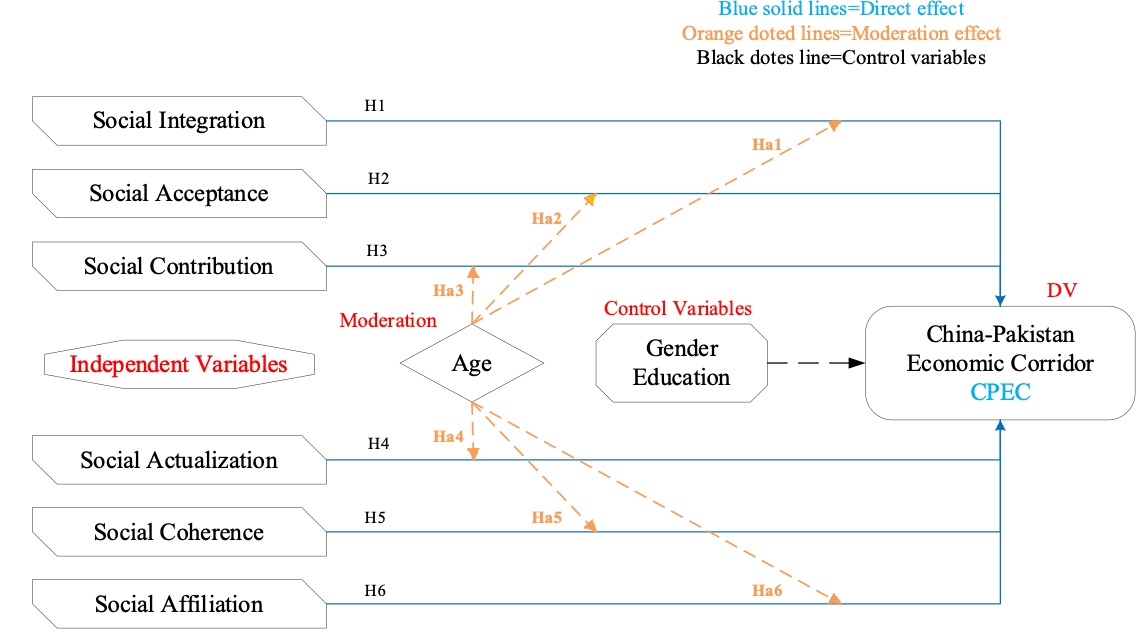
China and Pakistan have maintained significant bilateral commercial and mutually beneficial relationships throughout history. The China-Pakistan Economic Corridor (CPEC) is a multifaceted growth strategy that revolves around several unique initiatives. The Chinese government anticipates investing a significant amount in the CPEC on multiple projects in general. In today's globalized environment, CPEC is a strategy for ensuring economic prosperity for both countries and is seen as an important breakthrough in this area. To examine the CPEC operational scenario, its confines, difficulties, and advantages, the mutually beneficial economic connection between China and Pakistan was extensively studied in this paper. To compare the general public's opinion of it with intended public perceptions, an empirical approach was employed. To examine the general public's opinions of it with a focus on public perceptions of foreign investment, an empirical approach was used. A PLS-SEM analysis aimed at improving the community well-being of Pakistan. The findings of the PLS-SEM direct pathway testing showed that IV and DV have a direct association, supporting the accepted hypotheses H1–H6. We also weigh up the respondents’ respective educational attainment together with gender as controlling variables; however, the results for both of these factors revealed no correlation in opposition to CPEC. This proves categorically that there is no relationship between the DV and either gender, education, or both. In this study, H1a, H2a, H4a, H5a, and H6a had significant associations in relation to age in the role of a moderator, although further moderators did not exhibit significant associations to some extent. Age substantially moderates the correlation between CPEC and IV, illustrating the moderating effect of age on the association. All factors in the present investigation are subject to a considerable relationship with one another; furthermore, a number of them have an intermediate to high correlation with one another. The research carried out demonstrated that CPEC has the potential for significant beneficial socioeconomic implications for the two nations, while the Pakistani public believes it will provide them with several opportunities for long-term social sustainability. The results of this research will aid decision-makers in formulating policies that are more efficient and support sustainable development.
Downloads
References
1. Mobasher, M.B., Understanding ethnic-electoral dynamics: how ethnic politics affect electoral laws and election outcomes in Afghanistan. Gonz. L. Rev., 2015. 51: p. 355.
2. Valenzuela, S., N. Park, and K.F. Kee. Lessons from Facebook: The effect of social network sites on college students’ social capital. in 9th International Symposium on Online Journalism. 2008.
3. McKelvey, B. and H. Aldrich, Populations, natural selection, and applied organizational science. Administrative Science Quarterly, 1983: p. 101-128.
4. Yongmei, C. and J. Afzal, Impact of Enactment of ‘The Prevention of Electronic Crimes Act, 2016’as Legal Support in Pakistan. Academy of Education and Social Sciences Review, 2023. 3(2): p. 203-212.
5. Wolf, S.O. China-Pakistan economic corridor, civil-military relations and democracy in Pakistan. 2016. SADF Working Paper Series, South Asia Democratic Forum (SADF), WP.
6. Karrar, H.H., In the shadow of the Silk Road: Border regimes and economic corridor development through an unremarkable Pakistan-China border market. Comparative Studies of South Asia, Africa and the Middle East, 2019. 39(3): p. 389-406.
7. Hussain, E., China–Pakistan economic corridor: will it sustain itself? Fudan Journal of the Humanities and Social Sciences, 2017. 10: p. 145-159.
8. Sanchez-Triana, E., et al., Revitalizing industrial growth in Pakistan: Trade, infrastructure, and environmental performance. 2014: World Bank Publications.
9. Awais, M., et al., Impact of financial literacy and investment experience on risk tolerance and investment decisions: Empirical evidence from Pakistan. International Journal of Economics and Financial Issues, 2016. 6(1): p. 73-79.
10. Chan, M.H.T., The belt and road initiative–the new silk road: a research agenda. Journal of Contemporary East Asia Studies, 2018. 7(2): p. 104-123.
11. Djankov, S. and S. Miner, China's Belt and Road Initiative: motives, scope, and challenges. 2016: Peterson Institute for International Economics.
12. Abid, M. and A. Ashfaq, CPEC: Challenges and opportunities for Pakistan. Journal of Pakistan Vision, 2015. 16(2): p. 142-169.
13. Kumar, J., et al., Cross border project in China-Pakistan economic corridor and its influence on women empowerment perspectives. Plos one, 2022. 17(6): p. e0269025.
14. uddin Ahmed, S., et al., China Pakistan Economic Corridor and Pakistan’s energy security: A meta-analytic review. Energy policy, 2019. 127: p. 147-154.
15. Wolf, S.O., China-Pakistan Economic Corridor of the Belt and Road Initiative. 2021: Springer.
16. Afzal, J., et al., Statistical Analysis of Foreign Investment Using Neutrosophic Interval Based Approach. Neutrosophic Sets and Systems, 2025. 79(1): p. 14.
17. Bhattacharjee, D., China Pakistan economic corridor. Available at SSRN 2608927, 2015.
18. Hussain, F. and M. Hussain, China-Pak economic corridor (CPEC) and its geopolitical paradigms. International Journal of Social Sciences, Humanities and Education, 2017. 1(2): p. 79-95.
19. Afzal, J., M.A. Afzal, and Z. Nishtar, Completion of the ten years of the China-Pakistan Economic Corridor (CPEC) and its economical goals. Inverge Journal of Social Sciences, 2023. 2(4): p. 23-29.
20. Ruggie, J., Protect, respect and remedy: A framework for business and human rights. Innovations: Technology, Governance, Globalization, 2008. 3(2): p. 189-212.
21. Johnson, D.W. and R.T. Johnson, Making cooperative learning work. Theory into practice, 1999. 38(2): p. 67-73.
22. Fivush, R., Accuracy, authority, and voice: Feminist perspectives on autobiographical memory. Toward a feminist developmental psychology, 2000: p. 85-105.
23. Afzal, J. and G. Anwar, AN EMPIRICAL STUDY ON ACADEMIC SUSTAINABILITY OF MOBILE LEARNING AT UNIVERSITY LEVEL. Pakistan Journal of Educational Research, 2023. 6(2).
24. Tellis, W., Introduction to case study. The qualitative report, 1997. 3(2): p. 1-14.
25. Afzal, J., W. Lumeng, and M. Aslam, Assessment of tolerance, harmony and coexistence: a study on university students in Government College University, Faisalabad. Siazga Research Journal, 2022. 1(1): p. 06-10.
26. Hair Jr, J.F., M.C. Howard, and C. Nitzl, Assessing measurement model quality in PLS-SEM using confirmatory composite analysis. Journal of Business Research, 2020. 109: p. 101-110.
27. Lowry, P.B. and J. Gaskin, Partial least squares (PLS) structural equation modeling (SEM) for building and testing behavioral causal theory: When to choose it and how to use it. IEEE transactions on professional communication, 2014. 57(2): p. 123-146.
28. Legate, A.E., et al., PLS‐SEM: Prediction‐oriented solutions for HRD researchers. Human Resource Development Quarterly, 2023. 34(1): p. 91-109.
29. Wong, K.K.-K., Partial least squares structural equation modeling (PLS-SEM) techniques using SmartPLS. Marketing Bulletin, 2013. 24(1): p. 1-32.
30. Hall, C.M. and J. Jenkins, Tourism and public policy. A companion to tourism, 2004: p. 523-540.
31. Litva, A., et al., ‘The public is too subjective’: public involvement at different levels of health-care decision making. Social science & medicine, 2002. 54(12): p. 1825-1837.
32. Lieb, R., Content marketing: Think like a publisher-How to use content to market online and in social media. 2012: Que Publishing.
33. Wang, J., Shock troops, Bulls** t, and Captain America: the US Marines' Decoding of Generation Kill and the Marine identity from the grunt's perspective. 2022.
34. Afzal, J., et al., Relationship between Organizational Silence and Commitment of Employees at University Level. Siazga Research Journal, 2023. 2(1): p. 58-65.
35. Rizvi, H.A., The China-Pakistan Economic Corridor. Strategic Studies, 2014. 34: p. 1-17.
36. Xu, Z., et al., China-Pakistan Cultural Exchanges and Cooperation under Belt & Road Initiative. Siazga Research Journal, 2023. 2(3): p. 186-191.
37. Ahmad, R., H. Mi, and L.W. Fernald, Revisiting the potential security threats linked with the China–Pakistan Economic Corridor (CPEC). Journal of the International council for small business, 2020. 1(1): p. 64-80.
38. Ahmar, M., Strategic meaning of the China-Pakistan economic corridor. Strategic Studies, 2014. 34: p. 35-49.
39. Starr, S.F.S.S.F., A ‘Greater Central Asia A ‘Greater Central Asia Partnership’for Afghanistan an Partnership’for Afghanistan and Its Neighbors Its Neighbors. Central Asia-Caucasus Institute & Silk Road Studies Program, 2005.
40. Afzal, M.A., et al., Empirical Evidence on Corporate Social Responsibility: A Case Study of Chinese Companies in Pakistan. International Journal of Trends and Innovations in Business & Social Sciences, 2024. 2(3): p. 367-374.
41. Afzal, J., H. Khatoon, and G. Anwar, A Comprehensive Study on Sales of Chinese Books and Literature in Pakistan. Siazga Research Journal, 2023. 2(4): p. 310-318.
42. Nussbaum, M.C., Creating capabilities: The human development approach and its implementation. Hypatia, 2009. 24(3): p. 211-215.
43. ZBaig, Z., M. Nilofar, and U. Meena, The Impact Of Inwards FDI on domestic management practices in Pakistan. Webology (ISSN: 1735-188X), 2022. 19(2).
Downloads
Published
Issue
Section
License
Copyright (c) 2026 Maria Qayum, Shanza Qayyum , Muhammad Noman , Ismat Ara Jarin (Author)

This work is licensed under a Creative Commons Attribution 4.0 International License.
How to Cite